
You may have clicked on this article because either the name “Jhana Grove” sounds familiar, the word “Jhana” caught your eye, or, more likely, because I mentioned Ajahn Brahm.
Either way, I’m here to explain why I have gone to Perth so many times for retreats by monks under the Thai Forest Tradition, when I could have gone to Thailand instead. (Trust me. I have lost count of the number of times I’ve had to explain myself when I tell people that I go to Australia for a meditation retreat.)
Who is Ajahn Brahm and what is Jhana Grove?
Firstly, I should explain who Ajahn Brahm is before I explain Jhana Grove, which is the retreat centre that he set up. Ajahn Brahm is a disciple of Ajahn Chah, one of the great meditation masters of the Thai Forest Tradition. In fact, Ajahn Brahm is the abbot of Bodhinyana Monastery, which was named after Ajahn Chah’s Pali name.
Ajahn Brahm is well-known for his use of humour and stories to teach the Dhamma. His book “Opening the Door of Your Heart” has been translated into many languages and features one of his famous stories, often referred to as “Two Bad Bricks in a Wall”, which is a true story based on Ajahn Brahm’s experience of building in the monastery that highlights how easily we default to a fault-finding state in our minds.
Jhana Grove is a meditation centre that is located about 1.5 hours away from Perth airport by car and 1km away from Bodhinyana Monastery. Having visited monasteries in various places, I must say that the living conditions at Jhana Grove are the best I have experienced so far.
Now, let’s go on to the reasons why you should go for a retreat at Jhana Grove!
Five-star Facilities Surrounded by Nature
For those who have been to retreats in forest monasteries in Thailand, you may recall the accommodations being generally simple and austere, teaching us to be content with little.
While the cottages in Jhana Grove are not extravagant, they are designed for retreatants to be physically comfortable so that our minds can settle into stillness more easily.
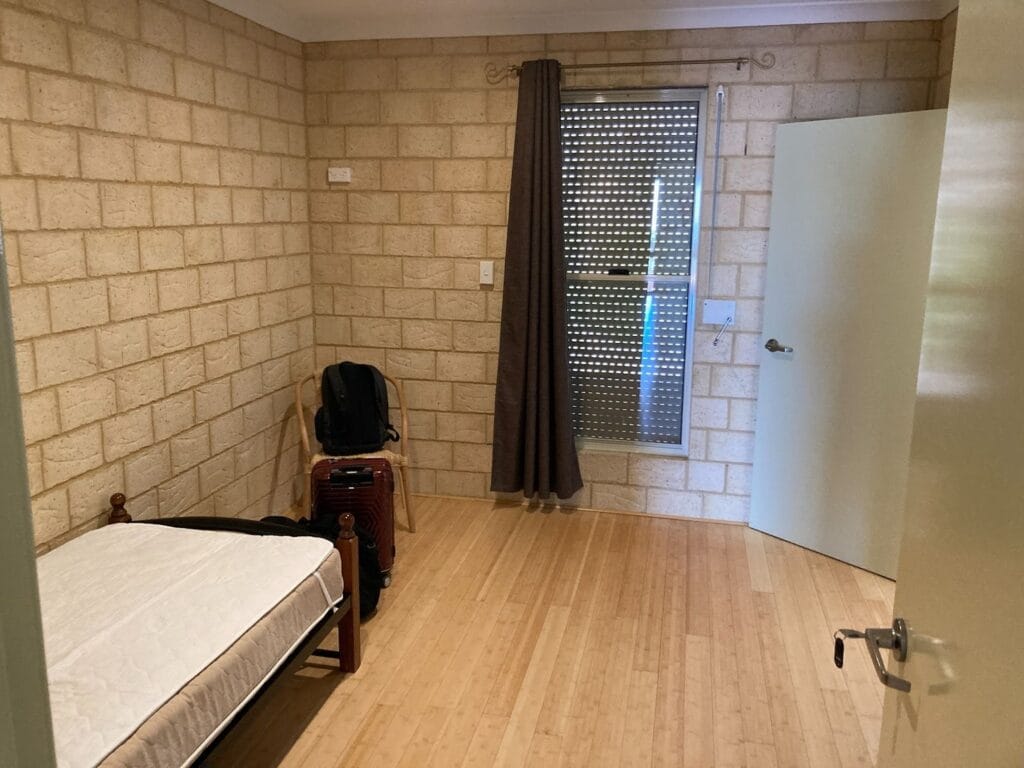
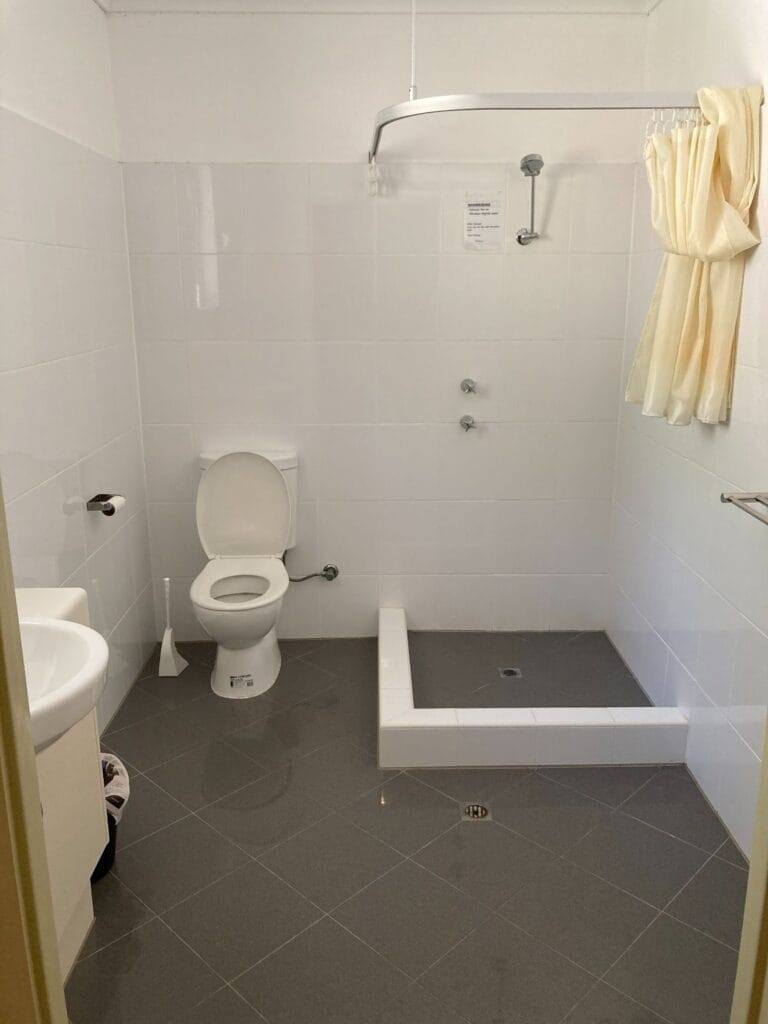
You would have your own room with an ensuite bathroom in a cottage consisting of 6 rooms and a simple living room with a large table, a sink and a fridge.
The cottages are nestled in the Australian bushland, which you can enjoy by taking a stroll—especially after the generous lunch offered by kind members of the nearby Buddhist community during retreats organised by the Buddhist Society of Western Australia (BSWA).
Also, nature in Western Australia (WA) is stunning. I love admiring the night sky full of stars while laying on the stupa near the meditation hall. The two stupas at Jhana Grove— reminiscent of the ones seen at Borobudur in Yogyakarta, Indonesia—were donated by Indonesian devotees, and the stones used to construct these stupas came from the same source as those used in Borobudur.

The meditation hall at Jhana Grove features many ‘beings’ you wouldn’t expect to find in a retreat centre—not heavenly beings or ghosts, but rows and rows of stuffed toys, mainly bears! Ajahn Brahm encourages retreatants to adopt one for the course of the retreat, as holding a stuffed toy in one’s hands during meditation can help metta to arise more easily.

Learning from Ajahn Brahm on Home Ground
What sets the retreats at Jhana Grove apart from those held elsewhere is the chance to immerse yourself in the Buddhist community in WA. You’ll see nuns from Dhammasara Nuns Monastery and monks from Bodhinyana Monastery joining in the retreat too and if you arrange your timing well, you could probably extend your stay either at Jhana Grove for self-retreat or at either monastery to interact further with the monastic community.
Alternatively, if you are joining the annual retreat organised by Bodhinyana Singapore, the Kathina ceremony, which celebrates the end of the three-month rains retreat for the monks, is held the day after the end of the retreat.
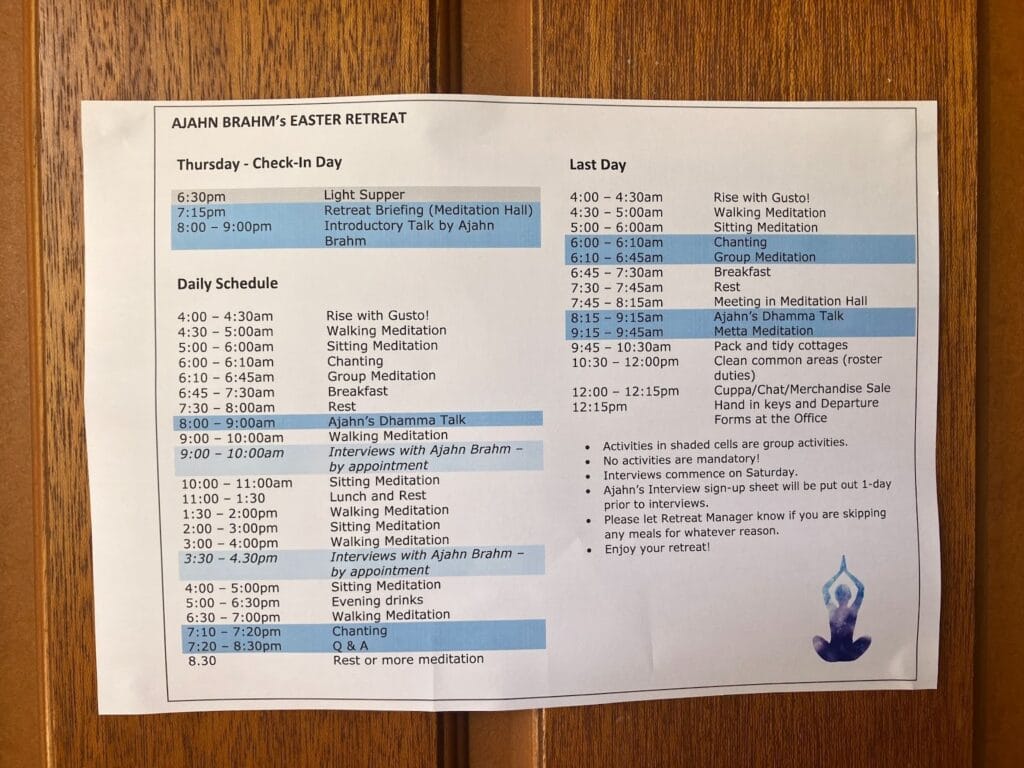
Also, retreats here are very flexible. While there is a very detailed schedule shared by the organisers, Ajahn Brahm likes to emphasise at the start of the retreat that the only events that we should take note of are breakfast and lunch and everything else is optional, including the morning Dhamma talk and evening Q&A session. He also shared that retreatants are welcome to meditate wherever they please.
One-to-one Interview Session with Ajahn Brahm
During the retreat, you can sign up for opportunities to have a one-to-one interview session with Ajahn Brahm to ask him questions related to meditation. It is a rare opportunity to have 10 minutes with him to seek advice on obstacles to your meditation.
Interestingly, even reflecting on how the mind behaves before, during, and after the interview can be useful for Buddhist practice.
You might feel hesitant because you have heard that some experienced monastics can read minds and feel embarrassed about your own thoughts. Or you might be hoping Ajahn Brahm will confirm your views. Alternatively, you may find your mind clinging to his answer for a long time afterward.
For me, I must confess I have experienced all three possibilities mentioned above. In the end, what surprised me was that after reviewing all my interviews with him, my conclusion is the advice given depends on the state of my mind and what I need help with at that point in time and that by letting go of expectations and keeping a calm mind, the answer given is more likely to sink in.
Visiting Bodhinyana Monastery
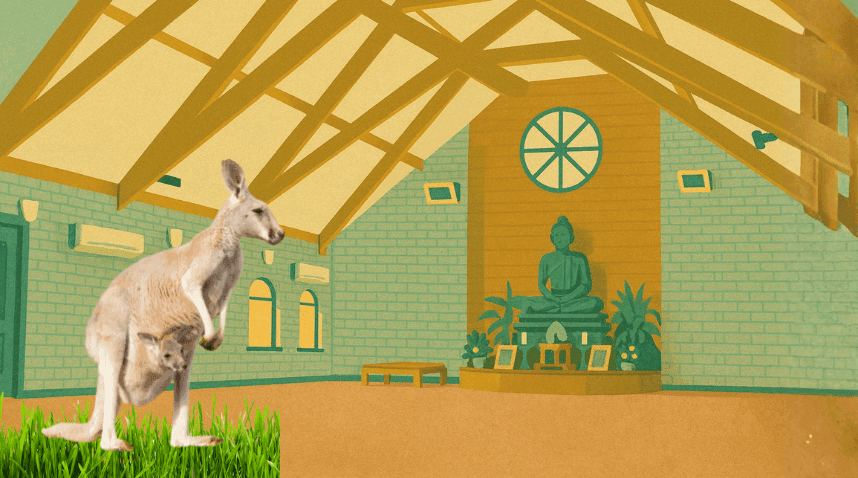
It is a nice 20-minute stroll to Bodhinyana Monastery from Jhana Grove, and you may encounter the kangaroos chomping on grass along the way or within the monastery itself. Many retreatants enjoy going to the Dhamma hall for meditation. However, you may be disappointed to hear that you wouldn’t be able to visit the famed wall with the two bad bricks because it belongs to an area only monks can enter.
However, if you are attending a retreat with Ajahn Brahm, you can visit his “cave”. His monks built it for him because they knew he loved the caves in Thailand, where it is not uncommon for monks to share their meditation space with bats flitting quietly overhead in the darkness. Every time I visit the “cave”, I am deeply moved. For such a renowned monk, his kuti is extremely simple: a thin mattress on the floor, a small sculpture of the Buddha giving his first sermon, and an adorable stuffed toy bat are all you will find in this small space.
There is a set of double doors for his “cave”, which when closed, Ajahn will be completely secluded from the sights and sounds of the world outside. I imagine him sitting in his cave, in complete darkness and silence, just blissing out in his meditation. A monk who is contented and easily satisfied.
On the last day of retreat, you should also consider joining in for the pindapata ceremony at Bodhinyana Monastery, where lay people offer food to the monastics. It is not a usual pindapata ceremony that can be witnessed elsewhere because on this day, food is offered to both monks and nuns. Ajahn Brahm also insists on the monastics lining up according to the number of rains retreats they have had thus far, regardless of whether they are a monk or a nun.
Variety of Retreat Options
There are many ways to go for a retreat at Jhana Grove. Apart from those organised by BSWA, other Buddhist organisations in Singapore, Hong Kong and Indonesia also organise retreats led by Ajahn Brahm.
Apart from Ajahn Brahm, there are also retreats of varying durations taught by other monastics at Jhana Grove, catering to meditators with different levels of experience. There are weekend retreats, 5-day retreats, 9-day retreats, and if you are an experienced meditator, you can even do a self-retreat at Jhana Grove.
Conclusion
Going for a meditation retreat and taking a break from our mundane commitments is a great way of guiding both the body and mind towards seclusion. Jhane Grove offers retreats for the fourfold assembly, i.e. laymen, laywomen, monks and nuns, to inspire and learn from one another. In such a conducive environment with trusted teachers, we are better able to manage our defilements as they rise.
However, if you want a sample of what meditation retreats are like first, you can consider shorter retreats offered in Singapore, Malaysia or Indonesia, offered by the different organisations.