

TLDR: Buddha’s wisdom still applies to modern careers. The Buddha’s teaching on Right Livelihood asks a blunt question we often avoid: Can you live with how you make your money? Pair that with Ikigai: the balance of passion, skill, purpose, and pay, and you get a practical framework for meaningful work.
Through start-ups, consulting, and fintech, this article argues that careers are not fixed tracks but steerable paths. Meaning does not require martyrdom, and good pay does not require selling your conscience. With right intention, steady effort, good company, and balanced living, it is possible to earn a living, sleep well at night, and still grow.
In short: don’t be “icky” about how you earn, aim for Ikigai, grounded in integrity.
Right Livelihood was taught by the Buddha over 2,600 years ago. A question many of us quietly ask is whether it still applies today. How can teachings meant for potters and builders remain relevant in a world of IT systems, artificial intelligence, and fintech?
To explore this, I draw on two complementary ideas: Right Livelihood as taught by the Buddha in the Samma-Ajiva Sutta, and the Japanese concept of Ikigai (生きがい), often described as one’s reason for living.
Samma-Ajiva Sutta (AN 5.177) – The Discourse on Right Livelihood
Five types of livelihoods a layperson should avoid:
- Trading in weapons
- Trading in living beings (including slavery and animal trade)
- Trading in meat
- Trading in intoxicants
- Trading in poisons
Generally, those industries can be relatively lucrative. An example is shares in Rheinmetall, a defence manufacturer, which have increased by more than 700% since the Ukraine war started.
Yet the Buddha’s question remains uncomfortable and relevant: how do we live with the consequences of how our money is made? The endurance of this teaching lies precisely in its refusal to separate income from ethics.
Ikigai is the Japanese concept of “reason for being” or “a meaningful life.” It represents the sweet spot where passion, mission, vocation, and profession intersect, leading to a fulfilling and purpose-driven life.
The four elements of Ikigai:
- What you love (Passion)
- What you are good at (Vocation)
- What the world needs (Mission)
- What you can be paid for (Profession)
If you only have passion + mission, you may feel fulfilled but struggle financially.
If you only have vocation + profession, you may earn well but lack purpose.
If you balance all four, you find Ikigai, a meaningful and sustainable life.
Balance is what sustains us. My view is that when Ikigai is grounded in Right Livelihood, work can be both ethical and enduring.
Work in Progress: My Career So Far

To further conceptualise, I would like to share how I used both to shape my career.
Over the past 10 years, my career can be surmised into three phases.
- Start-up
- Technology Consultant
- FinTech Payments
In my start-up phase, I had the greatest control over my passion and mission. I believed that acting with good intentions and a clear purpose would generate good karma, even if outcomes were uncertain.
My first venture was a marketplace connecting internationals leaving Australia with newly arrived students to sell household items, reducing waste and environmental impact (Yay for Mother Nature!). Although we won a start-up competition and secured early funding, the model proved to be capital-intensive and unattractive to investors, as many users eventually left the country and lacked product “stickiness”.
We pivoted to a second start-up focused on supporting international migrants throughout their journey, from arrival in Australia through to permanent residency. The Software-as-a-Service platform was built on Accountability, Convenience, and Trust, connecting migrants to vetted services such as job search, insurance, and moving services. Revenue was generated through a commission model on all platform transactions.
Driven by passion and mission, we raised over half a million dollars in funding. Financially, it was modest, but the work was meaningful. When COVID-19 hit, differing views among investors on how to pivot ultimately led to the business’s closure.
That brings me to stage 2 of my career. In this stage, I worked as a Technology Consultant for 3 years. Even though there was less control over my passion and mission than in my start-up stage, I guess my good karma (perhaps with some help from divine beings, too) helped me land my most fulfilling project: building the NDIS mobile app.
NDIS is a National government agency that helps individuals with disabilities receive funding for their daily needs and future empowerment. It was a fulfilling project spanning 1.5 years that met all four criteria: passion, vocation, mission, and profession. Alas, due to the impermanence of both life and consulting, I was moved to another project, and a change in the company’s management and values led me to my current role.
My current role is a Senior Product Business Analyst (almost 2 years now!) in Australia’s payments infrastructure. For those in Singapore, think of the equivalent of national payment rails such as PayNow or FAST. These systems are not only used for everyday payments but also for government disbursements to the vulnerable and those affected by natural disasters. While less personal, the work supports society at scale and retains meaning through its impact.
It does meet a few segments of my Ikigai: I am passionate about learning about payments (passion), I have sufficient guidance to gain the skills and knowledge required (vocation), my work in payments infrastructure is essential to the Australian economy (Mission), and I am paid decently well (Profession).
The Buddha’s Playbook for Working Life
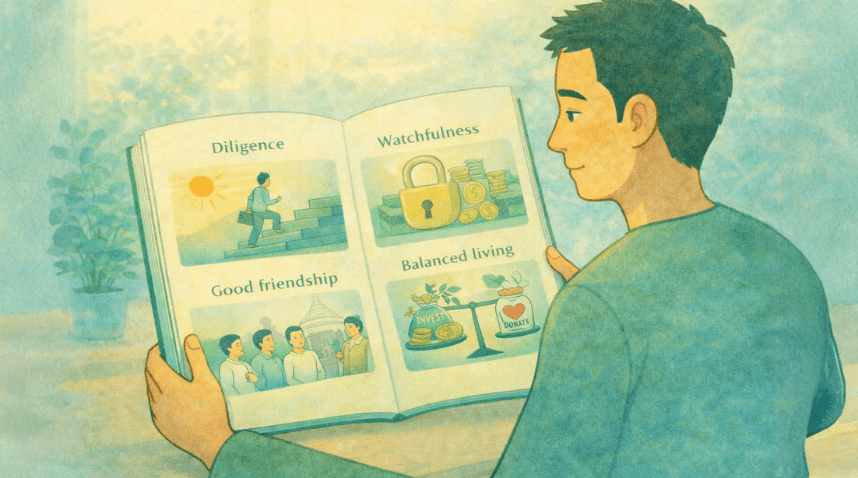
Another useful teaching is the Vyagghapajja Sutta (AN 8.54), which outlines four qualities for success in this life:
- Diligence (Uṭṭhāna-sampadā)
Be energetic, skilful, and proactive in your work. Earn your living competently and responsibly, not carelessly or lazily. I apply the Kaizen (continuous improvement) concept to motivate myself to work smart. - Watchfulness (Ārakkha-sampadā)
Protect what you have earned, safeguarding wealth, resources, reputation, and work outcomes from loss, fraud, or negligence. I like to watch finance-related YouTube videos to improve my financial literacy. - Good friendship (Kalyāṇa-mittatā)
Associate with people who are ethical, wise, disciplined, and encouraging. Your circle shapes your conduct and direction. I do try to keep in touch with Dhamma friends who share interests in my career updates. - Balanced living (Samajīvitā)
Live within your means by avoiding both extravagance and miserliness. Whenever my pay comes in, I budget for my mortgage, bills, investment and Dana (Generosity). The remainder will be for personal use and enjoyment.
Closing Reflection
Many people feel trapped in their careers, believing that a job is “just a job”. This overlooks the ability we have to steer our career ship. With the right intentions and deliberate steps, careers can be shaped over time.
Be honest with yourself, at your present stage and reflect on these questions:
- Can I earn from this job without harming others or compromising my values?
- What work energises me even when no one is watching or praising me?
- What am I willing to keep learning and improving at for the next 5 to 10 years?
If meaningful work is not available now, we can seek it, create it (Start-up), or develop the right skill sets for a future job that would fit our Ikigai. We do not have to choose between idealism with no income and high pay with no conscience. As the Buddha consistently taught, there is always a middle path.