
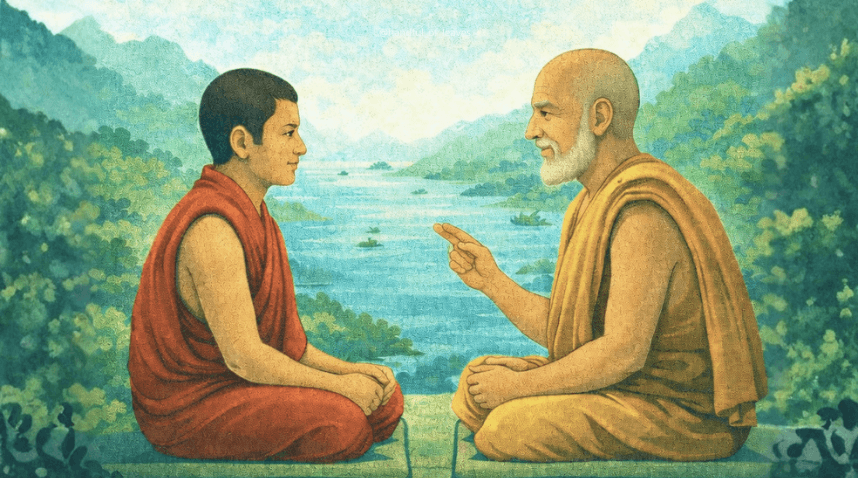
TLDR: Atiśa spent 12 years under Dharmakīrti Serlingpa before bringing lojong to Tibet. New attention to Kedah’s Bujang Valley suggests this teaching hub sat in Malaya, not Sumatra.
Editor’s Note: This is an edited version of the article first published on RYI’s Student Blog. We thank Dominic for sharing his insights with us.
As a student of Tibetan Buddhism at RYI, I’ve often found myself drawn to the figures of Atiśa and Dharmakīrti Serlingpa, two Buddhist masters whose stories span centuries and vast regions of Asia. These figures have come to symbolise for me the deep interconnectedness of the Buddhist world, one that cuts across geographic and cultural boundaries.
Atiśa, an 11th-century Bengali scholar-monk, is well-known for helping to establish Buddhism in Tibet during its ‘second transmission’. However, before his Tibetan journey, he spent 12 years studying under Dharmakīrti Serlingpa, a renowned teacher based in what was then the flourishing Śrīvijaya Empire. Atiśa regarded Dharmakīrti Serlingpa as his root guru, and it was from him that Atiśa learnt the practice of mind training (lojong).
This lineage of lojong, which focuses on taming the mind through the use of ‘slogans’, and transforming adversity into spiritual growth, would become a cornerstone of Tibetan Buddhism under Atiśa’s transmission.

Crossing Seas for Wisdom
Learning about Atiśa’s Śrīvijayan connection felt like part of a missing puzzle piece. It helped me to understand how Vajrayāna traditions extant today in the Himalayas are connected with those in Japan – with Malaya having being the ‘bridge’ region through which these ideas flowed, travelling with the monsoon winds on merchant ships. It helped me see how Southeast Asia was joined not just to its own rich Buddhist past, but to the very teachings that have shaped Tibetan Buddhism, which I now study.

The Malaysian Connection?

Modern scholars suggest that Dharmakīrti Serlingpa was based not in Sumatra, as is often assumed, but in Kedah — specifically, the Bujang Valley, an important hub in the Śrīvijayan sphere of influence. The Bujang Valley, often overlooked, holds over 180 archaeological sites dating back to the 3rd century CE, showcasing a thriving Buddhist civilisation. This was where Dharmakīrti Serlingpa likely taught, and where Atiśa studied, absorbing knowledge that would later transform Tibetan Buddhism.
Dharmakīrti Serlingpa’s impact on Atiśa extended beyond mind training — Atiśa’s devotion to Tārā, the female bodhisattva of compassion is also attributed to his root guru.
This deep spiritual connection would accompany Atiśa to Tibet, where he would spread both the lojong teachings and his devotion to Tārā.
The Footsteps of The Wise

Earlier this year, I embarked on a pilgrimage to the Bujang Valley, driven by a desire to connect more intimately with this part of Buddhist history. My visit coincided with an exciting moment in archaeological history — a young Malaysian archaeologist, Dr. Nasha Rodziadi-Khaw, had just uncovered new findings, including a near life-size Buddha statue from the valley. The news made global headlines, but also sparked debates within Malaysia, where Islamic scholars sought to downplay or contest the role Buddhism played in ancient Malaya.
This tension reflects the ongoing challenges of reconciling historical narratives with contemporary cultural and religious identities.

Yet, for me, the experience of visiting Bujang was something to be treasured. Walking through the ruins where Atiśa and Dharmakīrti may have once walked, I felt a sense of closeness to the teachings I now study. Atiśa’s journey to the “Golden Isles,” (Suvarṇadvīpa) as Śrīvijaya was often called, was fraught with difficulty — accounts describe how his ship was caught in a violent storm, possibly sent by hostile forces. The idea that he endured these trials to seek wisdom from Dharmakīrti Serlingpa adds another layer of inspiration to his story.
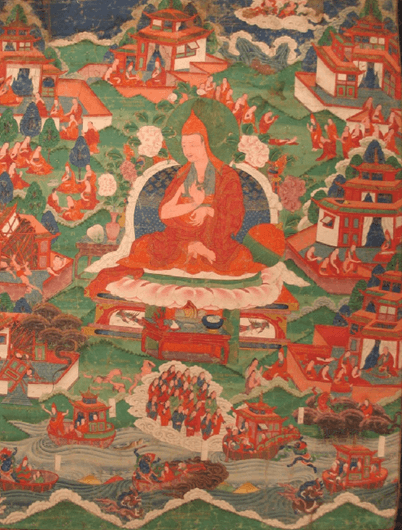
Perhaps the most touching symbol of Atiśa’s devotion to his guru was a small gold reliquary containing Dharmakīrti Śrībhadra’s bodily remains that Atiśa carried with him to Tibet. This stupa, topped by a silver umbrella, was regarded as Atiśa’s “most precious spiritual object.” After Atiśa’s death, his devoted student Dromton enshrined the reliquary in Reting Monastery, historically important as the seat of the Kadampa school.
This pilgrimage has reinforced for me how Buddhism has always been a tradition of movement and exchange. From India to Southeast Asia, to Tibet and Nepal, the teachings have travelled across oceans and mountains, bridging cultures and peoples. Through Atisa and Dharmakirti Serlingpa, I’ve come to see how deeply joined these histories are. Travelling to Bujang formed for me a way of connecting with a legacy that stretches back over 2 millennia, a reminder that the path of Buddhism continues to unfold across time and space.
Wise Steps:
- Close each study session by dedicating merit to the continuity of wise exchange, for example “may teachings travel safely across lands and minds, as they did from Kedah to Tibet.”
- Build felt connection through place by visiting a local archaeological site or museum, for example spend one mindful hour at a gallery display on early Southeast Asian Buddhism.