

TLDR: A serendipitous Eventbrite listing led me from being stuck in secular mindfulness apps to walking on the Noble Eightfold Path. This article is about how I found a spiritual community in Dhamma Assembly for Young Working Adults (DAYWA), and how my early steps in the Dhamma have opened up new horizons.
How Suffering Led Me to (Meditation) Apps
I was born to a family of “free-thinkers”; we humans should stand on our own feet, without religion as a “crutch”. Given my scepticism towards religion, I never thought I would join a religious community.
In my late twenties, stress from work and life brought me to secular mindfulness practices. I downloaded and used a full suite of meditation apps, from Headspace to Medito to Happier.
Despite some progress, I felt like I had hit a wall. It was hard to calm the mind for meditation, and I felt stuck – stress would still overwhelm me, old habits would pull me back. Something important was missing.
A Serendipitous Turn of Fate

In my search for the missing piece, in late 2023, I stumbled upon a YouTube video of a monk’s teachings. It struck a chord in me. I sensed that I needed more than simply “being mindful”: I needed meaning, guidance, and community. Eager to learn more about the Dhamma (though I didn’t know the term then), I searched for Buddhist events on Eventbrite.
One entry caught my eye, “Finding Peace in a Noisy World – Q&A with Ajahn Dhammasiha” (Jan 2024), hosted by the Dhamma Assembly for Young Working Adults (DAYWA). Amidst the ups and downs of life, the message of finding peace resonated with me. I was also looking forward to meeting fellow young adults with similar concerns.
Finding Community
The Q&A with Ajahn Dhammasiha was an eye-opening introduction to DAYWA. I realised many other young working adults shared the same questions and concerns, to which Ajahn offered clear, practical guidance. As DAYWA brought together people aged 20-39, it was easy to connect.
Ajahn Dhammasiha answered a question I’d been stuck on for months: “Why does mindfulness fade the moment work gets hard?”
He said very calmly, try training the conditions, not just the mind. Keep basic precepts, simplify one habit, and sit at the same time daily.
It felt embarrassingly obvious, and exactly what I hadn’t been doing.
I fondly remember the warm welcomes, including from Heng Xuan. When he heard that I found the talk via Eventbrite, he was a little surprised, as it was rare for folks to learn about DAYWA from Eventbrite, and DAYWA rarely posted there. This serendipitous find gave me the feeling that “things happened for a reason”.
Moving Deeper into DAYWA
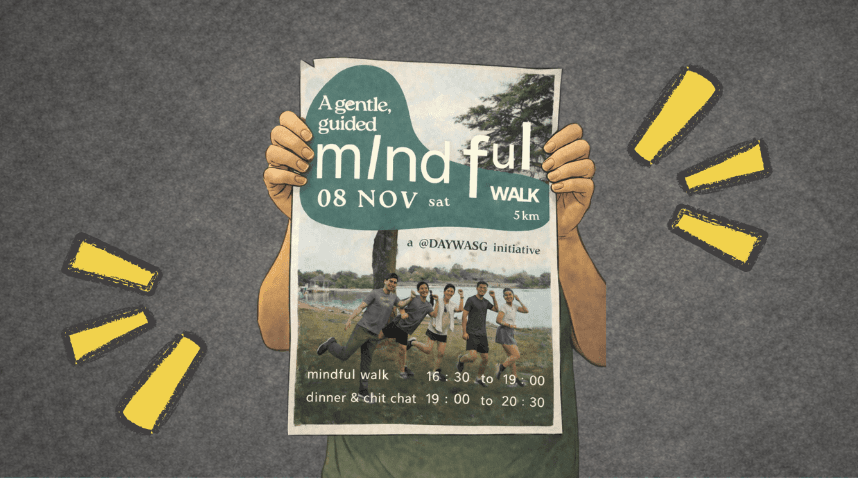
The positive introduction to DAYWA led me to find out more about them. DAYWA’s offerings were simple, community-oriented and effective, such as weekly meditation sessions, mindful runs, Dhamma discussions, and a Commune chat (Telegram group chat for members who have attended at least three events).
As an organiser and regular attendee of community events, I was impressed by how well-run DAYWA was. Information was clearly communicated, and planning was thoughtful, e.g. sharing event venues with confirmed attendees only, to ensure that there were sufficient facilitators. The organisers brought their experience in running start-ups to DAYWA: starting small, iterating fast, and scaling up. Instead of profit, the purpose was to bring the Dhamma to more young adults.
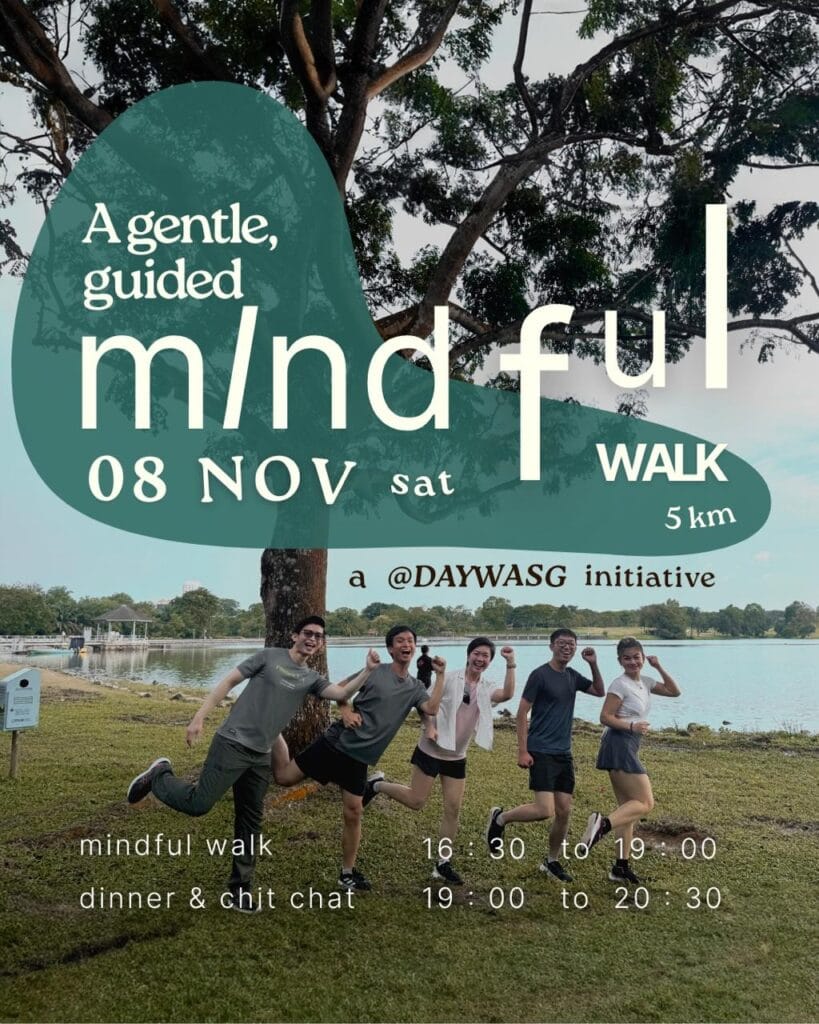
My favourite activity was Mindful Walks. Doing walking meditation in nature helped to calm my mind, and I had a taste of the peace that follows Dhamma practice. At the end of the session, my mind felt like a lazy cat on a sunny afternoon – you couldn’t pull it into chaos even if you tried!
Dhamma Foundation Course (DFC): A Solid Introduction
The DAYWA community also generously introduced me to Buddhist classes and resources. A DAYWA member and HOL contributor, You Shan, encouraged me to attend the Dhamma Foundation Course (DFC) by the Buddhist Fellowship.
I learnt key Buddhist teachings, such as the Four Noble Truths, the Noble Eightfold Path, and how to integrate practice into daily life, which was very helpful for a beginner. The class encouraged discussion between participants, which brought the concepts to life.
I realised that seeing sense objects as permanent and personal had intensified my suffering. In the Buddhist tradition, there are six senses. In addition to the five bodily senses, the mind is the sixth sense, given its importance.
Instead of clinging to sense objects (e.g. sights, sounds, thoughts), that bombard us, we could guard the sense doors, and perceive them as “just a sight”, “just a sound”, “just a taste”, “just a sensation” and “just a thought”. When I saw them clearly as just impermanent sense objects, there was less to cling to, and less to resist.
With fewer stories and judgments, my mind inclined to equanimity and contentment.
Finding the Missing Piece
I realised that my missing piece was the Dhamma and the spiritual community. Given my initial scepticism towards religion, I liked that Buddhism did not call for blind faith, but rather experiential faith. One could simply try out a Buddhist practice for six months and assess whether suffering has decreased. If it does, the gratitude towards the teaching would naturally strengthen one’s faith.
For example, meditation indeed became easier after I observed sila (ethical conduct). By keeping the precepts such as not killing, stealing and lying, the mind was free from guilt and naturally settled into stillness.
Instead of standing still on my own two feet, I could step forward on the path, with kalyāṇa‑mittas (spiritual friends) by my side.
Reflections and Invitation
The wall I had hit in secular mindfulness was not the end of the road, but a signal to make a turn to the Buddhist path, and to find community. As the Buddha said in SN 3.18 Kalyāṇamittasutta, “Good friends, companions, and associates are the whole of the spiritual life.”
If you are reading this and feel similarly stuck, restless, or curious, perhaps this is your sign to check out a spiritual community!
If you are a fellow young working adult aged 20-39, have a look at DAYWA:
- DAYWA Telegram channel: https://t.me/s/daywasg
- DAYWA Instagram: https://www.instagram.com/daywasg/
Pro tip: Choose a group that:
- Welcomes questions without shaming.
- Teaches both ethics and meditation, not just hacks for calm.
- Has clear safeguarding and practical comms (where, when, who to contact).
- Encourages gradual, testable change over hype.
- Feels kind in the small things: how they greet latecomers, how they close sessions.
Bonus: For a virtual “kalyāṇa‑mitta”, check out Norbu, an AI chatbot for Buddhist wisdom: https://norbu-ai.org/en/norbu
Conclusion
Meditation apps taught me to pause. The Dhamma gave me a direction and the courage to move forward. If you’ve hit the same wall, don’t download another app or technique. Find a room, find a few good friends, and try out the path for six months. Watch what happens to your speech, your sleep, and the way you respond to the next hard email.
Acknowledgements
I would like to express my heartfelt appreciation to DAYWA and its organisers, such as Heng Xuan and You Shan. Thank you for your hard and heart work, and for being my first kalyāṇa‑mittas!
Wise Steps
- Recognise that it is never too late to start (or re-start) your practice.
- Find a community of like-minded people to practice together with – it’s more fun, and you’re more likely to continue!
- Set aside regular time for practice, e.g. attend Buddhist activities regularly.