
TLDR: Rooted in both soil and stillness, this conversation with Will Chua traces how Dhamma can be lived fully amid the multifaceted demands of everyday life. Through the practices of farming, music, generosity, and sangha building, we glimpse a path where spiritual practice is not escaped into—but embodied, moment by moment, in the world.
Dharma in the City is a series featuring ordinary Buddhists who have spent decades in the practice, and also in service to their communities and beyond.
Most lay Buddhists are multi-hyphenates: wearing the hats of a family member, a professional, a volunteer, a friend, and more. How do we go about the practice in a way that integrates all these different roles that we take up?
The journeys of our interviewees shed light on how Buddhist teachings have influenced and supported their diverse aspirations, roles, and occupations, all while cultivating the same path of peace.
The following interview features Will Chua, an Order of Interbeing (OI) member in the Plum Village tradition of Zen Master Thich Nhat Hanh, OI family member of the Joyful Garden Sangha community of practice in Singapore, and a co-founder of the syntropic agroforestry project A Little Wild and the organic farm Feed Our Loved Ones (FOLO).
In the Plum Village tradition, Will’s Lineage Name is Crossing to the Other Shore of the Heart, and his Dharma Name is True Fearlessness.
The Teacher Finds the Student
Nigel
Dear Brother Will, thank you for accepting this interview! Our paths have crossed on multiple occasions, whether at the Joyful Garden Sangha home, the 2024 Mindfulness and Music Tour in Singapore, or even on the farm A Little Wild.
I’ve been drawn to your practice seeing as you have a passion for music and for farming, alongside practising the teachings of the Buddha. May I ask what drew you to the Plum Village tradition of Zen master Thich Nhat Hanh 13 years ago?
Will
In typical Buddhist fashion, the short answer is: The conditions were ripe 🙂
In particular, it took 1) a healthy dose of suffering; and 2) a moment of Divinity, for the Dharma to enter my life through Thay (Zen master Thich Nhat Hanh) and Plum Village.
A Healthy Dose of Suffering
In 2012, it all came to a head. While being offered a promotion in the Singapore Government, I was surprised to find myself frozen, unable to accept it at all. After all, it was the promotion that I and many others were fighting and striving for. My ex-boss was also surprised.
- At 33, my physical health had deteriorated. The 2012 government medical checks revealed very high blood pressure, high cholesterol, fatty liver and borderline blood sugar levels.
- Emotionally, I was totally burnt out. I had experienced several failed relationships, disconnection from family, and was overworked and lonely.
- Environmentally, I felt homeless in the city, in a small apartment.
And there was no time. My ex-boss said that the management expected a decision about the promotion in a week.
A Moment of Divinity
Helpless, I turned to the only place my engineering brain could deduce: Kinokuniya. In particular, the Self-Help and Religion shelves of Kinokuniya.
The first round of book purchases was a bunch of self-help books and one by the Dalai Lama: Towards a Kinship of Faiths. I recall finding them inspiring, but unable to “solve” my predicament.
A few days later, less than a week from my ex-boss’s deadline, there I was, staring at the shelves again. I was looking for another Dalai Lama book when a strange old uncle tapped me on the shoulder, asking me to step aside so he could walk through. Visibly frustrated, he said in passing,
“All you young people, only know how to look straight, so all the books at the top shelves can sell. Look down and around la!”
In reflex, and slightly irritated, my eyes went from “D” (for Dalai Lama) down to the 2nd bottom shelf, where an author starting with “T” had an equally impressive number of books.
Thich Nhat Hanh. I picked the book The Heart of Buddha’s Teaching.
I could not put it down for 2 days. The teacher found his student in time of need.
Watering the Dharma Seed
Externally, the dharma door that opened my heart was like the many millions of readers Thay’s books have touched: an invitation to a simple, gently rebellious, poetic, communal and inclusive practice of spirituality deeply anchored in Buddhist wisdom and full of compassion for modern suffering.
Internally, it felt like three big dams broke into one giant flowing river. In Plum Village, we are taught that, especially when Touching the Earth (prostrations), we can practice not only prostrating to the Three Jewels, but also to our three ancestral lineages: our blood ancestors, our land ancestors and our spiritual ancestors.
Encountering the Plum Village practice, I felt these blockages in my ancestral connections and lineages come unclogged. There was a surge in energy, a call to live in a more authentic way, honouring my ancestors and Mother Earth. Thay’s invitation to train, to bring the practice of mindfulness into everyday life, to embrace and transform our suffering, felt like a moment-to-moment remembering or re-joining of parts forgotten.
Participating in my first Day of Mindfulness with Joyful Garden Sangha a few days later, I got up from a beautiful mindful eating practice to find a postcard of Thay’s calligraphy staring at me:
昨日泪
今日雨
(The tears shed yesterday have become rain)
At that moment, I somehow knew this was the path. Without hesitation, I took a one-year sabbatical (instead of the promotion), and went on four Plum Village retreats in 2014, in France where Thay was still teaching, while reconnecting with family and land.
So, the conditions were ripe lah. The rest is history 🙂
Note: In the Plum Village tradition, Zen Master Thich Nhat Hanh is known as Thay (pronounced “Tay” or “Tie”) by his students, which is Vietnamese for “teacher”.
Embracing Right Art
Nigel
Some time ago, I found it challenging to draw a link between music and mindfulness for friends who could not appreciate why art and song featured in a Buddhist tradition and practice.
For the benefit of those who might not be familiar, may I invite you to shine light on the role of music and other art forms in the Plum Village tradition, and perhaps in your own dharma journey?
Will
The arts have always been a go-to escape for me growing up, an escape from being “funnelled” into an education and (initial) career in engineering. Whether it was Nirvana (how ironic), Jay Chou, Snoop Dogg, or an Andy Warhol painting, I found temporary relief in a good tune, fresh lyrics, and rebellious colours.
Thanks to the Plum Village practice, the same neural pathways for appreciation of art became a dharma door and dharma practice.
Anyone who has been to a Plum Village retreat, or Day of Mindfulness, will have experienced music, movement, poetry, calligraphy, film, writing, and even martial arts as very much part of Plum Village communal life and practice. The monastics and lay practitioners also practice and offer other art forms like woodworking, regenerative farming and creative ways to bring mindfulness into schools, hospitals, prisons etc.
Art in Plum Village is not just for art’s sake. It has to be practised with Right Mindfulness. In response to a request for a Plum Village Dharma teacher to teach mindfulness to the US Army, Thay responded with the teaching, “Mindfulness is not a tool, it is a Path.”
Mindfulness must always be Right Mindfulness, applied on the foundation of ethics (our precepts), interbeing with the other 7 elements of the Noble Eightfold Path.
Practising art with Right Mindfulness, art can become Right Art. It also means, with Sangha eyes, there is collective wisdom to know when the practice of art becomes “too much”, and to return to the core and basic practices.
For example, all the songs remind us about Dharma and mindfulness practice. One of my favourite songs in Plum Village goes:
Arrived, arrived,
At Home, I am at Home.
Dwelling in the Here,
Dwelling in the Now.
Solid as a mountain,
Free as the white cloud
The door to No Birth and No Death,
is open,
Free and unshakeable.
Try singing or listening to the song “Arrived” with awareness of our body and our breathing. How is it for you?
Dharma Practice as a Farmer
Nigel
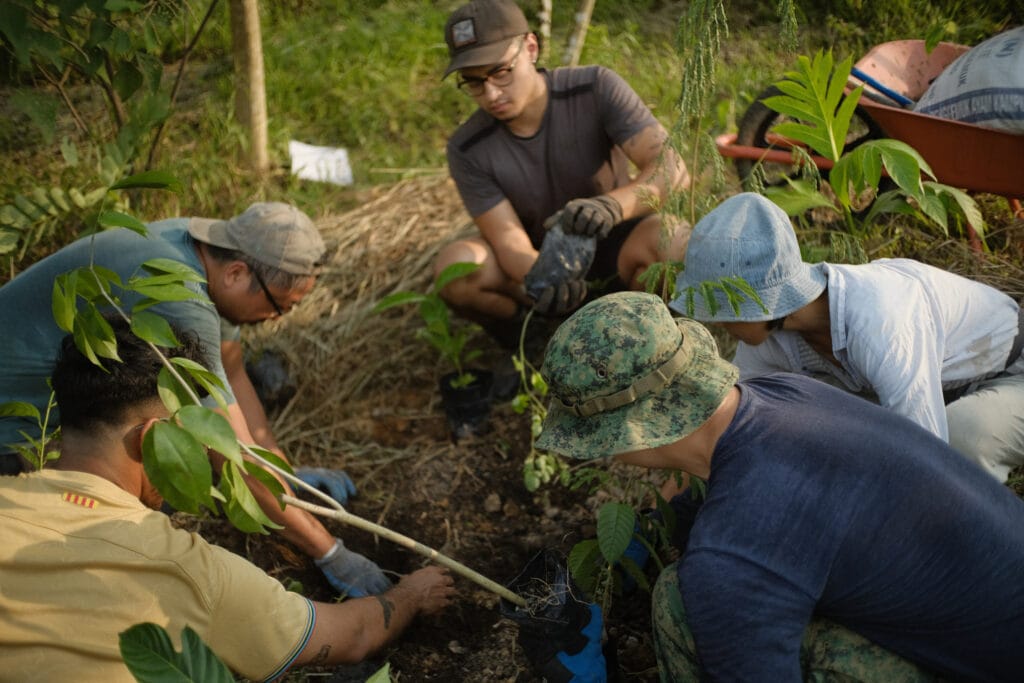
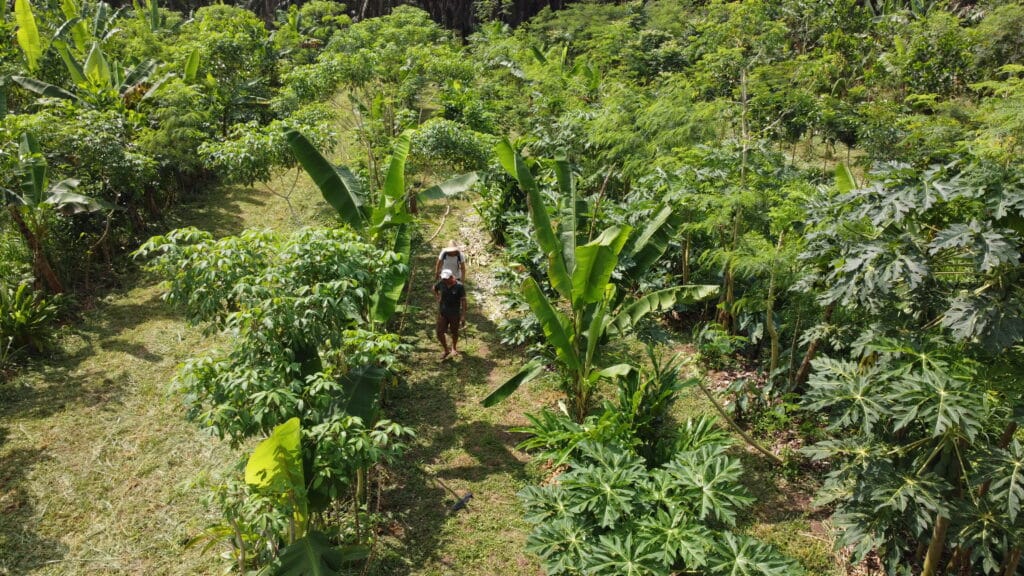
The next question is asked in part for my friend Vignesh, who is a dedicated volunteer and supporter of Singapore’s ‘last kampung’ Ground-Up Initiative. Apart from being a musician, another hat that you wear is that of being a farmer.
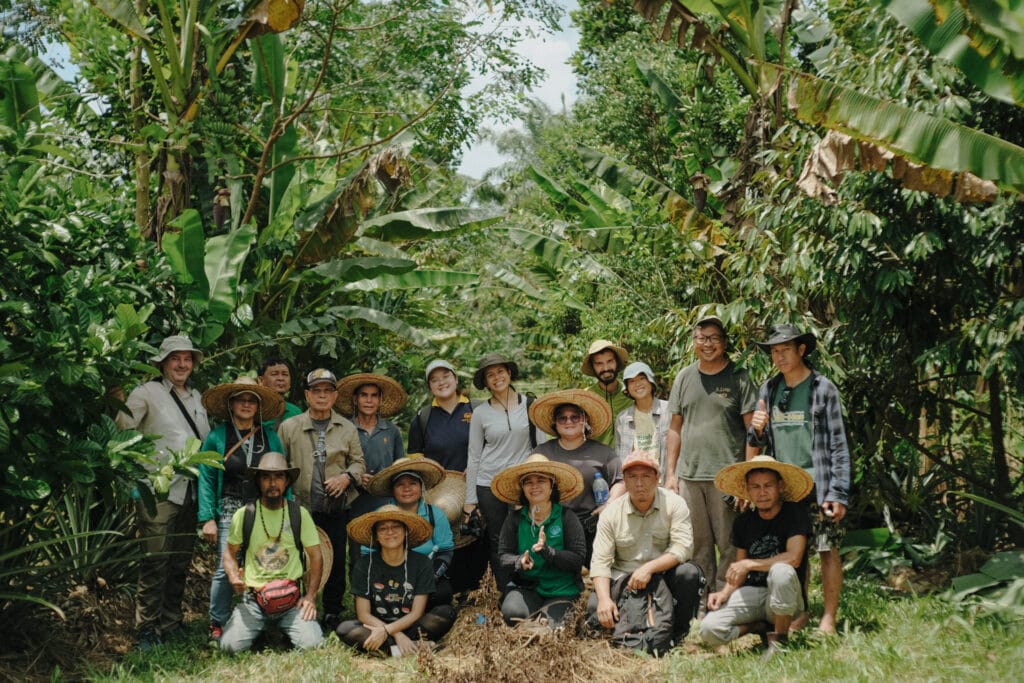
“Every land’s dream is to be a forest”, reads the motto of A Little Wild – a phrase which came to you at a time of reflection on the farm. Could you please share with us how dharma practice is integrated in farming?
Will
Oh, I can write so much on this, haha… but just to offer a few.
First, I try my best to practice Non-attachment to Views.
- This means to let go of the content – be it the best design, the best method of farming or the best way to manage, etc. Rather, to focus on the way I attend to whatever happens, to be aware of the attitude, as much as possible to come from a place of peace, of understanding, of kindness, of gentleness. (There can be a lot of harsh energy in farming).
- In Plum Village, we recite a Love Meditation, a form of Metta meditation. I love the last line, which says, “May I be free from attachment and aversion, but not be indifferent.”
Second, I try my best to practice the Five Mindfulness Trainings (the five precepts) and the Fourteen Mindfulness Trainings (the bodhisattva precepts) of the Order of Interbeing.
- I find that the precepts are so aligned with the principles of permaculture, syntropic agroforestry and natural farming. The precepts have really served as a protection and guiding light in times of difficulty with other community members or when having to make difficult decisions. It helps me live a life with less regret and more ease, within and in relation to others.
- Sometimes I feel like it even helps build deeper trust with the dogs, cats and wild animals. Some time back, I encountered a black spitting cobra less than a meter away from me. Somehow, I just came back to my breathing and wished it well, and it withdrew its head and slowly reversed into the bushes. Maybe I was just lucky, haha.
Thirdly, I try my best to practice the Four Elements of True Love (the Four Immeasurable Minds).
- To practice being with suffering in a way that is kind, compassionate, joyful, inclusive and non-discriminating. It is such a beautiful practice to grow the heart limitlessly.
- Regenerative farming, while deeply meaningful, is not an easy livelihood. One is exposed to the elements, working alongside people on the fringe of society, many times moving against the stream – it is a form of rebellion that is not always peaceful. Practising True Love helps.
Giving with Understanding
Nigel
Reading your letter in The Mindfulness Bell (Issue #96), I was astounded to learn about your dedication to developing the perfection of giving (dana paramita). Amongst your practices include not asking for salary or any form of return for your work in the communities (such as FOLO, A Little Wild, Joyful Garden Sangha) for the last 13 years.
This practice seems a close parallel to one of the monastic training rules in the Patimokkha, whereby monastics (at least in Theravadin traditions) do not handle money. It’s a practice that also runs opposite to the pressure which many youth seem to experience around wealth accumulation – epitomised by movements such as Financial Independence Retire Early (FIRE), and so on.
Would you be able to take us through your experience of forgoing a salary, or any form of return? If there were particular difficulties or doubts during this time, may I ask which individuals or particular teachings have helped you to overcome them?
Will
As I shared in the Mindfulness Bell article, it is not just about foregoing a salary or return. It is the practice of giving with understanding. Offering my presence, time, talent, energy and resources, sensitive to what is needed around me, without expectation of return.
But letting go is also paired with letting in: so it is also a practice of receiving, allowing myself to accept what is offered, what is needed, with gratitude, and in the process entering into an interrelationship with others (receiving, especially money, is sometimes harder than giving when I do not want to “owe” anyone anything!).
There are times, especially in the beginning, when fear and doubt come, and criticism comes. These tend to lessen with time, as we strengthen our relationships and trust deepens. Along with trust, happiness also increases, as the fruits of this practice ripen and bring surprises in so many ways.
Like how a smile can be infectious, dana (generosity) is also infectious, and people awakening to this can be very thoughtful and creative, in stark contrast with transactional relationships.
At the heart of this way of living though, are some important practices based on my experience so far (13th year and counting):
- Renunciation: We have to practice Voluntary Simplicity. Learning how to be happy and not fussy with daily needs and what needs to be done, to be content with less comfort and fewer choices, to let go of comparison with peers. I will be happy to drive a little Grab, or to be a part-time security guard, gardener or kitchen-hand in a vegetarian restaurant, if one day the need arises!
- Reconciliation: We have to keep practising and working at healing and deepening our relationships with our family and close friends. To listen deeply, to understand their needs, to reconnect at the heart level. A lot of my way of life is possible because of the healing (in progress) and reconciliation with my mum, siblings, childhood friends and dharma siblings.
- Aspiration: In Plum Village, we are taught that volition is a very important nutriment keeping us on the Path. (See the “Four Types of Food for Healthy Growth” or Four Nutriments for more.) This means that we are always asked to connect deeply with our spiritual aspirations, and to remind each other as sangha siblings. To ask on behalf of Mary Oliver, dear friend, “Tell me, what is it you plan to do with your one wild and precious life?” Today I would like to share with you mine. Please remind me if I forget!
Dear Sangha, I aspire to live and love deeply in each moment, to serve all beings with gratitude, and to be a beautiful continuation of my ancestors.
Sangha Building
Nigel
In relation to Joyful Garden Sangha, it has been at least fifteen years of sangha building* on your part, Br Will. Thank you for continuing the deep aspiration of Thay, helping so many more of us touch the living Dharma.
Just as A Little Wild sprouted during the pandemic times, other ground-up initiatives – such as Dhamma Assembly for Young Working Adults (DAYWA), spiritual friendship group Rainbodhi SG, and this blog Handful of Leaves had come to life during, and in spite of, those difficult times.
May I invite you to share words of encouragement and reflection for these young groups that are helping to carry the teachings of the Buddha, please?
Note: In the Plum Village tradition, a community of Buddhist practitioners is referred to as a “sangha”. A sangha can include both monastics and lay practitioners. As the third jewel of Buddhism, Sanghas offer a deep well of support and wisdom.
Will
One of the beauties of Dharma practice in community is that our eyes start to change. These days, I am beginning to appreciate more deeply the dharma in other traditions and areas of life.
So I would like to express reverence for these other traditions by taking off my Plum Village hat and offering words of encouragement from my learning and experience of the Thai Forest tradition.
Practising Spiritual Friendship
Like many of us, I am very inspired by the teachings and practices of Ajahn Amaro. One of his teachings that deeply moves me (amongst many) is when he talks about the importance of rejoicing in spiritual friendship. In particular, he often quotes the Avijjasutta (Ignorance) Sutta.
- In it, the Buddha shares that at the root, “association with untrue persons” step by step eventually fuels Ignorance.
- And “association with true persons” step by step fuels wisdom and freedom, like how the rain eventually travels down the mountain to fill the ocean. How beautiful!
So to my dear friends on the path, however challenging the suffering, whatever the endeavour, spiritual friendship is both means and end, and we can trust that the rest can unfold with ease.
Spiritual friendship is not a practice of personal judgement of who is “true” or “untrue”, but a practice of that which is True here and now. It is a practice of gathering together, of patient endurance when differences arise, of supporting each other by holding up the timeless mirror of Mindfulness, Wisdom and Compassion for each other.
Practising Patient Endurance
The practice of patient endurance, as Ajahn Amaro teaches, is not the gritting of one’s teeth, or (in Malay) to ‘tahan’, but the letting go of time. Can we practice letting go of time when being with one another, and allowing the doing to come from that place of understanding, love and togetherness?
That’s my practice these days lah, spiritual friendship and patient endurance. After all,
“We are all just walking each other Home” – Ram Dass (capital H is my own hehe)
Thank you, dear friends, for reading. I pause now one more time, come back to my breathing for a few minutes, with a smile. Wishing you all peace and all the best.
In love and trust,
Will
Wise Steps
- Let suffering ripen wisdom: Rather than turning away from burnout, confusion, or loss, learn to meet them with mindfulness, allowing difficulty to become the very doorway through which the Dharma enters.
- Integrate the Path into daily life: Whether through art, farming, or work, practice Right Mindfulness in what you already do, letting ethics, care, and presence guide each action instead of chasing ideal forms or outcomes.
- Walk together in generosity and trust: Sustain the path through spiritual friendship, voluntary simplicity, and giving with understanding, remembering that we are supported not by self-reliance alone, but by deep interbeing with others and the Earth.