Comprehensive Calendar for Buddhists in Singapore and Malaysia 2026
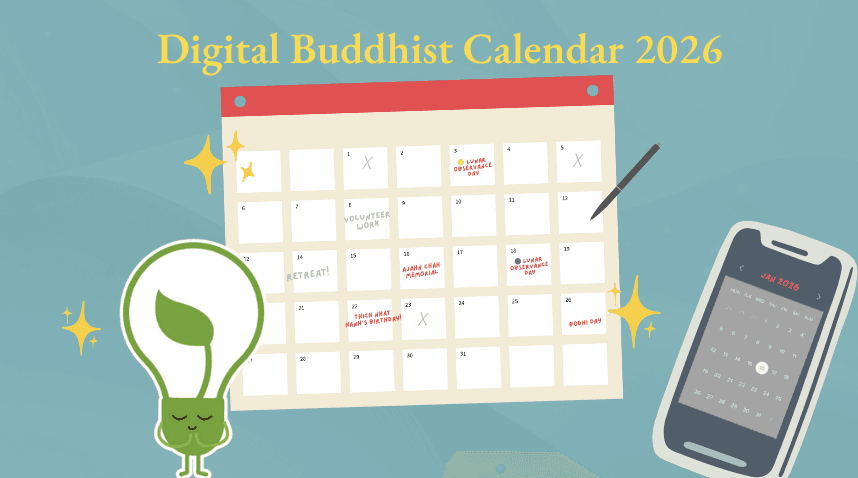
Planning to start your new year with wholesome aspirations to deepen your spiritual practice? Consider leveraging the full moon, new moon days, and significant Buddhist holy days as milestones for your progress. HOL has launched a digital calendar that helps you get on track!
Here is a comprehensive list of special days celebrated or commemorated by Buddhists globally across the 3 main Buddhist traditions: Mahayana, Vajrayana, and Theravada. The calendar includes Buddhist religious holidays, lunar observance days, and holy days.
Note: The dates in the lunar calendar are established through traditional calculation methods. Hence, there might be occasional discrepancies with precise astronomical events. The observance days for significant events such as Wesaka Puja, Asalha Puja, Magha Puja, and Pavarana, may vary across different countries.
| Date | Day | Lunar observance/Holy day |
| 3 Jan | Sat | 🌕 Full Moon |
| 16 Jan | Fri | Ajahn Chah – Teacher remembrance day |
| 18 Jan | Sun | 🌑 New Moon |
| 22 Jan | Thur | Thích Nhất Hạnh – Teacher remembrance day |
| 26 Jan | Mon | Bodhi Day (Lunar calendar) |
| 2 Feb | Mon | 🌕 Full Moon |
| 3 Feb | Tue | Master Sheng Yen – Teacher remembrance day |
| 15 Feb | Sun | Mahayana Parinirvāṇa / Nirvana Day |
| 16 Feb | Mon | 🌑 New Moon |
| 17 Feb | Tue | Chinese New Year, Maitreya Buddha’s Birthday |
| 18 Feb | Wed | Losar – Tibetan New Year |
| 27 Feb | Fri | Parinnibbana Day |
| 3 Mar | Tues | 🌕 Full Moon, Māgha Pūjā |
| 4 Mar | Wed | Chötrül Düchen – Festival of Miracles |
| 18 Mar | Wed | 🌑 New Moon |
| 26 Mar | Thu | Śākyamuni Renunciation Day |
| 2 Apr | Thu | 🌕 Full Moon |
| 6 Apr | Mon | 🪷(Guan Yin) Avalokitesvara Bodhisattva’s Birthday |
| 8 Apr | Wed | 🪷(Pu Xian) Samantabhadra Bodhisattva’s Birthday |
| 13 Apr | Mon | Theravada New Year/Songkran, Thubten Zopa Rinpoche – Teacher remembrance day |
| 16 Apr | Thu | 🌑 New Moon |
| 1 May | Fri | 🌕 Full Moon |
| 16 May | Sat | 🌑 New Moon |
| 20 May | Wed | 🪷(Wen Shu) Manjushri Bodhisattva’s Birthday |
| 24 May | Sun | Buddha’s Birthday/Bathing the Buddha ceremony, Vesākha Pūjā (China) |
| 31 May | Sun | 🌕 Full Moon, Vesākha Pūjā/Vesak Day (Singapore, Malaysia, Sri Lanka, Indonesia, Myanmar, Thailand), Saga Dawa Düchen |
| 14 Jun | Sun | 🌑 New Moon |
| 17 Jun | Wed | Ajahn Chah’s Birthday |
| 24 Jun | Wed | Birth Anniversary of Guru Rinpoche |
| 29 Jun | Mon | 🌕 Full Moon |
| 6 Jul | Sun | 14th Dalai Lama’s Birthday |
| 14 Jul | Tue | 🌑 New Moon, Weituo/Skanda Bodhisattva’s Birthday |
| 17 Jul | Fri | Chökhor Düchen |
| 29 Jul | Wed | 🌕 Full Moon, Āsāḷha Pūjā |
| 30 Jul | Thu | First day of Vassa |
| 31 Jul | Fri | 🪷 Guan Yin Bodhisattva’s Enlightenment Day |
| 13 Aug | Thu | 🌑 New Moon |
| 19 Aug | Wed | Master Hsing Yun’s Birthday |
| 27 Aug | Thu | Ullambana / Ghost Festival |
| 28 Aug | Fri | 🌕 Full Moon |
| 29 Aug | Sat | Tsenzhab Serkong Rinpoche – Teacher remembrance day |
| 11 Sep | Fri | 🌑 New Moon |
| 26 Sep | Sat | 🌕 Full Moon, Ksitigarbha Bodhisattva’s birthday |
| 29 Sep | Tue | Nan Huai‑Chin – Teacher remembrance day |
| 11 Oct | Sun | 🌑 New Moon, Thich Naht Hanh’s Birthday |
| 26 Oct | Mon | 🌕 Full Moon, Last day of Vassa, Abhidhamma Day |
| 8 Nov | Sun | Bhaisajyaguru/Medicine Buddha’s Birthday |
| 9 Nov | Mon | 🌑 New Moon, Lhabab Düchen |
| 24 Nov | Tue | 🌕 Full Moon |
| 25 Nov | Wed | Loy Krathong Festival |
| 8 Dec | Tue | Bodhi Day (Fixed solar date, Japan) |
| 9 Dec | Wed | 🌑 New Moon |
| 23 Dec | Wed | Sanghamittā Day |
| 24 Dec | Thu | 🌕 Full Moon |
| 26 Dec | Fri | 🪷大势至菩萨 Mahasthamaprapta Bodhisattva Birthday |
Want quick access to these observance days?
Download the digital version of the 2026 Buddhist calendar here.
Why observe holy days?
Engaging in the observance of holy days within the Buddhist tradition serves as a profound catalyst for the enrichment of one’s spiritual practice. These sacred occasions present practitioners with a structured and significant opportunity to pause, reflect, and recalibrate their journey towards enlightenment.
On these days, Buddhists around the world would typically engage in activities such as making offerings and participating in prayers to demonstrate devotion. Many Buddhist practitioners would also take on the 5 precepts or 8 precepts, intensify their meditation practice, read the discourses, and listen to Dhamma talks to aid them in their spiritual growth. Temples, monasteries, and Buddhist centres would usually organise large-scale events on Holy days such as Vesak Day. Such events are great opportunities for Buddhists to cultivate their generosity through volunteering and donations to support wholesome efforts in propagating the Dhamma.

New moon and full moon days (Uposatha days)
The observing of new and full moon days is an ancient tradition. Due to the moon’s full size and radiant luminosity, the full moon day is considered the most auspicious among the four lunar phases. Therefore, the full moon days (Poya Days) were historically public holidays, emphasising spiritual pursuits, a tradition some Buddhist countries seek to reintroduce. Sri Lanka, for example, marks all full moon days as national public holidays.
The Buddha taught that on Uposatha days, to reap significant spiritual benefits (surpassing even the rewards of worldly kingship), one shall use proper technique for cleansing the defiled mind through recollections of the Tathagata (Buddha), the Dhamma, the Ariya Sangha, one’s own virtues, and the devas.
“As he is recollecting the (Tathagata, Dhamma, Sangha) his mind is cleansed, and joy arises; the defilements of his mind are abandoned.
AN 3.70
He is thus called a disciple of the noble ones… his mind is calmed, that joy arises, and that whatever defilements there are in his mind are abandoned.
This is how the defiled mind is cleansed through the proper technique.”
Buddhists also believe that full moon days, in particular, hold a special religious significance as they are believed to coincide with critical milestones such as the Buddha’s birth, renunciation, enlightenment, the delivery of his first sermon, and his Parinibbana.

Major Buddhist Events/Observance
Bodhi Day (26 Jan 2026, Lunar Date)
Bodhi Day is a significant Buddhist observance honoured across Mahayana, Theravāda, and Vajrayāna traditions, though it may be commemorated on different dates, like its secular date on December 8th, or integrated into other major festivals such as Vesak. It marks the moment when Prince Siddhārtha Gautama attained enlightenment after meditating under the Bodhi tree in Bodh Gaya and became the Buddha. The Buddha realised the ultimate truth of existence, overcoming ignorance and suffering, and awakening to the nature of reality through profound wisdom and compassion. His enlightenment revealed the Four Noble Truths and the Noble Eightfold Path, laying the foundation for the Dhamma that continues to guide countless beings toward liberation.
The Buddha’s awakening embodies the possibility of liberation from suffering, serving as a powerful reminder that enlightenment is attainable through sincere effort, patience, and unwavering determination. This day encourages practitioners to reflect on their own spiritual journey, cultivate inner clarity, and renew their commitment to walking the path of compassion.
Parinirvana Day/Parinibbana Day (15/27 Feb 2026)
Parinirvana Day (Mahayana, Feb 15) or Parinibbana Day (Theravada, Feb 27) is a Buddhist holiday celebrated mostly in East Asia, Vietnam and the Philippines. It is to commemorate the passing away of the Shakyamuni Buddha when he attained complete nibbana or Parinibbana.
On this day, before the Buddha’s passing into Parinirvana, his last words to his disciples were:
Behold now, bhikkhus, I exhort you: “All compounded things are subject to vanish. Strive with earnestness!”
DN 16
These poignant words emphasise the universal truth of impermanence (Anicca) and the transient nature of all phenomena.
The Buddha’s encouragement to strive with earnestness underscores the importance of diligent practice and mindfulness on the path to enlightenment.
The day serves as a reminder of the transformative potential within individuals to attain enlightenment and contribute to the well-being of all sentient beings.
Śākyamuni Renunciation Day (26 Mar 2026)
Śākyamuni Renunciation Day commemorates the pivotal moment in the life of Siddhartha Gautama, who later became the Buddha, when he renounced his princely life in search of spiritual awakening. On this day, Siddhartha left behind his luxurious palace and worldly comforts to embark on the ascetic path, reflecting the universal theme of renunciation and the quest for deeper truths.
Theravada Events
Ajahn Chah – Teacher Remembrance Day (16 Jan 2026)
Ajahn Chah Remembrance Day is observed to honour the life and legacy of Ajahn Chah Subhaddo, one of the most influential Theravāda Buddhist masters of the Thai Forest Tradition in modern times. Ajahn Chah was renowned for his profound teachings that emphasised mindfulness, direct experience, and the understanding of impermanence, suffering, and non-self. He guided countless monastics and lay practitioners, and his teachings continue to shape Buddhist practice worldwide.
Māgha Pūjā (3 Mar 2026)
Magha Puja, also known as Sangha Day, is a significant Buddhist festival commemorating a spontaneous gathering of 1,250 arahants (enlightened disciples) who assembled in the presence of the Buddha without prior arrangement.
This event occurred on the full moon day of the third lunar month in the Buddhist calendar.
The significance of Magha Puja lies in the purity and serendipity of the gathering, where the Buddha delivered the “Ovada Patimokkha,” a concise summary of ethical principles.
This teaching emphasises the importance of avoiding evil, doing good, and purifying the mind, encapsulating the core tenets of Buddhism.
Magha Puja serves as a reminder of the power of virtuous conduct, unity in the Sangha (monastic community), and the timeless wisdom encapsulated in the Buddha’s teachings.
Songkran/Theravada New Year (13 Apr 2026)
Songkran/Theravada New Year marks the traditional New Year in many Theravāda Buddhist countries, including Thailand, Laos, Myanmar, and Cambodia. Rooted in ancient traditions, Songkran signifies renewal, purification, and the turning of a new cycle. Spiritually, the festival is a time for cleansing the mind and renewing one’s commitment to wholesome actions. Visiting temples to make offerings, listening to teachings, and performing acts of merit are common during Songkran.
Water plays a central symbolic role during Songkran. The gentle pouring of water over Buddha images, elders, and teachers represents the washing away of defilements, the cultivation of humility, and the aspiration for blessings, clarity, and fresh beginnings.
Vesākha Pūjā / Vesak Day (31 May 2026)
Vesak, also known as Buddha Purnima, commemorates the birth, enlightenment, and passing away (Parinirvana) of Siddhartha Gautama, who later became the Buddha.
Celebrated on the full moon day of the fourth lunar month, Vesak is a day of reflection on the Buddha’s teachings of compassion, wisdom, and peace.
Ajahn Chah’s Birthday (17 Jun 2026)
Ajahn Chah’s Birthday commemorates the birth of Venerable Ajahn Chah Subhaddo, one of the most influential meditation masters of the Thai Forest Tradition within Theravāda Buddhism.
Āsāḷhā Pūjā/ Dhamma Day (29 July 2026)
Asalha Puja falls on the full moon of the eighth lunar month.
It marks the day of the Buddha’s first sermon, Dhammacakkappavattana Sutta, setting in motion the Wheel of Dhamma.
On this occasion, the Buddha imparted the core essence of his teachings: Four Noble Truths and the Eightfold Path to the five ascetics.
During the discourse, Koṇḍañña, the eldest among them, became the first to reach enlightenment by comprehending the Dhamma.
The others soon followed, and together they became the Buddha’s first five disciples.
This event is significant in Buddhist history as the formal beginning of the monastic community and the spread of the Buddha’s teachings.
First day of Vassa (30 Jul 2026)
The First Day of Vassa marks the beginning of the annual Buddhist rains retreat, traditionally observed in the Theravāda tradition and also respected across Mahāyāna and Vajrayāna communities.
Vassa is a 3-month period during which monastics remain in one place during the monsoon season to deepen their practice through meditation, study, and discipline. This tradition originated during the rainy season in ancient India, when the Buddha instructed his disciples to minimise travel to prevent damage to crops and creatures during travel and to devote themselves more fully to spiritual cultivation.
This day serves as a reminder of the importance of patience and perseverance, encouraging the cultivation of inner stillness and wisdom.
Pravāraṇā (Last day of Vassa), Abhiddhama Day (26 Oct 2026)
Abhidhamma Day, a revered Theravada Buddhist tradition in Myanmar, marks the Buddha’s ascent to Tavatimsa heaven to teach his mother the Abhidhamma.
The day, celebrated as the Festival of Light of Buddha’s Mother Day, commemorates Gautama Buddha’s descent from Tāvatiṃsa heaven after teaching his mother the Abhidhamma. This doctrine, found in the Abhidhamma Pitaka, delves into the profound moral psychology and philosophy of Buddha’s teachings, emphasising the nature of existence and the process of rebirth.
Pravāraṇā celebrates the end of Vassa (rains retreat).
Pravāraṇā means “inviting admonition.” This refers to inviting one’s fellow monastics to offer reprimands for any offences or misdeeds committed during the three-month retreat when monastics lived communally.
Loy Krathong Festival (25 Nov 2026)
While not a formal Buddhist holy day, Loy Krathong Festival is closely associated with Theravāda Buddhist cultures and is often observed alongside temple visits and merit-making activities. During Loy Krathong, people float small decorated rafts (krathongs) on rivers, lakes, or ponds. This symbolic act represents gratitude to nature, particularly water, as well as the letting go of negativity, unwholesome actions, and past misfortunes. Many also make aspirations for clarity, renewal, and wholesome intentions. In Buddhist interpretation, the festival encourages reflection on impermanence and non-attachment, reminding practitioners to release clinging and cultivate mindfulness and compassion.
Sanghamittā Day (23 Dec 2026)
Sanghamittā Day is observed in honour of female practitioners and commemorates Arahat Therī Sanghamittā, the daughter of Emperor Ashoka and a pioneering figure in the history of Buddhism, particularly within the Theravāda tradition.
Sanghamittā Therī is revered for her vital role in transmitting the Buddha’s teachings beyond India, bringing the Bhikkhunī (nun) ordination lineage to Sri Lanka and carrying a sapling of the
Mahayana Events
Thích Nhất Hạnh – Teacher Remembrance Day (22 Jan 2026)
Thich Nhất Hạnh Remembrance Day is observed to honour the life and teachings of Zen Master Thích Nhất Hạnh, a revered Vietnamese Buddhist monk, poet, and peace activist who introduced the practice of mindfulness to millions around the world.
Renowned for his gentle wisdom and deep compassion, Thích Nhất Hạnh emphasised mindful living, engaged Buddhism, and the cultivation of peace in everyday life. His teachings encouraged practitioners around the world to return to the present moment, to embrace interbeing, and to transform suffering through understanding and loving-kindness.
Master Sheng Yen Memorial Day (3 Feb 2026)
This day commemorates the life and teachings of Venerable Master Sheng Yen, a respected Zen Buddhist master and the founder of Dharma Drum Mountain. Renowned for his emphasis on mindfulness, self-cultivation, and the integration of meditation with daily life, Master Sheng Yen dedicated his life to promoting the Dharma in modern society. On this day, practitioners reflect on his teachings, express gratitude for his guidance, and renew their commitment to practising wisdom, compassion, and ethical conduct as a path toward inner peace and the well-being of all sentient beings.
Maitreya Buddha’s Birthday, Chinese New Year (17 Feb 2026)
Maitreya Buddha’s Birthday commemorates Maitreya Bodhisattva, the future Buddha who is foretold to appear in the world when the teachings of Śākyamuni Buddha have faded.
In East Asian Buddhist traditions, Maitreya is often associated with joy, kindness, and hope for a harmonious future. His birthday is traditionally observed on the first day of the Lunar New Year, making it a time of renewal, optimism, and wholesome aspiration.
This day serves as a reminder that seeds of the future are planted in the present, encouraging practitioners to begin the New Year with compassion, wisdom, and joyful effort.
(Guan Yin) Avalokitesvara Bodhisattva’s Birthday (6 Apr 2026)
观音菩萨 (Guān Yīn Púsà)
The Bodhisattva of Compassion, also known as Guan Yin, is deeply revered across East Asia for boundless mercy and commitment to relieving the suffering of all beings. According to tradition, Guan Yin listens to the cries of the world, offering aid and comfort to those in need. The celebration serves as a reminder to embody Guan Yin’s compassionate qualities in daily life, helping others selflessly and spreading kindness.
(Wen Shu) Manjushri Bodhisattva’s Birthday (20 May 2026)
文殊菩薩 (Wénshū Púsà)
Manjushri, also known as Manjusri Bodhisattva, is one of the most revered figures in Mahayana and Vajrayana Buddhism, often referred to as the Bodhisattva of Wisdom. In Vajrayana Buddhism, he holds a particularly exalted status and is sometimes called the King of Tantra due to his profound connection to wisdom and the esoteric teachings of the Tantras. He is seen as the source of wisdom that underpins all tantric teachings, and represents the union of method (compassion) and wisdom (realisation of emptiness, śūnyatā), which is the essence of Vajrayana practice.
(Pu Xian) Samantabhadra Bodhisattva’s Birthday (8 Apr 2026)
普贤菩萨 (Pǔxián Púsà)
Samantabhadra Bodhisattva, known as Pu Xian in Mahayana Buddhism, is celebrated on their birthday as the embodiment of great practice, virtue, and vows. This auspicious day is observed with reverence, honouring Samantabhadra’s commitment to the Ten Great Vows (as outlined in the Avatamsaka Sutra (Flower Garland Sutra)):
1. Pay homage to all Buddhas
2. Praise the Tathagatas
3. Practice offering extensively
4. Repent all unwholesome karma
5. Rejoice in others’ merits and virtues
6. Request the turning of the Dharma Wheel
7. Request the presence of Buddhas in the world
8. Always learn the Dharma
9. Forever assist according to sentient beings’ needs and abilities
10. Dedicate merit and virtue to all sentient beings
Known as a protector of those who aspire to cultivate wisdom, Samantabhadra encourages practitioners to put the teachings of the Buddha into compassionate action.
Buddha’s Birthday/Bathing the Buddha ceremony, Vesākha Pūjā (China) (24 May 2026)
Buddha’s Birthday/Vesākha Pūjā is a major Buddhist celebration commemorating the birth of Prince Siddhārtha Gautama, who would later become Śākyamuni Buddha.
According to tradition, the Buddha was born in Lumbinī, and his birth symbolises the arising of wisdom and compassion in the world. On this day, many temples observe the Bathing the Buddha ceremony, a ceremony in which devotees pour fragrant water over an image of the infant Buddha. This act represents the purification of one’s body, speech, and mind, and the aspiration to cleanse defilements such as greed, hatred, and ignorance.
Vesākha Pūjā invites reflection on the Buddha’s life and teachings. While Vesak is widely associated with the Buddha’s birth, enlightenment, and parinirvāṇa, in the Chinese tradition, this day places special emphasis on celebrating his birth.
Weituo/Skanda Bodhisattva’s Birthday (14 Jul 2026)
韦陀菩萨 (Wèituó Púsà)
Wei Tuo Bodhisattva, also known as Skanda, is honoured on their birthday as the guardian and protector of the Buddhist teachings and monastic communities. Known for their unwavering strength and vigilance, Weituo is often depicted as a warrior, symbolising the courage and determination needed to protect the Dhamma.
Guan Yin Bodhisattva’s Enlightenment Day (31 Jul 2026)
Guan Yin Bodhisattva’s Enlightenment Day is a significant Mahāyāna Buddhist observance honouring the enlightenment of Avalokiteśvara Bodhisattva, known in Chinese tradition as Guan Yin, the embodiment of great compassion. Guan Yin is revered for her boundless mercy and her vow to respond to the cries of suffering beings. Guan Yin’s enlightenment reminds practitioners of the Bodhisattva ideal: to seek awakening not only for oneself, but for the liberation of all sentient beings.
Master Hsing Yun’s Birthday (19 Aug 2026)
Master Hsing Yun is the founder of Fo Guang Shan and a leading figure in the promotion of Humanistic Buddhism in the modern world, dedicating his life to making the Buddha’s teachings accessible and relevant to contemporary society. He emphasised the integration of Buddhist practice with daily life, advocating compassion, wisdom, ethical conduct, and social responsibility as the foundation of spiritual cultivation.
Ullambana / Ghost Festival (27 Aug 2026)
Ullambana, also known as Obon or Hungry Ghost Festival, finds its origin in Buddhist and Taoist traditions.
Rooted in the Ullambana Sutra, the festival commemorates Venerable Maha Mongallana’s rescue of his mother from the hungry ghost realm.
This day is celebrated from mid-July to mid-August, with dates varying among cultures.
Observed in China, Japan, and Vietnam, Ullambana involves offerings to ancestors and prayers for the deceased.
Devotees make symbolic gestures like food offerings and paper replicas. While paper replicas are integral to Chinese Taoist customs, they aren’t strictly part of Buddhist tradition.
The festival signifies filial piety and compassion, emphasising addressing the needs of departed loved ones in their spiritual journey.
Ullambana stands as an important reminder of the cultivation of one’s virtues, such as generosity and contentment, in order to not be reborn in the lower realms.
Ksitigarbha Bodhisattva’s birthday (26 Sep 2026)
地藏菩萨 (Dìzàng Púsà)
Ksitigarbha Bodhisattva’s birthday is celebrated as a day of compassion, dedication, and tireless support for those in need, particularly those in suffering or realms of darkness. Known as the Bodhisattva of Great Vows, Ksitigarbha made a profound commitment to aid all beings trapped in the cycles of suffering, vowing not to attain Buddhahood until every being is freed.
Nan Huai‑Chin – Teacher remembrance day (29 Sep 2026)
Nan Huai-Chin was a highly respected Chinese Buddhist scholar, meditation master, and lay teacher of the 20th century who is considered to be a major force in the revival of Buddhism in China. Renowned for his deep understanding of Buddhism, Confucianism, and Daoism, Master Nan emphasised the integration of spiritual cultivation with daily life, bridging classical wisdom and modern experience.
Thich Nhat Hanh’s Birthday (11 Oct 2026)
This day commemorates the birth of the revered Vietnamese Zen master, peace activist, and teacher who introduced the practice of mindfulness to millions around the world. Known for his gentle wisdom and emphasis on living fully in the present moment, Thích Nhất Hạnh taught that true practice is found in everyday actions, mindful breathing, and compassionate engagement with the world.
Bhaisajyaguru/Medicine Buddha’s Birthday (8 Nov 2026)
药师佛 (Yàoshī Fó)
Bhaiṣajyaguru Buddha’s Birthday, also known as Medicine Buddha’s Birthday, is a significant observance in Mahāyāna Buddhism honouring the Buddha of Healing and Medicine.
Bhaiṣajyaguru is revered for his great vows to relieve suffering, heal illness, and guide beings toward physical, mental, and spiritual well-being. Often depicted holding a bowl of healing nectar or a medicinal plant, he symbolises the healing power of wisdom and compassion.
On this day, practitioners engage in chanting, offerings, and healing prayers, dedicating merit for those who are ill or facing hardship. Reflection on the Medicine Buddha’s vows encourages the cultivation of compassion, ethical living, and clarity of mind as foundations for true healing.
Mahasthamaprapta Bodhisattva’s Birthday (26 Dec 2026)
大勢至菩萨 (Dàshìzhì Púsà)
Mahasthamaprapta Bodhisattva, revered as the embodiment of great strength and spiritual power, is honoured on their birthday as a symbol of unwavering wisdom and resilience. Often depicted alongside Amitabha Buddha and Avalokiteśvara Bodhisattva in the Pure Land tradition, Mahasthamaprapta represents the light of wisdom that illuminates ignorance, guiding practitioners towards enlightenment.
Vajrayana Events
Losar (18 Feb 2026)
Losar marks the Tibetan New Year, celebrated primarily in Tibetan Buddhist communities across Tibet, Bhutan, Nepal, and the Himalayan regions, signifying the renewal, purification and beginning of a new cycle. Traditionally, it is a time for clearing away negativities of the past year and cultivating wholesome intentions for the year ahead. Observances often include temple visits, prayers, offerings, and rituals dedicated to protection, compassion, and wisdom.
Chotrul Düchen / Day of Miracles (4 Mar 2026)
Chotrul Düchen, the Day of Miracles, commemorates the Buddha’s display of miraculous powers over fifteen days to inspire faith in his teachings. The final day, observed by Tibetan Buddhists on the 15th day of the first lunar month, is considered especially auspicious.
Thubten Zopa Rinpoche – Teacher Remembrance Day (13 Apr 2026)
Thubten Zopa Rinpoche was a revered Tibetan Buddhist master and teacher of the Foundation for the Preservation of the Mahayana Tradition (FPMT) lineage. He guided countless practitioners worldwide in meditation, ethical living, and the cultivation of bodhicitta. On this day, followers reflect on his teachings, express gratitude for his guidance, and renew their commitment to compassionate practice, remembering that through mindful effort and devotion, his example continues to inspire the liberation and well-being of all sentient beings.
Saga Dawa Düchen (31 May 2026)
Saga Dawa Düchen is among the most sacred days in Tibetan Buddhism, honouring the Buddha’s birth, enlightenment, and Parinibbana (passing away). This occasion is parallel to what other Buddhist traditions call Vesak or Buddha Day, though the date can vary across countries while Vesak may be marked on different dates globally.
Birth Anniversary of Guru Rinpoche (24 Jun 2026)
This day commemorates the birth of Padmasambhava, also known as Guru Rinpoche, the great tantric master who played a pivotal role in establishing Vajrayāna Buddhism in Tibet and is the founder of the Nyingma tradition, the oldest of the four major schools of Tibetan Buddhism. Guru Rinpoche is celebrated for his profound wisdom, spiritual power, and compassionate activity. Through his mastery of tantric practices, he helped subdue obstacles, transmit esoteric teachings, and firmly root the Dhamma in the Himalayan regions.
14th Dalai Lama’s Birthday (6 Jul 2026)
The Dalai Lama is the spiritual leader of Tibetan Buddhism, renowned for his advocacy of compassion and nonviolence. Born on July 6th 1935, he became the 14th Dalai Lama at the age of two. On this significant day, followers globally engage in prayer ceremonies and acts of kindness.
Chökhor Düchen (17 Jul 2026)
Chökhor Düchen is one of the four great holy days in the Tibetan Buddhist calendar, commemorating the Buddha’s first turning of the Wheel of Dharma at Deer Park in Sarnath.
On this day, Śākyamuni Buddha delivered his first teaching to the five ascetics, expounding the Four Noble Truths and setting in motion the path that leads to the cessation of suffering. This moment marked the beginning of the Buddha’s teaching career and the establishment of the Sangha.
Tsenzhab Serkong Rinpoche – Teacher Remembrance Day (29 Aug 2026)
Tsenzhab Serkong Rinpoche was a highly revered Tibetan Buddhist master of the Gelug tradition and one of the principal teachers of His Holiness the 14th Dalai Lama. Serkong Rinpoche was known for teaching in a direct and practical manner, guiding students to integrate the Dhamma into everyday life. His emphasis on ethical discipline, bodhicitta, and profound insight left a lasting impact on both monastic and lay practitioners across cultures.
Lhabab Düchen (9 Nov 2026)
This sacred holy day observed by Buddhists of Tibetan sect, commemorates the Buddha’s descent from the Trāyastriṃśa heaven after teaching his mother and other celestial beings. It symbolises the Buddha’s compassion for all beings, including those in celestial realms.
Wise Steps:
- Leverage observance days to renew your aspirations, reflect on teachings, and resolve to strengthen your practice.
- Download the digital calendar to be reminded of the observance days and take a mindful pause amidst your fast-paced life.
- Balance your faith with wisdom by learning about the meaning and significance.