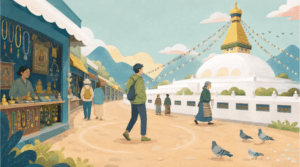
Summary
What gives life true meaning beyond achievement, comfort, and success? In this episode, Venerable Sumangala reflects on purpose, happiness, and the Buddhist path—challenging modern ideas of fulfillment and inviting us to look inward. Through teachings on non-attachment, mental training, and the Noble Eightfold Path, this conversation explores how lasting happiness comes from freedom of mind, not endless striving.
In a world driven by speed, consumption, and constant comparison, Venerable Sumangala offers a countercultural perspective: that peace is not found by adding more to our lives, but by understanding what is truly essential. She speaks about the quiet stress underlying modern living, the illusion of control through success, and how mindful awareness allows us to appreciate life without clinging to it—pointing toward a simpler, steadier form of happiness that can be cultivated here and now.
About the Speaker
👤 Venerable Sumaṅgalā Therī is the Abbess of Ariya Vihara Buddhist Society. She embarked on her spiritual journey in Buddhism at the age of 19, inspired by the serene sight of a monk and people meditating, which deeply delighted her heart. This initial inspiration led her to actively pursue, learn, and practise the Buddha’s teachings, with a particular focus on meditation.
She holds a B.A. in Psychology and in 1999, she completed her M.A. in Industrial and Organizational Psychology, both from Universiti Kebangsaan Malaysia. Furthering her academic and spiritual education, Ven. Sumaṅgalā Therī obtained an M.A. in Philosophy (Buddhism) from the International Buddhist College, Thailand in 2011.
Her formal journey into monastic life began in 2005 when she left the household life to become an Anagarika. Her ordination as a Dasasil (akin to a Sāmaṇerī) took place in November 2008 under the sacred Sri Mahābodhi at Bodhgaya, India. Her preceptor-teacher was Ven. Mahinda Mahāthera, a proponent of Mettā and one of the early disciples of the late Ven. Dr. K. Sri Dhammananda Nāyaka Mahāthera from Malaysia. Her meditation teacher was Ven. Nadimale Sumedhā Maniyo of Sri Lanka, who guided her in samatha-vipassanā meditation practices.
On 21 June 2015, she took her higher ordination under the guidance of preceptor Ven. B. Sri Saranankara Nāyaka Mahāthera – the Chief Judiciary Monk of Malaysia, and bhikkhuni preceptor-teacher Ayya Santinī Mahātherī of Indonesia.
In 2004, inspired by the late Venerable K. Sri Dhammananda Nāyaka Mahāthera, she decided to start a bhikkhunī training centre to complete the Fourfold Assembly for Theravādin practice: bhikkhu, bhikkhunī, upāsaka and upāsikā. In 2015, she pioneered the formation and registration of Ariya Vihara, Malaysia’s first Theravāda Bhikkhunī Nunnery and Dhamma Training Centre. In 2019, she received a government allocated land for the building of the project with construction to commence in the first half of 2025.
From 2014 to 2023, she inspired six short-term Theravāda Samanerīs to go forth for good, including the first 3 Cambodian Samanerīs to do so. She has assisted more than 50 bhikkhunīs in higher ordinations in Bodhgaya, India.
Currently, she serves as the Abbess and President of Ariya Vihara Buddhist Society and is an advisor of Gotami Vihara Society in Malaysia. Ven. Sumaṅgalā Therī is actively involved in conducting meditation retreats and giving Dhamma talks in various centers and camps, sharing her deep understanding and experiences in the Dhamma with others.
She is one of the recipients of the 23rd Anniversary Outstanding Women Awards (OWBA) 2024, in honour of the United Nations International Women’s Day.
Key Takeaways
Purpose Beyond Success
Modern ambition promises fulfillment, but lasting meaning comes from understanding suffering and cultivating inner freedom rather than external identity.
Non-Attachment, Real Peace
By loosening our grip on desires and outcomes, the mind becomes lighter, steadier, and less shaken by change or loss.
Train the Mind
Regular mindfulness and meditation build clarity and emotional resilience, helping us respond to life with wisdom instead of habit.
Transcript
Full Transcript
[00:00:00] Ven Sumangala: if a person live a hundred years without a purpose, so, what they do is eat,
[00:00:04] Ven Sumangala: sleep,
[00:00:05] Ven Sumangala: then play, play,
[00:00:07] Ven Sumangala: pain, pain,
[00:00:08] Ven Sumangala: die.
[00:00:14] Cheryl: Welcome to the Handful of Leaves podcast. My name is Cheryl. And today I have Venerable Sumangala as my guest. Today, we question the purpose of life. A lot of us wonder around just doing our nine to five, and then after that we spend five to nine on scrolling on IG, scrolling on TikTok.
[00:00:34] Cheryl: Then day by day, it just goes by and one day we are 60. So what truly is the purpose of life and how can we make our day to day more meaningful? My guest today, Venerable Sumangala, is a fully ordained nun of 10 vassas and she’s also the president of
[00:00:51] Cheryl: Ariya Vihara Buddhist Society, Malaysia’s first Theravada bhikkhuni nunnery and Dhamma training center.
[00:00:57] Cheryl: She’s also an advisor to
[00:00:58] Cheryl: Gotami Vihara Society in Malaysia. Welcome Venerable Sumangala.
[00:01:02] Ven Sumangala: Thank you. Namo Buddhaya.
[00:01:05] Cheryl: Namo Buddhaya so to begin off, I will start with a cheeky question, which is what is the purpose of your life?
[00:01:15] Ven Sumangala: My purpose of life is
[00:01:17] Ven Sumangala: to live every moment as it is. The main purpose is to be free from suffering and feeling free.
[00:01:27] Cheryl: Can you share a bit more what does feeling free mean?
[00:01:30] Ven Sumangala: So when we practice the Dhamma,
[00:01:32] Ven Sumangala: we will come to the stage of the mind where we get into the insight of what reality is, which is impermanent, constant change. And because of that, you can see there’s no entity that is in operation.
[00:01:48] Ven Sumangala: Then from there,
[00:01:49] Ven Sumangala: then the practice of letting go of desire and also the attachment on things in the world, even regarding with our body, we have that kind of sense of understanding that everything that we see, we experience is a fleeting nature.
[00:02:09] Ven Sumangala: So, if you understand that, then you would not want to crave and also grab or attach.
[00:02:19] Ven Sumangala: Thing comes and thing goes. We make good use of it when it is necessary or in need. But other than that,
[00:02:26] Ven Sumangala: when it comes, it comes. When it goes, it goes. If we don’t hold that attachment, then everything will flow freely.
[00:02:34] Ven Sumangala: We don’t get stressed and upset,
[00:02:37] Ven Sumangala: angry over the change of things or not getting what we want. So I think this is a very important insight to experience that freedom from all this entanglement and the grip of desire and attachment. Once the mind understand the reality, I think we will be free. And then because of that, we are happy. Not because we look for, but because we experience that happiness through that freedom from attachment.
[00:03:04] Cheryl: Wow. Sadhu. Well, does this also mean then that purpose will be changing and flowing? And if that’s the case, then why do we need purpose?
[00:03:17] Ven Sumangala: Well, when we are young, when we don’t have the understanding of the Dhamma or the truth, this is the process that we go. I mean, in the past when I was young, I mean, all of us go through, right?
[00:03:29] Ven Sumangala: And when we are young, people will ask, what’s your ambition? So I would say, oh, my ambition is to become a doctor. Then the mission start to change again because your inclination may change. So our purpose of life, we think, is to be or to become somebody.
[00:03:44] Ven Sumangala: And so if our purpose of life just to become and become and become, there’s no end. So these are the things that is ongoing. So we don’t have any really purpose, but we just live life like passing time. We don’t have a direction. But at the same time, we also know that we are not really that happy, although we have all the material things.
[00:04:05] Ven Sumangala: And we are also worried,
[00:04:08] Ven Sumangala: have fear,
[00:04:09] Ven Sumangala: and we are confused,
[00:04:10] Ven Sumangala: we don’t know our destination. So if we do not have any purpose in life, this is how we are going to live our life. Like I used to share with people,
[00:04:20] Ven Sumangala: even if you live a hundred years right, and then if you look at it, people will say,
[00:04:26] Ven Sumangala: wow such a long life.
[00:04:27] Ven Sumangala: It must be a good life. But one third of our life is what? Sleeping. Can you imagine you sleep for nearly 33 years in your life, doing nothing. Then another one third of your life is what? You’re taking care of this body. Then another third, then they say, oh, Venerable, normally, you know, it’s work. So, but I say if you live 100 years old, the likelihood is 12, 13 years old, you play, play, right?
[00:04:56] Ven Sumangala: Then 80 to 100 years old, what happen? Here pain, there pain. So, if a person live a hundred years without a purpose, so, what they do is eat, sleep, then play, play, pain, pain, die.
[00:05:11] Ven Sumangala: I ask them meaningful or not. If we are not aware, this is the life that we are going through. And this is what we see around us. And we think that majority doing that, so it must be true. But actually, sometimes majority may not be correct. And so we have to be very careful to see why we are facing stress, unhappiness,
[00:05:35] Ven Sumangala: the feeling of bored, upset, angry, not satisfied, fear, and then worry,
[00:05:42] Ven Sumangala: so much worry about our career, about family, about future.
[00:05:47] Ven Sumangala: Why is this happening? It’s because we do not know. We do not have purpose in our life. So it’s important to ground ourselves. to have a purpose. What is purpose? Very simple. Everybody say, if I have a car, I’ll be happy. If I have a house, I’ll be happy. If I have a career, I’ll be happy. So what do you want?
[00:06:08] Ven Sumangala: Not the car, not the house, not the partner. Happiness. So how to find the happiness. So happiness doesn’t come from just spending time doing, all these other things without that kind of mindfulness and awareness of how they can get out from that, unhappiness or unsatisfactoriness and fear and confusion.
[00:06:33] Ven Sumangala: Because we want happiness, we want freedom. But how to get there? So it’s important that we set the goal, how this purpose to be is because we want to find true happiness and freedom. So there is a path that leads to that. And we are so fortunate. 2,600 over years ago until today,
[00:06:53] Ven Sumangala: we still have this path to true happiness and freedom. That is the Noble Eightfold Path that the Buddha taught. And the Buddha also went forth to search for this path. And of course, he found the path and we are so fortunate we are the followers or the disciples of the Buddha.
[00:07:11] Ven Sumangala: We have like kind of a more in advance package for us to find true happiness and freedom. It’s only whether we take it or not,
[00:07:20] Ven Sumangala: or we just make a wish and do nothing. We must put into action. Then we can actually realize
[00:07:27] Ven Sumangala: the true happiness that we are looking for, the freedom that we are looking for, and live meaningfully.
[00:07:33] Cheryl: Can you share more about
[00:07:36] Cheryl: true happiness and freedom,
[00:07:37] Cheryl: and the happiness from material success?
[00:07:42] Ven Sumangala: As we look for something that is material, whether is money or is in the form of thing or is in form of relationship,
[00:07:52] Ven Sumangala: we get pleasure actually from the material association. And so we thought this is like the true happiness, but actually, this is sensual pleasure,
[00:08:04] Ven Sumangala: the senses are activated and derive the pleasure in it. But this happiness, we know that it is very fleeting and when the visual object is not there, then we feel unhappy.
[00:08:17] Ven Sumangala: Whereas the happiness that come from true happiness is a happiness that come from within.
[00:08:22] Ven Sumangala: It’s a cultivation of mind. We can see between a mind that is distracted and a mind that is calm and peaceful. What is the happiness that come from material things? Because when we don’t have it, that’s why we feel very restless. Especially when they say going for meditation, right? Then they sit still there, don’t move, close your eyes, don’t see, don’t hear. Don’t move. Yeah, that’s a time where a lot of people say, well, it’s torturing, they say. But actually no, that is the path to the happiness. Because right when the mind starts to be trained to know how to look within to the mind itself in a way that if the mind is scattered, distracted, restless, what would be the way, the method to help it calm down without looking at things or without hearing it.
[00:09:17] Ven Sumangala: So we silence everything around us, and then just go deep into the mind, and then there’s always method that the Buddha already shown us. For example, even like mindfulness of your in breath, out breath,
[00:09:29] Ven Sumangala: then metta bhavana,
[00:09:31] Ven Sumangala: means cultivation of mindfulness on your loving kindness,
[00:09:35] Ven Sumangala: then on your compassion to see joy and equanimity.
[00:09:40] Ven Sumangala: And then also there are methods that help us to cultivate, like for example,
[00:09:44] Ven Sumangala: the loathsomeness of attaching to the body, which we are attached so much and we think so beautiful,
[00:09:50] Ven Sumangala: but every day, you know,
[00:09:51] Ven Sumangala: it has turned out so much stinky things, yeah?
[00:09:54] Ven Sumangala: we still say, oh, it’s nice, it’s nice, when the moment it comes up from a body, we say yucky. But how come when it’s in the body, this is so beautiful. So it’s kind of to come to reality, we need to have that bravery to really address. It is true, you know, is reality. We still live like normal, but we understood that so that we don’t get the kind of a desire or attachment over something that actually is not what it is. So, if we cultivate the mind, then we establish a true experience of love, kindness. And it doesn’t become something that is so self centered, we feel the spaciousness of things.
[00:10:39] Ven Sumangala: And also the interconnectedness of all things. And then we see the beauty of how we actually change without holding to it. So we can embrace it as you move along. We are happy and at peace. So that happiness of within one is not so much of the kind of happiness that people think, you need to have a stimulant from external source.
[00:11:03] Ven Sumangala: But this kind of happiness, it actually spring up. The Buddha expressed it like in a lake, there’s a spring water that comes up. So it gives us that cool feeling, comfortable, calm, at peace, clear, light, and so embracing, and they can kind of be even more clear in knowing and understanding things around.
[00:11:28] Ven Sumangala: And at the same time, keeping the mind very, very stable and very peaceful. So, one is from outside, the other one is from inside. So, I think in our daily life as a layperson, we need both, right? Only thing we, we have to understand that the external one, in order to experience that, yes, we earn our money, we can spend on ourselves and for our family, relatives and friends.
[00:11:55] Ven Sumangala: Well, we spend it rightfully. And then we can gain happiness to the money that we earn. And so the pleasure that we experience. But at the same time, we also know the danger of sensual pleasure. So, if they don’t go to the extreme. I think for a lay person, that’s how they live their life.
[00:12:14] Ven Sumangala: But at the same time, it’s important to couple with what we call the spiritual cultivation of happiness that comes from within. So, when you’re able to develop this, then you do not seek the external happiness anymore, because all the time you can maintain that, uh, that peace, that calmness in your mind.
[00:12:35] Ven Sumangala: So that is even better, isn’t it? Because if you keep seeking, you know, there’s no end to it. And then when you lose it, then you already feel imbalanced.
[00:12:45] Cheryl: I think what really stood out to me is that the Buddha’s teachings is almost contrarian where the whole society is about maintaining and upkeeping beauty. The Buddha tells us, hey, the body is not so beautiful. And when, you know, so many companies, consumerism is geared towards getting more and more and more, the Buddha says, Hmm, sense pleasure is not true happiness.
[00:13:11] Cheryl: I’m just trying to reconcile the idea of finding true happiness with the reality of how much suffering it is. So for example, getting material or sense pleasures is so easy. Just one click of the button, then we get to see something that we like, or just one, one click of the button again, we get to order a food that we like.
[00:13:32] Cheryl: But then you ask us to sit down, meditate, fall asleep, restless, then anxious thoughts come. So what advice would you have for people who are struggling to find that internal happiness and easily get distracted with the sensual pleasures of the world?
[00:13:51] Ven Sumangala: The world that we are in, it is such. And not only that, you know, we are pushed to the kind of speed that I think a human mind, if they are not mindful, they go off tangent, because the speed that they are pushing the human today, yeah, is very, very fast, right?
[00:14:11] Ven Sumangala: You feel like you are being pushed around. Even though you don’t want to, whether the emails or WhatsApp, whatever, that keep coming, right? Now is the era of AI. It’s even more. You don’t even understand yourself so much, but the AI will understand you better. They know what you crave for. They know what you’re attached and they keep coming and feeding you.
[00:14:34] Ven Sumangala: So, if you don’t sit back and reflect, then, you know, our life is just like spinning and spinning and spinning, and then, when you spin around without your own control, then what will happen? You get confused. You just feel like life is so stressful. And this is the danger of it.* *So, as I think a wise person, we should actually come out from that cycle, and then look back into it. Actually, what the Buddha teach is not about suffering. The Buddha taught us, the end of suffering, you have a choice.
[00:15:06] Ven Sumangala: So we must have this wisdom to see that, that what is the reality. So if we go against reality, that’s why we go spinning. But what the Buddha taught us, a lot of people misunderstood, because the Buddha say there is suffering. So people say, Buddhism always tell us suffering, nothing but suffering.
[00:15:24] Ven Sumangala: We are, you know, still enjoying our life. But we also get all the stress. All the fast paced kind of life that we cannot sometimes breathe. Because everywhere we see, everybody is the same. What choice do we have?
[00:15:38] Ven Sumangala: Last time I remember, my boss, when I put in the letter for resignation cum retirement. Right at the age of 39. Then my boss was thinking,
[00:15:53] Ven Sumangala: you have things to enjoy. You are at the peak of your career. Why are you going to let go all these things. Don’t you think they are abnormal?
[00:16:02] Ven Sumangala: So then I told him, I said, it’s true, it’s abnormal, but there are different kind of abnormality in the normal curve. So there are majority that fall in the normal curve, and those, there are normal curve is actually because they are majority, but their lifestyle, everything is against reality. And they can get sick.
[00:16:23] Ven Sumangala: They can get stressed, get depressed. And when they cannot handle it, then they will fall into the abnormal, abnormal, which is very serious depression and out of the normal group, which is also abnormal. Yeah, but it’s only the abnormality still can be contained with the stress.
[00:16:41] Ven Sumangala: But I said there’s another kind of abnormality which is abnormal normal.
[00:16:47] Ven Sumangala: They are abnormal because they are small group, but their lifestyle their everything that they do according to the order, according to the reality
[00:16:54] Ven Sumangala: But because they are small group and very few people wants to do that, although they know it’s good, they always think, not for me, only maybe the Buddha or only those monastic people can do, but not us.
[00:17:07] Ven Sumangala: But the result is they are normal, because they are living according to the order. Naturally, it will lead you to peace, happiness, freedom, which everyone is wishing for.
[00:17:21] Ven Sumangala: But when come to action, they do separately. They do differently against what they wish. So how to get back? So the Buddha say, we have to know what is essential is essential. What is unessential is unessential. And then only we can get to the essential.
[00:17:38] Ven Sumangala: It cannot be. You want to be happy, then you do something else. I want to find peace, but then you keep having craving, you want this, you want that, right?
[00:17:47] Ven Sumangala: So like, for example, you wish for a big house. But then I said, then, no, you have to toil and toil to pay for your house. But then after that, so big, your house, and nobody clean. Then you have to get a maid. Then toil and toil to pay for the maid. Then I say, then you don’t have time, you are always in the office.
[00:18:06] Ven Sumangala: Then, who is enjoying the house? Your maid, not you.
[00:18:10] Cheryl: Which is so true, yeah.
[00:18:12] Ven Sumangala: So you see, the order is such, so you have to follow the order. Then from the order, you will still find enjoyment. Because you know that everything is interconnected, and it doesn’t belong to anyone, it’s appreciation of all things without being possessive. So when we are living, why not be really rejoice, right? In this journey, we can really see so many we can appreciate without possessing, right? So then we feel light, isn’t it? So why not, you know, just simple. Our life actually four requisites only.
[00:18:46] Ven Sumangala: You can live already. The rest is a want.
[00:18:48] Ven Sumangala: I worked there for five years.
[00:18:50] Ven Sumangala: Only then they already promote me to branch manager. I didn’t ask for it. What would I be within three years or five years? I just say to be happy and to make others happy.
Special thanks to our sponsors:
Buddhist Youth Network, Lim Soon Kiat, Alvin Chan, Tan Key Seng, Soh Hwee Hoon, Geraldine Tay, Venerable You Guang, Wilson Ng, Diga, Joyce, Tan Jia Yee, Joanne, Suñña, Shuo Mei, Arif, Bernice, Wee Teck, Andrew Yam, Kan Rong Hui, Wei Li Quek, Shirley Shen, Ezra, Joanne Chan, Hsien Li Siaw, Gillian Ang, Wang Shiow Mei, Ong Chye Chye, Melvin, Yoke Kuen, Nai Kai Lee, Amelia Toh, Hannah Law, Shin Hui Chong, Dennis Lee, Kayliam, Darren
🙏 Sponsor us: https://vrqbl96dqbz.c.updraftclone.com/support/
Editors and Transcribers of this episode:
Hong Jiayi, Tan Si Jing, Bernice Bay, Cheryl Cheah
Visual and Sound Effects
Anton Thorne, Tan Pei Shan, Ang You Shan