TL:DR; Venerable Thubten Chodron talks about how we can better approach the fears and anxieties of illness, particularly on how how our mind can shape our experience dealing with sickness in any form for better or for worse.
We all get sick. The only way to avoid sickness is to die first. But otherwise, once we’re born into cyclic existence with this body that’s under the influence of mental afflictions and karma, then sickness is guaranteed. But that’s the nature of our body—it gets old and it gets sick.
So how do we deal with sickness when it comes? We can just feel sorry for ourselves. We can blame somebody else. We can be angry. We can make ourselves and everybody around us quite miserable. Does that cure the illness? No, of course not.
Eliminating ignorance and attachment (craving) will eliminate rebirth in saṃsāra, which is the root cause of sickness.
Obstacles to eliminating the root cause of sickness
One way to stop sickness is to stop its root cause as, birth in cyclic existence. If we don’t want to get sick, then we should not be born in saṃsāra. How do we get rid of birth in saṃsāra? By eliminating the principal cause, which is ignorance and attachment.
We all say, “Yes, yes, I must get rid of my ignorance. But, later. “I’m having a good time right now. I’m young and my whole life is in front of me. There’s so much I can do. There are so many people I want to be with. So many people I care about. I want to have a career. I want to travel. I want to have all the pleasures. I want to do this and that. I’ll worry about rebirth in cyclic existence later on.”
Well, that’s what we have been doing for eons. We’ve been procrastinating for eons. Where has it gotten us? One rebirth after another. We just keep taking one rebirth after another because we keep procrastinating.
Why do we procrastinate? Because of attachment.
So here we are again, following the root cause of our suffering: ignorance and attachment. Why don’t we eliminate ignorance and attachment? Because we’re ignorant and attached. We have to see the situation clearly. We have to develop great courage to see the situation we’re in, and then put effort into realising the ultimate nature of reality, the emptiness of the inherent existence of all phenomena. In that way, we eliminate the ignorance which causes birth, aging, sickness and death.
Now, until we get to that point when we can realise emptiness, how else can we deal with sickness? There are a variety of quite interesting ways.
Press the “pause” button on our horror stories.
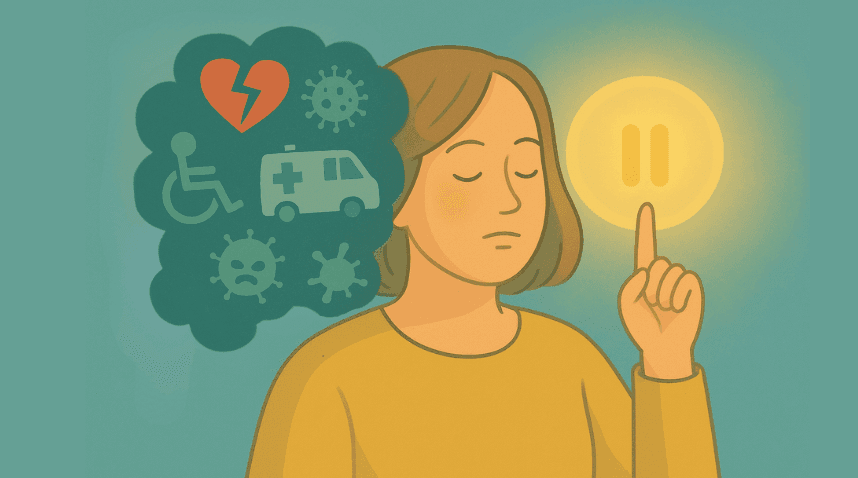
One way is to examine the mind and observe our reaction to sickness. I don’t know about you, but when I’m sick, my mind gets very afraid, and I start writing horror stories.
For example, I get a funny feeling here in my chest and I conclude that I’m going to have a heart attack. “Is somebody going to pick me up? Will they take me to the hospital? What will happen at the hospital?” It was just a small feeling, but my mind blew it up into, “I’m going to have a heart attack!”
Or we have an upset stomach and we think, “Oh, I have stomach cancer.” When our knees hurt in meditation position, “Oh, I’d better move because otherwise I’m going to be crippled my entire life.” Does your mind write these kinds of horror stories?
What we have initially is the sensation of some discomfort in the body—a physical sensation. And depending on how we relate to that physical sensation, we can create a whole lot of mental suffering. When we react to that physical sensation with fear and make up horror stories, we create tons of mental suffering, don’t we?
If we’re able to press the “pause” button on our horror stories and just be aware of the physical sensation, we don’t need to create so much mental suffering. It becomes just a sensation to experience. It doesn’t have to be something that we’re afraid of, something that we tense up about. It’s just a sensation, and we let that sensation be.
It’s quite interesting: In our meditation, we experience different physical sensations. If we label a sensation “pain in the knee,” then our knees really start to hurt. But if we label it “sensation” and we don’t have the concept of the knee so much, then it’s just a sensation. Where’s the sensation? Where’s the body?
You can experiment with different ways of playing with the physical experience of pain in your meditation, instead of falling back into the habit of getting tense, worried, and being afraid of it.
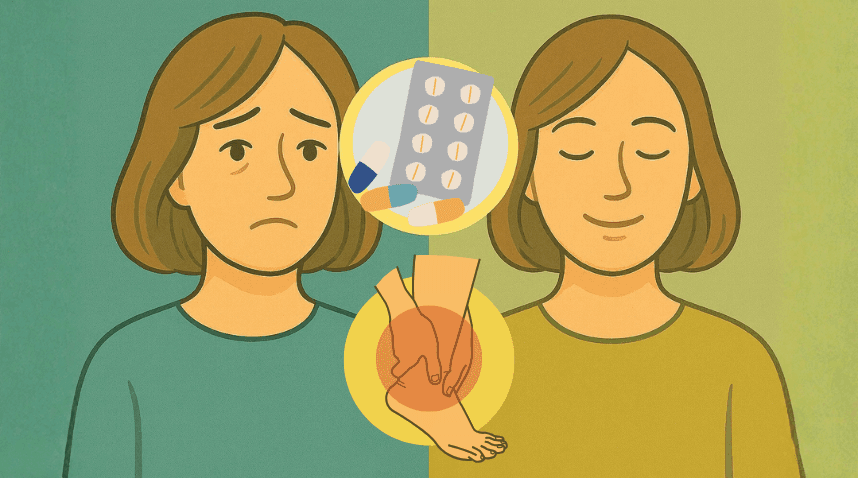
Another alternative way to respond when we’re sick, is to say, “How great that I’m sick!”
It’s the opposite of how we usually think, isn’t it? The Dharma antidotes for most of our afflictions are the exact opposite—exactly what we don’t want to do. It’s the case here, which means when we’re sick, to say, “Fantastic! It’s so great that I’m sick.”
You’re going to say, “Are you crazy? What do you mean by it’s great that to be sick?”
Our illness is caused by negative karma that we created in the past. Now that the negative karma is ripening in the form of our sickness, it’s not obscuring our mind anymore. That negative karma may have had the force to cause us to be reborn in a horrible rebirth (such as a hell being, hungry ghost or animal) for quite a long time, but instead it’s ripening now as some kind of comparatively small pain. If we look at it that way, the illness we have right now is actually quite manageable. It’s not something to freak out about. It’s not that bad.
So sometimes, saying “Oh good!” is a good antidote. In that regard, I’ll tell you a story about one nun who is a friend of mine.
One time when she was on retreat, she had a big boil on her cheek, which was very painful. During the break time between her meditation sessions, she was taking a walk and encountered our teacher, Lama Zopa Rinpoche.
Rinpoche said, “How are you?”
She said [in a moaning tone], “Oh! I have this boil…”
And Rinpoche said, “Great! Fantastic! You’re so fortunate!”
This was, of course, the last thing she wanted to hear. She wanted some pity and comfort instead. But Rinpoche said, “This is fantastic! All this negative karma that could have ripened in a horrible rebirth that lasted eons, you’re now experiencing it just by having a boil. How fortunate you are!”
So whenever we have some kind of physical pain or illness, if we look at it in this way and able to see it from this other perspective, then we realise that it’s actually not so bad. We can bear it when we think of how it could have ripened in another way that would have brought much more suffering. We can feel fortunate that this karma is ripening now and won’t obscure our mind anymore. This is another tool to use when you are sick.
What would His Holiness the Dalai Lama say?
There is another story that I love. This happened several years ago to a friend of mine. She was young, maybe in her early thirties. She had not been feeling well for a while and had gone to the doctor. The doctor gave her a frightening prognosis and told her, “This does not look good. You’re going to be sick for a long time. You might die.”
My friend’s instantaneous reaction was of course, to get upset and feel scared and sorry for herself. Then at one point, when she was lying in bed and feeling awful, she stopped and asked herself, “If the Dalai Lama were in my position, how would he feel? How would he handle this situation?” She thought about it, and the conclusion she came to was that His Holiness would say, “Just be kind.”
So she adopted that as her motto: “Just be kind.” And she thought, “OK, I’m going to be in the hospital for a while. I’m going to meet all sorts of people—the nurses, technicians, therapists, doctors, janitors, other patients, my family, and others. I’m going to come into contact with a lot of people, and I’m just going to be kind.” She made up her mind that what she was going to do was to be kind to whomever she happened to encounter.
She said once her mind thought like that, she became peaceful. That’s because she accepted that she was going to be sick and knew that she had a plan of how to manage the illness:just be kind. She realized that even when she was sick, she could still make her life meaningful and beneficial for others. She could still give something to others that would improve the quality of their life.
As it turned out, her doctor did more tests and told her that he had given her misdiagnosed her illness and that she didn’t have such a bad disease. Of course, she was relieved to hear that, but she said that going through that situation was a very good experience. It enhanced her refuge in the Three Jewels and gave her confidence that the thought training techniques for transforming adversity into the path to awakening worked.
What is a worthwhile life? When I was living in Singapore in 1987 and 1988, there was a young man in his late twenties who was dying from cancer. He asked me to help, and I got to know him and his sister, who was taking care of him. One day I visited him and he said, “I’m just a useless person. I can’t even leave my flat.” We were near the window, and I said, “Look out that window. All those people running around—do you think their lives are worthwhile? They might be busy doing a lot of things but does that mean their lives are worthwhile?”
I went on to explain to him that living a worthwhile life does not mean being the busiest of the busy. Living a worthwhile life depends on what we do with our minds. Even if our body is incapacitated, if we use our heart and our mind to practice the Dharma, our life becomes very beneficial. We don’t need to be healthy to practice the Dharma.
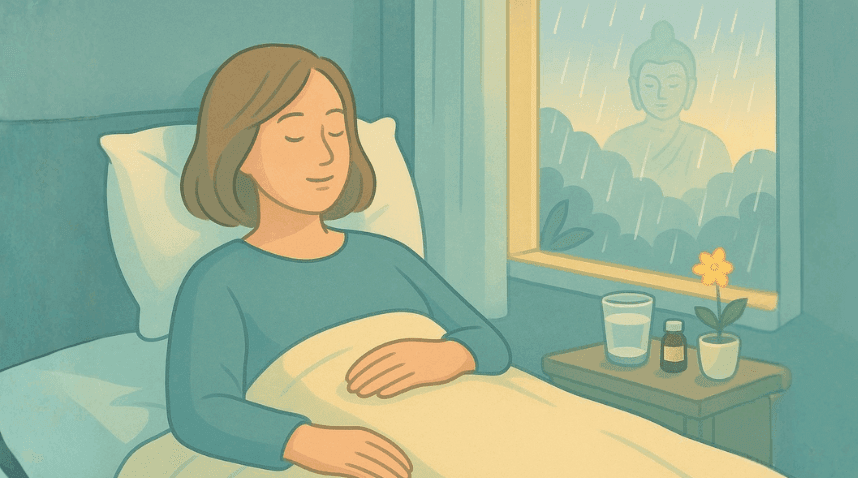
It might be easier to practice if we are healthy, but still, if you’re sick, you use whatever time and energy you have to practice, to generate wisdom and compassion. Even if you can’t sit up straight, or you’re lying on the bed, or you’re sleeping a lot, you can still think kind thoughts. You can still contemplate the nature of reality. You can still think about karma. You can still take refuge in the Buddha, Dharma and Sangha. There’s a lot that you can do even when you are sick. And that makes your life very meaningful.
Don’t think your life is meaningful just because you are running around making widgets or going from one social event to another. Don’t think that being able to impress other people with your money, possessions, or social status is a qualification for a meaningful life. Sometimes, we may have a lot of things to show for our efforts on the outside, but in the process of doing these things, we create a lot of negative karma by lying, cheating, and so forth. That negative karma is not a useful product of our life.
On the other hand, we could be sick and lying in bed, but if we use our mind to create positive karma, that will become the cause for good rebirths and bring us closer to liberation and enlightenment.
Don’t underestimate the power of the mind. The mind is really very powerful. Even if you’re sick, just the power of the compassionate and kind thoughts that you generate can influence the people around you.
Venerable Thubten Chodron is an American Buddhist Nun who focuses on the practical application of Buddhist wisdom to our everyday lives. An author of many books for meditation and philosophy, she is currently co-authoring with the Dalai Lama a series of books on the Buddhist path, called The Library of Wisdom and Compassion.