

TLDR: Dhamma and business how I ran my chiropractor clinic with Buddhist principles at heart. Struggles with people-pleasing turned into lessons on right speech and running a business revealed where attachment and aversion hide.
Moving Home
Early last year, I made the decision to move home to Malaysia after spending 9 years abroad. It was a difficult decision as I loved the life I’d built in Singapore and the people I surrounded myself with. However, my mother’s health had been declining over the years, and my father was her only carer.
I sat on the decision for a long time before I had the opportunity to share my dilemma with Ajahn Dhammasiha. With compassion, he reminded me of our debt of gratitude to our parents, and how the Buddha spoke of the importance of supporting our parents.
He said that it would be hard to imagine me regretting the decision to move back to spend more time with my ageing parents. At that moment, as much as I was attached to the life that could have been in Singapore, I had my answer.
I think I knew all along; I just lacked the courage to act on it.
Starting a Business – My ‘WHY’

I’m a chiropractor and I’ve been in practice for 6 years. The thing that brings me most joy about work is getting to take care of people. When I first started out in university, I had a note pinned to my corkboard that read:
“To Help People; To Alleviate Suffering.”
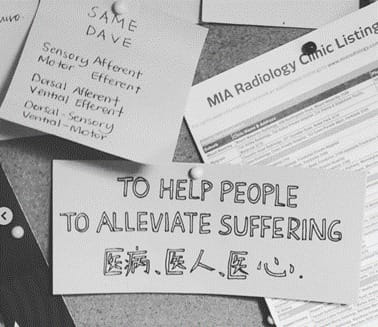
Over the years, I’ve learned the hard way that while I can’t help every single person or alleviate suffering completely, the most important thing I can do is show care and offer my best. There is this quote by Ajahn Brahm that I take to heart and remember to this day:
“You can’t always cure, but you can always care.
After several years of being an associate and working for people, I felt this move back home was a perfect juncture to start my own chiropractic practice. This was a decision many years in the making, having prepared myself over the years.
Ease

With the aspiration to do good in mind, I started Ease Family Chiropractic. I wanted the name to remind me of Dhamma practice and to promote a sense of well-being. ‘Ease’ was a word that came up quite often in the English translation of Pali chants, and I particularly liked how that word made me feel when reciting ‘The Buddha’s Words on Loving-Kindness’:
“Wishing: In gladness and in safety, may all beings be at ease.”
Beginning Well
There is this Chinese saying that goes: 万事起头难 (The first step is always the most difficult). Starting this business felt like leaping into the unknown, and with that came a lot of mental turmoil. During this period, my formal meditation practice went out the window. In those moments of confusion and when I felt unsure, I found myself looking up the Mangala Sutta as my guide.
In the Mangala Sutta, one of the blessings that is conducive to happiness and prosperity is to set oneself in the right direction. Before starting the business, I reflected deeply on a few questions: Who do I want to serve? What do I want the business to look like in 5 years, 10 years? What are my non-negotiables?
I made a gentle determination that my business would be rooted in the values of compassion, excellence, and honesty. I knew deep in my heart that setting the groundwork and building the business on a good foundation was very important. I was mindful to express it through the space, the way we dress, the materials that we give out, and the words we use.
‘To be of good speech’ is a reminder that I hold very close to heart when creating the patient experience blueprint. I find this so hard to do well. We took a lot of care with the language we used, from the choice of words on our intake forms to the words that my staff used when communicating with patients.
My goal was to invoke a sense of safety, and not fear. When communicating with patients, I ask myself: is what we are saying true and beneficial? Am I saying this for the benefit of the patient, or for the benefit of my business?
Having worked in different clinics for different employers, I have learned how successful clinics are run. However, I also witnessed certain procedures and policies that weren’t necessarily ethical or done with the patient’s best interest at heart. I made a mental note to not adopt them for the sake of profit for the business.
People-Pleasing Tendencies
This process of setting up the business meant having to deal with many people while being on a tight timeline and budget. It meant having to confront people and resolve conflicts. I’ve always been adamant that if I were kind to people, they would be kind in return.
This experience painfully exposed how my people-pleasing tendencies were a bigger problem than I thought. I realised how attached I was to the identity of a ‘nice’ person, and how averse I was to conflict. I didn’t realise it then, but these were all delusion, craving, and aversion at play. Being kind and being nice are not the same.
I had the most challenging time with the interior designers: work was not delivered on time, and output was not as promised. However, I found it incredibly challenging to confront them despite all the time and money that was at stake. I had visceral reactions whenever I had to have difficult conversations with them and felt like a bad person.
I was worried that if I raised my dissatisfaction and did not accept their substandard output, I was going against my values of being ‘kind’. I remember thinking to myself, “maybe I’m not being empathetic enough”, “maybe it’s challenging for them too”, “what if they think bad things about me”. In retrospect, I wanted to control how others viewed me, which is an act of delusion.
Understanding Right Speech
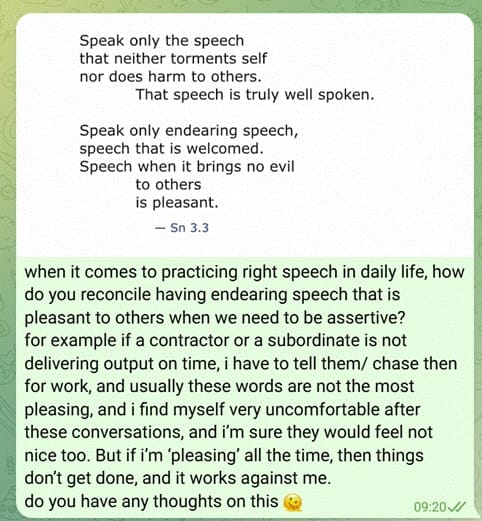
In my moments of desperation, I reached out to friends for advice on how to practice right speech whilst not allowing myself to be taken advantage of. I was afraid that what I said was unkind and would upset others — I mistook pleasing others with words that are pleasing.
I have learned that sometimes we do have to say things that are true and beneficial, but not pleasant to hear so that people do not continue making the same mistakes. Ajahn Sona shared that right speech is closely intertwined with right view and right intention. It is a skill we have to practice again and again. Whenever we slip, it’s always because the heart wasn’t in the right place.
Even when you’re saying things that are unpleasant, you have to show respect for the other person. Don’t show disdain; don’t show contempt. – Thanissaro Bhikkhu
Content Creation
With social media being one of the most important tools of marketing, I had to use it despite all the anxiety that came with it. For a period of time, I was averse to social media and was off it for the months before the business started. I looked at it as something I had to do to get the business to take off.
In the beginning, I was swayed by craving and ignorance, scrolling through the internet to find the fastest way to go viral and get the most engagement. I soon realised my motivations and saw that I didn’t at all enjoy the viral content I was trying to emulate. So why would I add to the noise? Am I cluttering up other people’s minds? I sat down and listed down the content creators whom I liked and whose content has genuinely inspired and uplifted me, and thought about the value I could offer.
I recognised the power we all wield with social media and how we can use it both wisely and unscrupulously. The least I could do was to make sure that whatever I put out on the internet was well thought out and true to the best of my knowledge.
Mangala Sutta – The Blessings of Being Highly Trained
Beyond business development and marketing, I understood that the basis of the practice has to be my competence and knowledge as a chiropractor. That meant continued professional development, perfecting my craft and getting advice from good mentors.
Ajahn Thanissaro once said in a talk:
“If you want to see/attain things you’ve never, you need to do things you’ve never done before. You can’t do just enough to get by. Hold yourself to a high standard.”
I drew parallels between work and advice on Dhamma practice, in both of which success comes from discipline and well-reasoned action.
In the same vein, throughout the process of renovations, I’ve relied on the help of property agents, contractors, construction workers, signboard makers and many others. I have a newfound appreciation for what they do, and the significance of every job. It helped me see that no matter what work it is that we do, if we do honest work wholeheartedly and hone our craft, that alone is enough to make a difference.
Wise Steps
- Anchor your work with a clear ‘why’: We may not always cure but we can always care, shifting the focus from outcomes to compassion
- Set the right direction before you begin: Reflect on who you want to serve and what values you refuse to compromise on.
- Practice right speech in every interaction: Ask if your words are true and beneficial.
- Distinguish between being kind and being nice: Learn to confront problems firmly yet respectfully.