How reliable is Norbu the Chatbot?
TL:DR: Benny interviews Kooi Foong, creator of the Norbu Buddhist chatbot, discussing its origins, creation process, strengths, and weaknesses as a tool for enriching one’s spiritual learning.
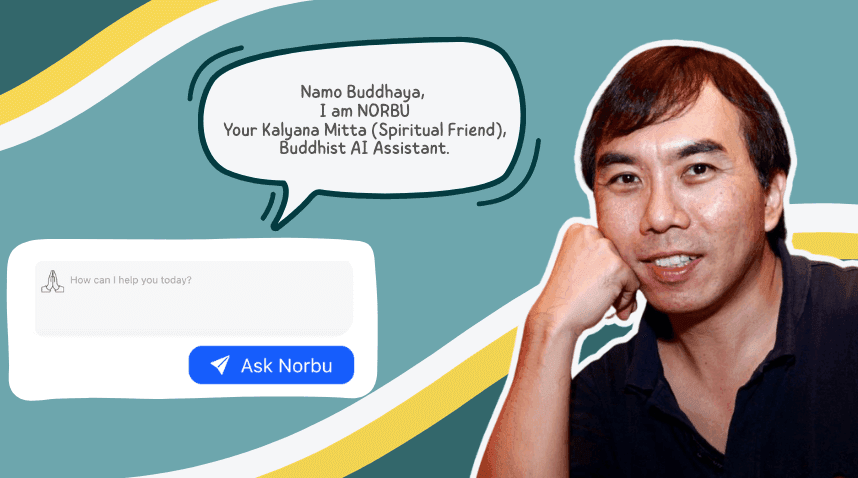
Benny: You created Norbu, a chatbot that can answer questions related to Buddhism. What was your inspiration behind this initiative?
Kooi Fong: I attended the Global Buddhist Summit organised by the International Buddhist Confederation (IBC) held in New Delhi in April 2023. On the second day, HH the Dalai Lama gave a keynote address. His speech was about 90 minutes and he talked about many things. But two key points stuck with me, and that was “We must be grateful to the Nalanda Tradition, for without it, there would be no Tibetan Buddhism today”, and “We need to bring Nalanda Tradition outside of India”.
Now I am a Theravadian Buddhist, and does not really know much about Vajyrayana or Tibetan Buddhism. Much less Nalanda Tradition. I was really pique why that 2 points kept on playing in my mind, even after coming back to Kuala Lumpur. When I came back, my IT friend who supports the Buddhist Channel server facility offered me to take a look at some “ChatGPT source codes” and asked me to “do something with it”.
So with his help, an AI service provider, and two other Buddhist friends in Bro. Wong Tin Song and Bro. Ng Wee Keat, NORBU was born. Incidentally, NORBU stands for “Neural Operator for Responsible Buddhist Understanding,” which by itself indicates some intelligent capability
With NORBU’s birth I also realised the meaning of the message I took away from HH’s speech, that is, the Buddha’s teachings are now “available to be asked and questioned”, and that “Dharma personalisation for self learning” is now possible. These are the hallmark of the Nalanda Tradition, which prides itself in the culture of debating and questioning validity of Buddhist tenets. Also NORBU is now available to Buddhists all over the world, which technically fulfils HH’s second point.
A chatbot is a computer program that simulates human conversation with an end user, but not all chatbots are equipped with artificial intelligence (AI). Is Norbu a form of AI?
Yes, NORBU is a Language Learning Model (LLM) based on Claude 3.5 Sonnet. It is a machine learning model specialized in comprehending and generating text, a crucial aspect of natural language processing (NLP). Trained on vast amounts of text data, NORBU understands context, semantics, and generates coherent, contextually relevant text responses based on Buddhist teachings. In short, NORBU is an AI.

A chatbot can only provide a response based on information it receive. Where are your sources of information for Norbu?
To date, more than 3,000 data sources have been used to train NORBU. For instance, the following sources have been implemented for the Theravada school:
- Entire Pali Tipitaka collection (Sutta, Vinaya, and Abhidhamma). These include materials that are already in the public domain, such as Sutta Central and Access to Insight. These materials are thoroughly debated and rigorously checked through online communities such as Dharma Wheel.
- Commentaries from the Pali Tipitaka
- Articles from renowned author-monks and peer reviewed academic works
We are also working closely with CBETA.org from Taiwan and Tibet House based in New Delhi to train NORBU on Chinese Mahayana Yogacara / the Agamas and Vajrayana source data.
A formula of three types of information elements – Right (authenticity of source), Correct (in terms of versions, interpretation, and translation), and Verified (by a team of Dharma experts) – is used to implement the source data mentioned above to train the bot. NORBU is trained exclusively with authentic Buddhist source data, in accordance with the outlined principles.

How do you ensure that Norbu will not be fed information that lacks accuracy either in terms of translation or doctrine, including fake Buddha quotes?
The administration of the source data is carried out by a full-time team of knowledgeable monastics from all traditions and lay Buddhists known as “Source Guardians of NORBU.” Criteria for selecting individuals as “Source Guardians” include expertise in the content, deep knowledge of data sources, proficiency in the working language of the source data and being meditation practitioners or proficient in Buddhist philosophy
So how do we ensure the quality of its knowledge base, or its ability to wean out “fake quotes”?
- All conversations between the bot and users are logged and securely stored in the backend system. The quality of the bot’s responses is assessed using markers that allow users to indicate whether the response was “Helpful” or “Unhelpful.” The “Helpful” marks affirm the accuracy of the information provided, while “Unhelpful” responses prompt fine tuning efforts to improve future interactions.
- If the bot encounters query to which it cannot provide an immediate answer, it seeks additional information from users. Feedback received during these instances is instrumental in refining the bot’s knowledge base and responses.
- Should the bot produces answer that are contradictory, due to the way questions are structured, the source guardian will look at them and will make efforts to “fine-tune” them within the context how the question was framed.
- If NORBU is unsure of the answer, it will respond with “I’m sorry, I don’t know the answer to that question. I am still in the process of being trained. Can you provide more information, please?”. Strict mechanism such as the above are implemented to minimize the bot from producing inaccurate responses and to reduce hallucination.
Would Norbu be able to understand the motivations of an individual when questions are asked so that the answers would be more directly applicable and prescriptive rather than purely descriptive?
To understand another’s motivations is a complex task that requires deep insight and often extended interaction. While NORBU is able to provide explanations, offer perspectives, and suggest practices that might be helpful, but the application of these teachings to someone’s specific situation is a personal journey. That said, NORBU always aim to provide answers that are not just descriptive, but also practical and applicable to daily life. Buddhism is, after all, a path of practice, not just theory. In Buddhism, we often speak of “ehipassiko” – meaning “come and see for yourself.” This encourages personal investigation and experience rather than blind acceptance of teachings or advice. NORBU is trained on this premise.
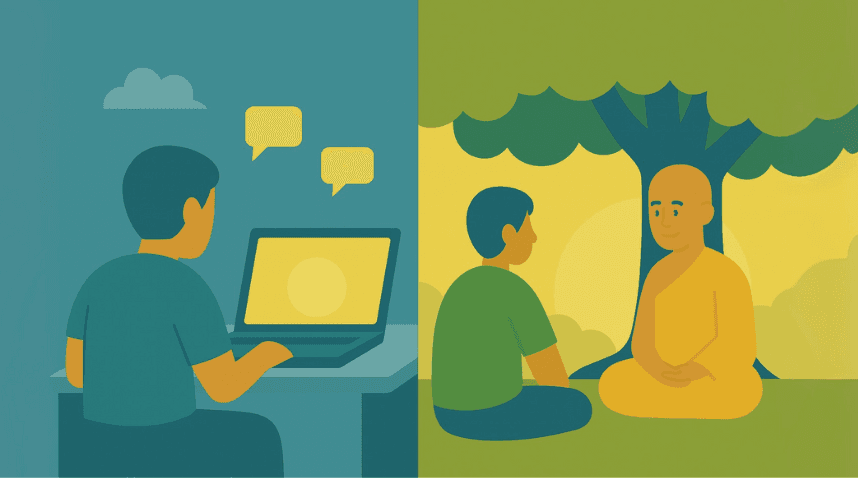
Do you think Norbu or other more advanced chatbots can replace a human teacher in guiding an individual towards awakening?
I have to emphasize that the role of a human teacher in the Buddhist path is irreplaceable and of utmost importance. The Buddha himself stressed the significance of having a kalyana mitta (spiritual friend) or a qualified teacher to guide one on the path to awakening. In the Upaddha Sutta, the Buddha tells Ananda: “Admirable friendship, admirable companionship, admirable camaraderie is actually the whole of the holy life.”
A human teacher brings several crucial elements to the spiritual journey that cannot be fully replicated by an AI, such as:
- Direct experience – a realized teacher can share insights from their own awakening experience.
- Personalized guidance – good Dharma teachers can observe a student’s practice and provide tailored advice.
- Embodiment of the teachings – the teacher/student relationship demonstrate how the Dharma manifests in daily life.
- Transmission – in many traditions, there’s a direct teacher-to-student transmission of teachings.
- Sangha – the 4-fold assembly provide a connection to a living community of practitioners.
As an AI therefore, NORBU cannot replace the depth of interaction, the nuanced understanding, and the living example that a human teacher provides.
Would there be situations where you would recommend an individual not to continue asking Norbu for answers but instead seek an accomplished Buddhist teacher for his spiritual problems?
Absolutely, there are many situations where consulting an accomplished Buddhist teacher would be more appropriate and beneficial than seeking answers from NORBU. In fact, NORBU is trained to recognize its limitations and the irreplaceable value of a living, experienced teacher. Here are some scenarios where one should definitely seek guidance from an accomplished Buddhist teacher:
- Personal crises or deep emotional issues. These often require the empathy, wisdom, and direct interaction that only a human teacher can provide.
- Advanced meditation practices. This involves especially intense experiences or potential risks, such as certain Vajrayana practices or extended retreats.
- Interpreting profound spiritual experiences. An accomplished teacher can help navigate and contextualize deep meditative states or insights.
- Receiving empowerments or initiations. These are traditionally given directly from teacher to student in many Buddhist traditions.
- Overcoming persistent obstacles in practice. A teacher can offer personalized strategies based on direct observation of the student’s practice.
- Ethical dilemmas. Complex moral questions often require nuanced, context-specific guidance.
- Questions about one’s readiness for certain practices or teachings. This requires a deep understanding of both the teachings and the individual’s spiritual maturity.
- Dealing with doubt or confusion about core Buddhist concepts. A living teacher can address these with the depth and clarity that comes from realization.
- Seeking advice on life decisions from a Buddhist perspective. This often requires a holistic understanding of the person’s life circumstances.
- When experiencing unusual or troubling meditation-related phenomena. These situations may require immediate, expert guidance.
- The Dalai Lama emphasizes this point: “In Buddhism, we have a very special attitude to the guru, or teacher. We consider that to take a teacher is to take refuge. The teacher is the root of spiritual realization and the root of the path.”
You mentioned the four brahma viharas are incorporated into Norbu. Can you explain more about this?
When we first began training NORBU, we didn’t just upload a bunch of source data to populate its knowledge base. That was only one part of the process. Since LLMs have already mastered language processing and linguistic nuances, the next thing we asked was, how can we train an AI to foster compassionate communication grounded in Buddhist values and teachings?
It’s really pointless to just develop a clever Buddhist bot. We wanted a “compassionate and mindful” one as well. First of all, we envisioned NORBU as a kalyana mitra. Therefore, we had to attune the technological capabilities of the LLM within the framework of Buddhist conversation, which is deeply rooted in tones of empathy, compassion, and non-violence. NORBU was then continuously trained and fine-tuned to recognize and generate the subtle language cues that convey kindness, patience, and understanding, ensuring that every response is in line with compassionate conversational tone.
To do this, we apply the qualities of the four brahma viharas (positive emotions) into training NORBU’s conversational framework, which are:
- Loving-kindness (Metta) – The language and conversations framed to promote unconditional goodwill and friendliness.
- Compassion (Karuna) – Emphasizing empathetic concern for others’ suffering.
- Altruistic Joy (Mudita) – Rejoicing in others’ happiness and successes.
- Equanimity (Upekkha) – Maintaining a calm, balanced, unbiased view in all situations.
Training content for NORBU included extensive descriptions and examples of these qualities, ensuring that the AI’s conversational tone is consistently caring, empathetic, and patient. This non-violent communication style starkly contrasts with the often aggressive and hostile language found on many digital platforms.
What’s next in your mind after this pioneering effort in creating a Buddhist chatbot?
NORBU is be a lifelong journey. What we have accomplished thus far is just the beginning.
As AI lurches into the realm of Artificial General Intelligence (AGI), where technology attain human-like intelligence and the ability to self-teach in the not so distant future, we need to prepare for NORBU’s next level of evolution. What would be challenging – but doable – is to enable NORBU to be the first technology project to directly incorporate principles of Yogacara philosophy into its operational framework.
The Yogacara school’s Citta-matra (Mind-Only) doctrine posits that all phenomena are manifestations of the mind. For AI, this principle can be interpreted as the need to model human cognition by interpreting and generating responses based on subjective experiences. We will explore concepts such as Alaya-vijñāna (storehouse consciousness, a repository of all past experiences and knowledge) with Deep Learning, and Āśraya-parāvṛtti (transformation of the basis, the ability to adapt and initiate a profound shift in the underlying consciousness) with Adaptability.
Through the research and development efforts of these Yogacara principles, we aim to enable NORBU achieve significant improvements in its capability to understand and respond to complex queries with depth and context. This approach ensures that NORBU will not just a passive information provider but an active participant in the user’s spiritual journey, offering support and insight grounded in both advanced technology and profound spiritual wisdom.
There is still much to do.
Please feel free to access Norbu as follows: https// norbu-ai.org
Lim Kooi Foong has engaged in spreading Buddhist teachings and helping practitioners with projects like the Buddhist
Channel (www.buddhistchannel.tv), Buddhist Travel (www. buddhistravel.com), and the Buddhist AI chatbot NORBU (https:// norbu-ai.org). He regularly engages in Dhamma talks in Buddhist societies in Malaysia and is an active contributor in helping digitalise the spiritual practice.