
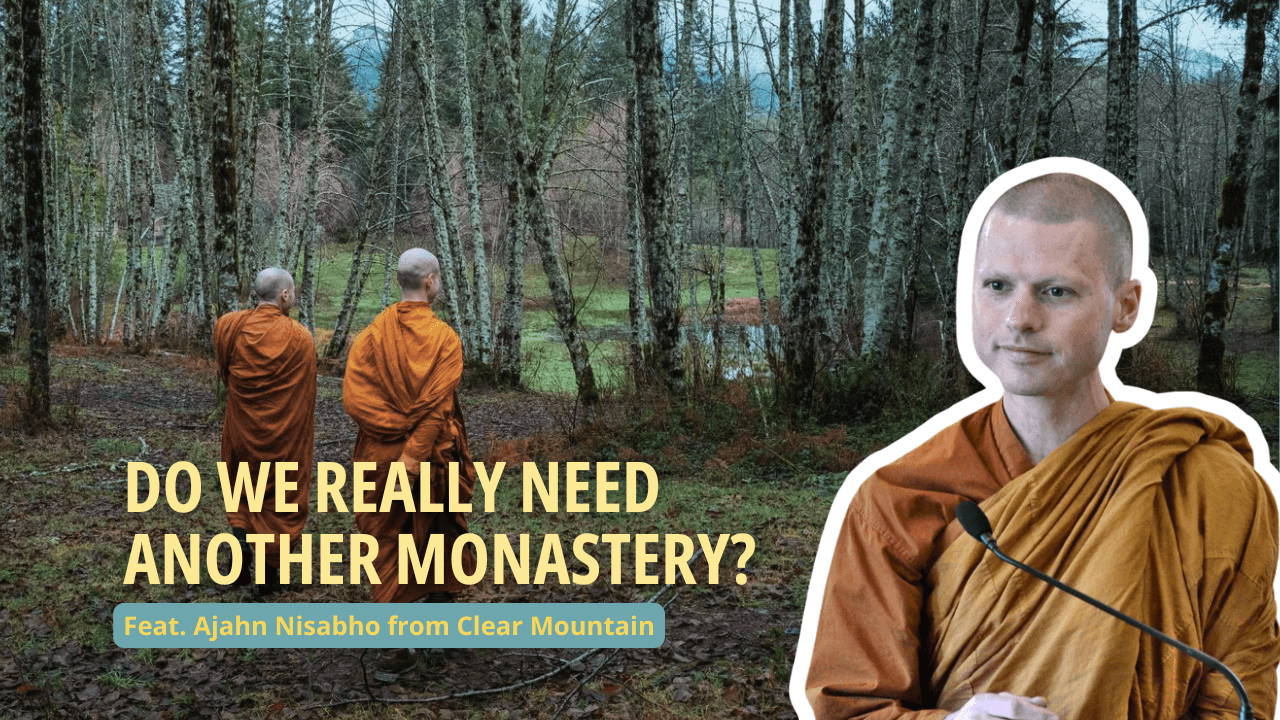
Ep 68: Do We Really Need Another Monastery? Ft. Ajahn Nisabho from Clear Mountain
Summary
In this episode, Cheryl sits down with Ajahn Nisabho to explore a powerful question many practitioners quietly wrestle with: with so many Buddhist paths available, why commit deeply to one?
Drawing from his journey in the Thai Forest Tradition, Ajahn Nisabho shares how commitment is less about limitation and more about depth and sincerity. Through his experience training as a monk and helping to build a monastery in the West, he reflects on how practice, service, and community are not competing priorities, but interconnected expressions of the same path.
This conversation offers a grounded look at how the Dhamma can remain authentic while meeting the needs of a modern, diverse world, showing that with care and clarity, depth and accessibility can coexist without losing the essence of the teachings.
About the Speaker
Ajahn Nisabho is a Buddhist monk in the Thai Forest Tradition and a founding teacher of Clear Mountain Monastery. After completing college in 2012, he left his native Washington to ordain in Thailand, seeking a life dedicated to meditation and the pursuit of liberation. He received full ordination the following year under Ajahn Anan, a senior disciple of the renowned meditation master Ajahn Chah.
Over the next several years, Ajahn Nisabho trained in forest monasteries across the world under respected teachers including Ajahn Pasanno and Ajahn Jayasaro. Through this deep training, he developed a strong conviction that the Thai Forest Tradition preserves an authentic expression of the original Buddhist path—one that remains profoundly relevant and transformative even in the context of modern life.
In 2021, he returned to the United States and began laying the foundation for Clear Mountain Monastery in Seattle, with the aim of creating a place where the timeless teachings of the Buddha can take root and flourish for contemporary practitioners.
Key Takeaways
🧘♂️ “I don’t think the Dhamma makes us choose.”
True Dhamma doesn’t force a choice between inner practice and outer service. When held wisely, both can deepen each other. A powerful reminder that practice and service, seclusion and community, can coexist when held with wisdom.
🤝 “This hunger for… spiritual friendship and community is very deep in people’s hearts.”
In a disconnected world, kalyanamitta is not optional, it is essential to the path, especially in a fragmented, modern world.
🌱 “Give where you feel inspired.”
Whether through time, energy, or intention, true generosity (dāna) begins with genuine inspiration not from pressure or obligation
Transcript
Full Transcript
[00:00:03] Cheryl: With so many Buddhist paths, why commit to just one?
[00:00:10] Ajahn Nisabho: My dad actually is the one to say this is like, good Dhamma, no one can really disagree with it.
[00:00:25] Cheryl: Welcome to the Handful of Leaves podcast. My name is Cheryl, the host of today’s podcast, and today we are very lucky to have Ajahn Nisabho from Clear Mountain joining us on this special episode. It’s good to meet you.
[00:00:36] Ajahn Nisabho: Thanks, Cheryl.
[00:00:38] Cheryl: So today I wanted to touch on the theme of balance with Ajahn Nisabho from Clear Mountain, really understanding how they hold their delicate balance between practice, community, and different Dhamma teachings in a world that’s so diverse. For those who may not know Clear Mountain, Ajahn Nisabho, would you be so kind to do a quick introduction about yourself and Clear Mountain?
[00:01:03] Ajahn Nisabho: Yeah, for context, I grew up in Spokane, Washington, which is near Seattle, where we are right now in the Pacific Northwest. My parents were Buddhist, and then when I was 15, I read the book of Siddhartha, which really inspired a lot of faith in me. Just the vision of the Buddha and the idea you could give your life to these teachings completely, and began to practice until by the end of college, meditation and the Buddhist path just felt like the most meaningful thing in my life.
[00:01:34] Ajahn Nisabho: And then I saw a video of Luang Por Chah on YouTube, and I’ve been so hungry to see someone who embodies something truly unique and precious. And in that vision of an enlightened master, I think I just felt immediately that resonance and call.
[00:01:54] Ajahn Nisabho: So I went to Thailand, where the Thai Forest Tradition’s purity really was meaningful to encounter, and a disciple of Luang Por Chah, Luang Por Anan at the monastery, Wat Marp Jan, and immediately just felt the resonance and loving kindness of that teacher and the way of life that he embodied and taught.
[00:02:16] Ajahn Nisabho: I trained there and branch monasteries and elsewhere for about 7 or 8 years, Australia, and then with Ajahn Jayasāro, then at Abhayagiri with Luang Por Passano. But always I really felt this call to come back to the US because there is a deep hunger in the West for just the depth and profundity of the Buddhist teachings, and I wanted to see if there could be a place for a monastery here.
[00:02:42] Ajahn Nisabho: So we really moved into this sort of Seattle area on faith in the way that the Buddha advised us to as monastics. So Clear Mountain’s vision is eventually a large monastery where we’d have room for 15 or 20 monastics to live and practice. We’d hope to have a large hall, though, where people from the city could come and find quiet and peace every morning, every day.
[00:03:11] Ajahn Nisabho: Seattle is statistically the most secular, non-religious city in the US, and yet there’s been so much hunger for these teachings. It is very surprising just the amount of interest. And so already, you know, our community on our Saturday morning gatherings, there have been 90 or 100 people many weeks.
[00:03:29] Cheryl: That’s incredibly beautiful on so many levels, right? One is that Seattle is a modern city, but yet the ancient practice of the Buddha, the forests, you know, seclusion, alms-round is able to merge in this place and all meeting with the Dhamma.
[00:03:47] Cheryl: Having the aim for liberation, of renouncing and letting go of everything, including the sense of self, how do you personally understand that with taking on the responsibility of building, constructing a huge monastery?
[00:04:02] Ajahn Nisabho: Thank you for that question. As to the balance of the practice of liberation versus building a monastery and seclusion versus the public-facing side of this endeavor, this is a very vibrant question for me right now because we’re just navigating it. And I can’t say I’ve done it perfectly or will.
[00:04:22] Ajahn Nisabho: I don’t think the Dhamma makes us choose. If we’re called to contribute meaningfully to the flourishing of the Dhamma, and I think most of us who have encountered this path know what it means to be called to either the practice or some way of embodying or living these teachings, it feels like something much deeper than just us.
[00:04:41] Ajahn Nisabho: And that’s honestly, that’s what called me to robes, and it’s what’s called me to Seattle. And you feel like you’re being swept along by much deeper currents.
[00:04:50] Ajahn Nisabho: And so, yes, there has been the qualities of building a community, and there will be more as the monastery. We found land in North Bend near Seattle, which we just put an offer in on our steward organization. So there’ll be more of that, but I really see that there’s a wholesome balance that can be struck.
[00:05:08] Ajahn Nisabho: And a huge aspect of the Buddhist path is finding joy and happiness in giving, Dhamma-dāna. And I see creating community and creating these spaces, if held with the right balance, as an aspect of Dana that brightens the heart and honestly galvanizes the practice.
[00:05:27] Ajahn Nisabho: As long as you hold the structures which the Buddha and our lineage holders gave us, in terms of we hold a three-month winter retreat every year where we really try to pull in, one month a year during the traditional summer rains retreat, which is summer here, we do another period of deep retreat.
[00:05:48] Ajahn Nisabho: You know, and we interact with the community on alms-round, but then we come back to our huts, actually have a lot of time in quiet. So we’re very aware of holding the core of our monastic lives precious, and that this is the greatest gift we can give to the community in the end.
[00:06:04] Ajahn Nisabho: And one thing we’ve really tried to do is be skillful about, people want to give. They want something meaningful to give their energies to. And as monastics, what we’ve really tried to do is be skillful about bringing in the lay community.
[00:06:18] Ajahn Nisabho: And one aspect of that is we have a dual structured nonprofit organization where we have one nonprofit, Clear Mountain, which is just the monastics, and it doesn’t handle liquid funds or money of any kind. And then we have a steward organization called Friends of Clear Mountain, which is composed of lay people but directed by the monastics or sort of spiritually advised by them.
[00:06:40] Ajahn Nisabho: And that organization takes care of donations and administration and so on. Our hope is that we can really allow the wider community to contribute to this kind of vision, which is, you know, hoping to bless them a lot, but also really keep that monastic core always front and center.
[00:06:57] Ajahn Nisabho: And if that begins to be compromised, then we’ll have to reevaluate our structures and how we’re doing things. But I don’t see the calling to create this space and what we’re doing here felt so deep. I really believe it is the thing that will be most beneficial to the Dhamma.
[00:07:13] Ajahn Nisabho: I don’t believe that has to come at the cost of one’s own practice, if it’s held with care. The heart that gives is the bright heart.
[00:07:20] Ajahn Nisabho: And out of the six objects of reverence, the Buddha laid out the Buddha, the Dhamma, the Sangha, heedfulness, the training, the sixth was hospitality. And there’s something about this whole endeavor which just feels like we’re really embodying that sacred value of hospitality, of making a place, a home in the Dhamma for people who need it desperately.
[00:07:37] Ajahn Nisabho: So it’s felt okay so far, actually.
[00:07:39] Cheryl: It’s really beautiful to see that the foundation is rooted deeply in Dhamma and the respect to the teachings, and of course the Buddha and the lineage holders. Anything that comes out of that blossoms in the right direction.
[00:07:53] Ajahn Nisabho: Yeah. Yes, yes.
[00:07:55] Cheryl: And even in the way you speak about the community, from the first day’s experience of receiving alms food from seven people to the land that people can call home, I can see that Clear Mountain is very community oriented, always with people at heart.
[00:08:11] Cheryl: Even the consideration of it being 20 to 30 minutes away from the city center so that it is open to the average tired working mom.
[00:08:24] Ajahn Nisabho: Yeah. Yes, and that is something I think is very unique, where a lot of monasteries start the other way around, right? This is a place, then the community forms around that. So what really inspired this approach?
[00:08:40] Cheryl: Is it more of a necessity that you see from the hunger of the people in Seattle or other things?
[00:08:48] Ajahn Nisabho: That’s a great question. First, the land we found is, it’s actually about 40 minutes, so I want to kind of make sure we’re being accurate about that. But still, far enough, I think 30 minutes or 20 minutes might be a bit too close, but 40 minutes is a good distance.
[00:09:04] Ajahn Nisabho: And it did start with the community, and I think that was from necessity because we didn’t have anything at the beginning. But it also is how I know there are now lineages and institutions which can purchase land and then somehow bring in monastics, etc., but that’s not how I think it was usually done.
[00:09:20] Ajahn Nisabho: The simple form the Buddha gave us of alms-round and our utter dependency on lay people for material support catalyzes a relationship which is both sacred and which builds naturally, this sort of symbiosis and community.
[00:09:35] Ajahn Nisabho: You know, the institution the Buddhist set out where monastics, you know, we can’t drive, we can’t use money, touch money, we can’t store food, we can’t ask for things. In some ways, you’d think this would be a completely impractical institution, and yet it’s worked for 2500 years in an amazing way.
[00:09:56] Ajahn Nisabho: So, yeah, in one sense, it was just necessity. Like we had nothing, so we just came and saw what happened. We went on alms-round. We held a meditation gathering once a week to see what would happen, and people began to come.
[00:10:10] Ajahn Nisabho: And you have to build this architecture of faith before the architecture of a monastery becomes feasible or needed. So I think it just happened naturally in that way, in a very organic manner.
[00:10:23] Ajahn Nisabho: And by the time, you know, that community is formed, there’s also enough care and volunteer support to actually hold a project and vision of that scope and scale.
[00:10:33] Ajahn Nisabho: The one other thing I would mention, though, is this aspect of community and connecting people. You’re right, it’s key, and very close to my heart. And I see this as one of the great missing ingredients in modern culture right now.
[00:10:50] Ajahn Nisabho: People are so siloed with, you know, digital medium and smartphones. And after the pandemic really drew us in, that this hunger for Kalyanamitta, spiritual friendship and community is very deep in people’s hearts.
[00:11:07] Ajahn Nisabho: I think another one of the really key missing ingredients in people’s lives right now in Buddhist circles in the US and elsewhere.
[00:11:14] Ajahn Nisabho: So it has been front and center in terms of connecting people and allowing something kind of sacred to happen in that way.
[00:11:20] Ajahn Nisabho: So we’ve been very intentional about, for every vertical teaching we give, like from YouTube to an audience or a Dhamma talk to an audience, we try to counterbalance that with a lateral horizontal structure where the lay people can connect with one another.
[00:11:41] Ajahn Nisabho: So after our YouTube teachings, we’ll have a Zoom session where it’s a chance for just the community to come together and connect. And, you know, the monastics will facilitate the space, but also allow people to bring their own wisdom into the space of it.
[00:11:58] Ajahn Nisabho: And after our weekly gatherings, we’ll have, you know, an hour or an hour and a half of just kind of people getting to be together and talk Dhamma. They can talk to the monk up front, but they can also just connect with one another.
[00:12:12] Ajahn Nisabho: And that balancing of the vertical aspect of teaching with a horizontal honoring of community has felt, you know, almost like an image of how we need to build this, which is it has its foundation in, yes, the teachings, but also in a wide community that holds it.
[00:12:32] Ajahn Nisabho: And then you do have this kind of vertical, touching into all these transcendent teachings and form of what the monastic can represent. But in the end, having people really honoring people’s need to connect, to create a Buddhist community is key.
[00:12:37] Cheryl: So I think it has been very close to our hearts through this all.
[00:12:43] Cheryl: And I love how you use the terms lateral as well as horizontal.
[00:12:49] Cheryl: Because I feel like having these different dimensions is also, to me, feels like how the Dhamma goes into the heart, right through the lived experience as well as that the Dhamma as the teachings that come towards you.
[00:13:03] Cheryl: Incredible. And I really resonate with that as well. Having a community of Kalyanamittas have been integral for my practice, both from just pulling me back from the distractions of the world and just being there as a shoulder to lean on when the defilements are too strong.
[00:13:21] Cheryl: It’s absolutely integral and one that I can only hope to give back, right, to continue to be a Kalyanamitta to others as well.
[00:13:32] Cheryl: I wanted to ask maybe something that could be on the top of many people’s minds, which is that there are so many good places to contribute to financially, so many causes where people can offer their material resources to as well. What would feel distinctive about supporting Clear Mountains land, especially for people who are away and might never step foot into Clear Mountain in the US?
[00:14:01] Ajahn Nisabho: I think first, framing up any answer I give, as most know, as monastics, we steer clear of the financial realm and have been very careful to do that with Clear Mountain by creating these two parallel organizations and never asking for anything for the teachings.
[00:14:20] Ajahn Nisabho: I think Ajahn Amaro did the math, and it takes about as much to care for a monastic as it does to care for a Great Dane, and so, you know, I’m taken care of, and the monks have enough.
[00:14:34] Ajahn Nisabho: And it was interesting to walk into this realm of trying to manifest a vision of a monastery. It’s been a really fascinating discussion with our board and with our elders. We’re in regular contact about, like, how do you present this to the world and not have it be a fundraiser ever, because we don’t want that.
[00:14:52] Ajahn Nisabho: And I think in the end, what we really came to is, you know, we do feel enough people are invested in this dream that we wanted to lay out the vision and let people know about it and the practicalities of making it happen, but never having any ask, any expectation, and to provide many ways that people can contribute their heart and their practice.
[00:15:15] Ajahn Nisabho: So, you know, one thing we really hold out is, you know, if people are inspired, then inviting them to just dedicate the goodness of their practice to this and really taking that seriously, like it means a lot to us.
[00:15:29] Ajahn Nisabho: And I think it has impact when people just remember in the morning after their meditation, like, may I dedicate, and I do this every morning in my practice, may, you know, I dedicate the rest of my life to the Buddha, the Dhamma, and the Sangha.
[00:15:44] Ajahn Nisabho: And may we create a refuge for all sentient beings for generations. If they’re inspired to give their heart that way and dedicate their practice.
[00:15:53] Ajahn Nisabho: But the other thing I’d mention is with distinctiveness. It’s been interesting in the West. They don’t quite know how to hold this aspect of Dana also.
[00:16:03] Ajahn Nisabho: And some retreat centers I’d go to and they’d be speaking about contributions, and they give in such a way that you don’t feel regret, and that never felt right to me, not quite, because when the Buddha was asked, because it implies you’re in the red.
[00:16:22] Ajahn Nisabho: And when the Buddha was asked, when should you give? Give where you feel inspired. And it’s just simple, beautiful invocation.
[00:16:33] Ajahn Nisabho: And so for me, that’s been the ethos here, is, you know, we’ve never asked for anything really, and we’ve just said, yeah, I mean, if people are inspired, they can offer to this vision.
[00:16:47] Ajahn Nisabho: If they’re inspired by what the Dhamma brings to the world, by what monasteries can bring to the world, by kind of how that ripples out.
[00:16:57] Ajahn Nisabho: And I don’t think we can say, I think the ripple that Thomas Merton said monastics are the still center around which the world turns, which is, you know, he was a monastic, and that’s quite a statement.
[00:17:10] Ajahn Nisabho: And I don’t say that in any sort of way, raising up my own form intentionally, but rather to say that I don’t think we can calculate the amount of good the Dhamma has done in the world.
[00:17:25] Ajahn Nisabho: I don’t know what history looks like with that, that quiet thread of Arahants running through it.
[00:17:33] Ajahn Nisabho: And so I actually have a lot of faith that for me, I used to be, before I ordained, deeply involved in social causes and volunteer work.
[00:17:44] Ajahn Nisabho: And I never saw my path in robes as counter to that or as in tension with that. I have so much faith that the bright, luminous heart and cultivating that in oneself and others ripples into the world in profound ways that have deep impact on the causes that we care about that are more easily seen.
[00:18:06] Ajahn Nisabho: That’s what I see a monastery doing, is alleviating the suffering in people’s hearts and rippling immense good into this realm and others.
[00:18:18] Ajahn Nisabho: So that’s why I’m giving my energy to it, and if others are inspired by that too, then of course they can help and contribute as they will, whether it be their own practice or otherwise.
[00:18:31] Ajahn Nisabho: But I’ve just been heartened by, like, that’s enough. You know, you don’t need to calculate or kind of contort yourself to, you know, hint at people doing this or that.
[00:18:43] Ajahn Nisabho: The Buddha, the purity of the Buddha’s visions is enough, and, you know, people have been inspired, and it’s been heartening to see that we’ve been held by the Buddha’s pāramī, his spiritual perfections, through all this.
[00:18:58] Ajahn Nisabho: That’s what I’d say is if people are inspired, then they can give in many ways.
[00:19:02] Cheryl: And as you were speaking, I just got reminded of the qualities of the Sangha, which brings about the incomparable goodness to the world, and it’s a field of merit as well.
[00:19:12] Ajahn Nisabho: Yeah. Yes.
[00:19:14] Cheryl: Sadhu!
[00:19:15] Cheryl: To touch a little bit about balancing Dhamma, right, between the accessibility of Dhamma and the deepening of Dhamma, what’s been the most surprising thing that you’ve learned through this diversity of conversations? And was there anything that’s been hardest to hear for you?
[00:19:32] Ajahn Nisabho: So for context, some people might know this, but we do conduct interviews on our YouTube channel and just connecting with people, and we really see part of our role as a bridge.
[00:19:44] Ajahn Nisabho: We have this deep grounding in this ancient tradition of, you know, the Thai forest and Luang Por Chah, and we also really appreciate connecting with a wide variety and kind of helping crystallize this new international community of Buddhists across the landscape.
[00:20:02] Ajahn Nisabho: To briefly just address part of the lead into your question, actually, which I think is important and interesting, between balancing deep teachings and accessibility, because there’s two aspects to this.
[00:20:16] Ajahn Nisabho: There’s ones like with people just interested in Theravada Buddhism, how do you speak to them, and that sort of very sincere, dedicated practitioners who’ve been practicing for years.
[00:20:28] Ajahn Nisabho: And then there’s the second part of your question, which is, you know, I think related more to the expansiveness of bringing in different voices.
[00:20:37] Ajahn Nisabho: With that first aspect of how do you teach to the new practitioners, and there’s many of them in the US are more secular minded, and yet also speak to this deep teachings, it’s just very impressive that the Buddhist vision of the cosmos is basically, it’s predicated or it’s resonant with chaos theory.
[00:20:57] Ajahn Nisabho: So a bunch of shifting conditions all interplay, and one feature of chaos is called scale invariance, where a pattern that repeats on a small level will repeat on a very big level too.
[00:21:12] Ajahn Nisabho: And why that’s relevant is it means that when we speak about any kind of more difficult to access point of the teachings, such as rebirth or dependent origination or cosmology, you can speak about them in the expansive cosmological vision, but because of scale invariance, those same patterns will repeat for most people on their day-to-day, moment-to-moment experience too.
[00:21:36] Ajahn Nisabho: You know, we all know what it’s like to be reborn this moment, in this moment, in this moment, or we all know what it’s like for the mind to manifest in an angelic state or a demonic state or a hungry ghost state.
[00:21:50] Ajahn Nisabho: So one really interesting thing has just been, if we teach and touch on both levels, actually it doesn’t turn people off, and you get to sort of speak to both the very dedicated practitioners who really feel like they can resonate with these sort of more literal interpretations, and you don’t alienate, and you’re able to speak very directly to people’s experience who just maybe came to meditate a little bit and are interested in the psychology.
[00:22:17] Ajahn Nisabho: Luang Por Sucitto said the Buddha had cosmology, we have psychology, so that’s very interesting.
[00:22:25] Ajahn Nisabho: And yet there is a liminal space in Buddhism right now in the West, I find, where before teachers were very cautious about teaching about rebirth or Devas or body contemplation, and now there’s a real hunger for it and ritual.
[00:22:42] Ajahn Nisabho: It’s interesting. I think we took a show of hands at a recent teaching about how many believed in rebirth, and it was 70% believed in rebirth. That was unbelievable.
[00:22:56] Ajahn Nisabho: I think I would have expected the exact opposite about 20 years ago. I just wanted to address that point because it’s very interesting what’s happening.
[00:23:05] Ajahn Nisabho: And it’s almost like the early pioneers of Buddhism in the West laid the groundwork for something that’s manifesting now in terms of this deep hunger for these teachings.
[00:23:18] Ajahn Nisabho: In terms of your actual question, what have I learned from the interviews? You know, we do them in part because it does allow us to connect with a broader community of Buddhists and to invoke these different angles.
[00:23:32] Ajahn Nisabho: Like, there’s deep wisdom being gleaned from certain aspects of Western psychology and even neurology. I mean, we’ve interviewed, you know, neurologists who are speaking, who are doing brain scans on people entering jhāna states and what that says about what the Buddha was talking about.
[00:23:51] Ajahn Nisabho: And because the Buddha spoke, you know, he spoke truth, when this research really bears it out, and it’s very heartening, I think, for people to see that what the Buddha said actually is being validated in circles by Western psychology, whether it be neurology or even quantum theory.
[00:24:10] Ajahn Nisabho: We just had an amazing interview with Bogdan Stravinsky, who spoke, he’s a pioneer in quantum computing, who spoke about the primacy of consciousness in quantum, and how that echoes the Buddhist teachings. Really fascinating.
[00:24:26] Ajahn Nisabho: What I found, I haven’t found too many things very difficult to learn in those interviews, but I do find myself continually being, I do take lessons from them constantly.
[00:24:40] Ajahn Nisabho: A recent example was our interview with Joseph Goldstein, who’s one of the most impressive practitioners I’ve ever met, and his precision with language and how carefully he held every word he spoke about the Dhamma was a huge teaching to me.
[00:24:59] Ajahn Nisabho: Just a reminder of, like, how carefully you should navigate every word of what the Buddha gave us so as not to necessarily misrepresent them.
[00:25:10] Ajahn Nisabho: So I feel like touching in with him or with our elders, Luang Por Anan, Ajahn Jayasaro, Luang Por Passano, it’s sort of a constant reminder of Hiri Ottappa, conscience and concern for me, of like, okay, we are representing and touched into these lineages, so are we embodying them well or are we drifting?
[00:25:32] Ajahn Nisabho: And so it kind of keeps us in check, I think, in a good way, it’s healthy.
[00:25:38] Ajahn Nisabho: And the one other thing I’d say we’ve learned is just the power, and we spoke about this early in the interview, of connection and what happens in the sacred bridging.
[00:25:49] Ajahn Nisabho: You know, same ethos of inviting in many different teachers and lineages and hearing their way of articulating truth has really influenced or been resonant with how we’ve approached building the monastery and or the vision, and really not shying away from bringing in different voices.
[00:26:10] Ajahn Nisabho: And, you know, we’re in the middle of this due diligence period with this piece of land, but in the next few weeks we’ll be bringing in an ecologist onto the land to speak about the migration corridor for elk that runs through it and the wetlands and how we can protect them.
[00:26:28] Ajahn Nisabho: And just not to be afraid of bringing in different voices and perspectives, even in the creation of the vision.
[00:26:36] Ajahn Nisabho: So that’s been a deep learning that has been resonant with the ethic or ethos of the interviews as well.
[00:25:07] Cheryl: I just wanted to touch on one point that you, you talked about just now, where, you know, always getting in touch with the elders.
[00:25:11] Cheryl: I think the word that came up to me was just being close to them, close to their presence is like a tuning fork.
[00:25:22] Cheryl: I really love how there is always a flexibility, always a space for the voice of the community to come up in the planning, in the way you teach, in the way you learn as well.
[00:25:37] Cheryl: How do you keep things welcoming without slowly bending the teachings to suit, let’s say, the preferences of the 30% who don’t believe in rebirth?
[00:25:48] Ajahn Nisabho: It’s a navigation constantly to make sure we don’t compromise the original teachings.
[00:25:53] Ajahn Nisabho: I’d say one thing that’s really struck me is I think a good test of Dhamma teaching often is, and my dad actually is the one to say this is like, good Dhamma, no one can really disagree with it.
[00:26:07] Ajahn Nisabho: And I found it’s pretty true. I mean, people could agree or disagree with rebirth, fair enough.
[00:26:13] Ajahn Nisabho: But you can couch your language, you know, things like it, in the right terms where it doesn’t leave a ripple.
[00:26:22] Ajahn Nisabho: And I found that many of the teachings that people would feel the need to bend or would bring up reaction, often there’s just a small, like, polish or caveat or frame you can put around those teachings which allow it to enter really cleanly and not having to bend, actually.
[00:26:36] Ajahn Nisabho: So I haven’t actually felt the tension or need to bend.
[00:26:43] Ajahn Nisabho: What I felt the need to do is constantly refine my articulation, because I really do think, I mean, you’ll always, you know, praise and blame will always come, but usually there’s a way of teaching these truths which can touch every heart without alienating anyone, and that’s what I’ve been trying to find.
[00:27:00] Ajahn Nisabho: And I feel like if you do that, basing your teachings on the suttas, there’s no need to, it’s not a zero sum game of, like, teaching to the newcomers while kind of compromising on the teachings that will resonate with the veterans, or those who are more deep practitioners.
[00:27:20] Ajahn Nisabho: A good teaching will touch both and can touch both.
[00:27:24] Ajahn Nisabho: You just have to be willing and agile enough to dance a bit between the two realms, to find ways to articulate which really don’t ruffle in the wrong way, but challenge in the right way.
[00:27:33] Ajahn Nisabho: It’s been heartening to see people have been steeped enough in kind of the basics, a lot of them, that there really is a hunger for these deeper teachings, and so I feel like the community has actually invited us to kind of speak to those.
[00:27:49] Ajahn Nisabho: Like, I was very hesitant about speaking about asubha, body contemplation, my first time, and the reaction was unbelievably positive, which is very unexpected.
[00:28:03] Ajahn Nisabho: Like, you do not think people will like to talk about, you know, body contemplation and dissecting the body to see through it, but I think they were, and that’s been very heartening too.
[00:28:13] Cheryl: And this is something that I’m also learning with the Handful Of Leaves, as to how much I share, how much to not appear as, oh, she’s a too intense practitioner.
[00:28:24] Cheryl: She’s taking too austere practices for a layperson.
[00:28:27] Cheryl: Nessajik (Ascetic practice of sitting). No, that’s only for monks.
[00:28:30] Cheryl: Yes, yes, but then I also, you know, as I open up my own practice and the different ways of sharing, I realize that people are really very receptive to that and appreciate the depths that they could also cascade their practices into, and it’s very beautiful when it’s always a constant reminder to me that everyone is not too different from each other.
[00:28:51] Cheryl: We are all seeking the end of suffering.
[00:28:56] Cheryl: I just wanted to check if you had anything that you wanted to bring up that did not have the opportunity to come up in the questions, in the framing?
[00:29:04] Ajahn Nisabho: Thank you for asking. No, I’m just happy to make the connection with this community.
[00:29:09] Ajahn Nisabho: I really, sincerely mean it about my rejoicing in these connections.
[00:29:14] Ajahn Nisabho: It’s meaningful in the midst of a world that is fractured in many ways to create these bonds and for people to feel like they’re part of something, because they are.
[00:29:23] Ajahn Nisabho: The thread of Dhamma, which is being, it’s growing.
[00:29:27] Ajahn Nisabho: The node of Dhamma is growing pretty astoundingly right now in the world.
[00:29:31] Ajahn Nisabho: I mean, these teachings are accessible.
[00:29:33] Ajahn Nisabho: I mean, just the walking Walk for Peace monks that some might have heard about, you know, walking from the south of the US, I mean, whole cities coming up to walk with these monks.
[00:29:43] Ajahn Nisabho: The image of the Buddha and the image of the monastic and of these teachings have a resonance in this day and age.
[00:29:51] Ajahn Nisabho: And if people can embody these teachings, it’s very meaningful.
[00:29:56] Ajahn Nisabho: And I find just even if you’re not in Seattle or never get a chance to visit, just really please feel invited to join our online.
[00:30:04] Ajahn Nisabho: You know, we have online meditations every day, sometimes for seven hours a day.
[00:30:08] Ajahn Nisabho: If you want to have a little meditation retreat or join our Wednesdays and say hello, just feel like you’re part of a wider community, which is truly framed by the digital medium, but is very real in a very sacred sense at the same time.
[00:30:23] Ajahn Nisabho: So I just would put that invitation out there and really give people a lot of encouragement in their practice.
[00:30:29] Ajahn Nisabho: We live in a very special moment with enormous potential for Dhammic practice and unprecedented access to teachings of a depth which is rare.
[00:30:41] Ajahn Nisabho: So, just giving people a bit of encouragement on that front.
[00:30:44] Ajahn Nisabho: And it’s wonderful to meet you all.
[00:30:46] Ajahn Nisabho: I hope I get to, you know, actually meet some of the people on the other end of this screen at some point in person.
Special thanks to our sponsors:
Buddhist Youth Network, Lim Soon Kiat, Alvin Chan, Tan Key Seng, Soh Hwee Hoon, Geraldine Tay, Venerable You Guang, Wilson Ng, Diga, Joyce, Tan Jia Yee, Joanne, Suñña, Shuo Mei, Arif, Bernice, Wee Teck, Andrew Yam, Kan Rong Hui, Wei Li Quek, Shirley Shen, Ezra, Joanne Chan, Hsien Li Siaw, Gillian Ang, Wang Shiow Mei, Ong Chye Chye, Melvin, Yoke Kuen, Nai Kai Lee, Amelia Toh, Hannah Law, Shin Hui Chong, Dennis Lee, Kayliam, Darren
🙏 Sponsor us: https://vrqbl96dqbz.c.updraftclone.com/support/
Editors and Transcribers of this episode:
Dexel Loo, Tan Si Jing, Ng Yah Tyng, Cheryl Cheah
Visual and Sound Effects
Anton Thorne, Tan Pei Shan, Ang You Shan