TLDR: A dying practitioner reflects on life and the path. The mind states that arises and how we can cope better.
Opening Reflections by Sylvia Bay
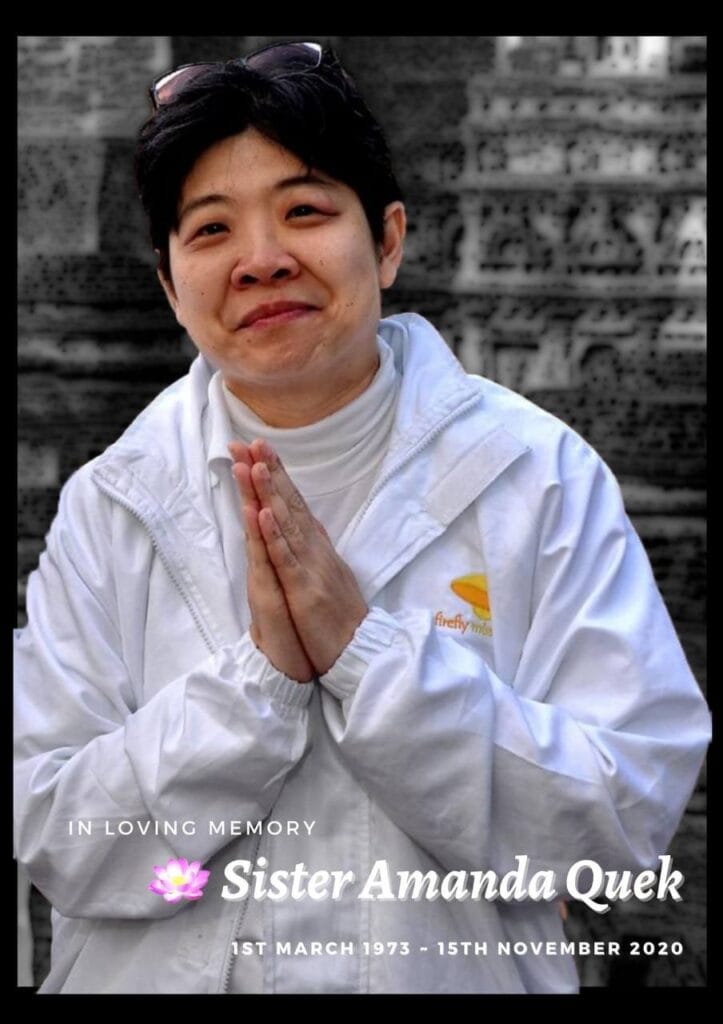
A good friend, Amanda Quek, penned a thoughtful, short note some years back, on how a constant reflection on mortality is very helpful to our efforts to keep the mind pure while not giving in to unwholesome mental habits.
Amanda was dying from cancer then, but even though her physical condition could be debilitating, she never lost faith and remained a determined and conscientious Dhamma practitioner to the end in November 2020.
Amanda remains an inspiring figure for friends and is fondly remembered for her wise sharing. HOL is releasing this reflection on the 5th anniversary of her death. May Sister Amanda be well and happy wherever she has been reborn.
From Amanda to Dhamma Friends On The Path
Hi friends, thanks so much for visiting.
Here’s my 1-cent worth of insight on the catalytic role of mortality on the practice.
Once the notion of mortality is firmly ingrained in our minds, it will rewire our mind’s operating system. We will know this when we start to ask what we should do to live a meaningful life and adjust our priorities accordingly.
We will also know that kusala mental states are beginning to take less effort to arise, they are becoming stronger when arisen and they are staying around more frequently, whereas akusala ones are starting to fade gradually into the background.
We can then set aside the constant reflection of mortality to just focus on developing those kusala mental states (gratitude, contentment, acceptance, profound joy of having found a truly meaningful life and living it, Brahmaviharas, etc.)
Reflection of mortality is just a spark plug to get the Dhamma mind up and running. Our mind will rebel if we were to constantly remind it of mortality because we are programmed to seek pleasure and avoid pain after all. We can still have sensual pleasures, but in small doses or moderation, without attachment or indulgence. Naturally, our mind will choose to behave like this after a certain level of practice.
Sometimes we might find that the kusala mental states are starting to lose steam (i.e., complacency kicks in, things are taken for granted, etc.).
This is the time to bring back the reflection of mortality to stop the decline and increase the momentum of our practice on the kusala mental states. When things are on track, reflection of mortality can once again take a back seat.
This can happen several times. Thus, reflection of mortality is like a whip – use it to get the mind moving in the right direction and when the mind begins to slacken.
Hopefully, this makes sense for you and it could be useful for you. Thank you so much for being my kalyana-mitta! May you step on the shore of Deathlessness in this lifetime! 🙏🙏🙏😊
TLDR: Most people avoid thinking about death, but Buddhists embrace it. Learn why contemplating mortality is considered the supreme mindfulness meditation.
TW: This article contains content focused on dying, death contemplation, and the end of life.
One day, we are all going to die.
How does being reminded of the above make you feel? I remember reading a Peanuts comic strip of Charlie Brown lamenting to Snoopy, “Some day, we will all die, Snoopy!” Snoopy replied, “True, but on all the other days, we will not.”
People usually do not want to think or talk about death. Consciously or unconsciously, we have a fear of death, a tendency to avoid thinking about it, and a reluctance to come face to face with this reality of life.
“The idea of death, the fear of it, haunts the human animal like nothing else,” wrote American cultural anthropologist, Ernest Becker in his book, The Denial of Death.
i. Only 50% of Singaporeans have ever talked about death and dying with their loved ones.
ii. Only 36% feel comfortable talking about their death.
Such mentality is similar in Western societies like Britain where a ComRes survey in 2014 found that eight in ten British people are uncomfortable talking about death, and only a third have written a will.
A student shared with me his experience attending a wake. He took only one look at the deceased’s face in the glass-covered coffin and that was enough for him to have a nightmare of ghosts haunting him that very night.
What is the Buddhist perspective of death?
According to the Buddhist perspective, death is not a subject to be shunned and avoided. It is by understanding death that we come to understand life and its impermanence. The Buddha highly encouraged the practice of mindfulness of death. A Buddhist quote echoes that: “Of all the footprints, that of the elephant is supreme. Similarly, of all mindfulness meditations, that on death is supreme.”
This practice of mindfulness of death is known as Marananussati Bhavana. To practise it, one must at stated times, and also every now and then, return to the thought “death will take place”.
The Visuddhi Magga, written by 5th Century Buddhist Scholar Buddhaghosa, teaches that to obtain the fullest results, one should practise this meditation with mindfulness, a sense of urgency, and understanding.
In the Anguttara Nikaya, the Buddha said, “Oh Monks, there are ten ideas which if made to grow, made much of, are of great fruit, of great profit for plunging into Nibbana, for ending up in Nibbana. Of these ten ideas, one is death.”
Contemplation on death and other forms of sorrow such as old age and sickness can drive us to practise and ultimately lead to liberation from the cycle of birth and death. Indeed, it was said that the sight of an old man, a sick man, a dead man, and an ascetic propelled Prince Siddhartha to renounce everything and embark on a journey that ended in the attainment of Buddhahood.
Contemplating Death
Contemplating death is such a useful and transformative practice, bringing about the following benefits as stated in the Visuddhi Magga:
“The disciple who devotes himself to this contemplation of death is always vigilant, takes no delight in any form of existence, gives up hankering after life, censures evil doing, is free from craving as regards the requisites of life, his perception of impermanence becomes established, he realises the painful and soulless nature of existence and at the moment of death, he is devoid of fear, and remains mindful and self-possessed. Finally, if in this present life he fails to attain Nibbana, upon the dissolution of the body he is bound for a happy destiny.”
Thus, mindfulness of death purifies the mind and has the effect of reducing our fear and discomfort of death. In the last moments of our lives, it helps us to face the situation with calm and understanding.
A student shared that by asking himself what matters on the last day of his life, many concerns, problems, and worries become insignificant, as they are put in the proper perspective.
Hence, it is said in the Visuddhi Magga, “Now when a man is truly wise, his constant task will surely be this recollection about death, blessed with such mighty potency.”
The science of facing death
Scientific studies also suggest that contemplation of death can produce beneficial effects. A 2007 study conducted by the University of Kentucky found that “thinking about death fosters an orientation toward emotionally pleasant stimuli.”
The study, conducted by researchers Nathan Dewall and Roy Baumeister, concluded that “death is a psychologically threatening fact, but when people contemplate it, apparently the automatic system begins to search for happy thoughts”.
In Bhutan, which is often regarded as one of the happiest countries in the world, there is a folk saying that goes, “To be a truly happy person, one must contemplate death five times daily.”
Are you ready to think about your death more often? Remember: One day you will die.
“People go through life blindly, ignoring death like revellers at a party feasting on fine foods. They ignore that later they will have to go to the toilet, so they do not bother to find out where there is one. When nature finally calls, they have no idea where to go and are in a mess.”
~Ajahn Chah
Wise Steps:
Start small: Begin by dedicating a few minutes each day to contemplate your mortality.
Reflect on life’s priorities: Ask yourself what truly matters in light of your finite existence.
Discuss openly: Break the taboo by talking about death with loved ones. Initiate conversations about end-of-life wishes and experiences with family and friends.
TLDR: A friendship of different faiths, a journey of letting go: Read about the power of Dhamma in guiding a dear friend’s peaceful passage.
The Diagnosis
A dear friend of mine, whom I had known for seven years, was diagnosed with a rare form of lymphoma that did not respond to any medical treatment. Our friendship was unique, with our different religious beliefs as a Christian and a Buddhist.
It was like butter and kaya, different tastes that blended so well together like in butter kaya toast.
Though A and I had different religious beliefs, we respected each other’s views, and our conversations were full of similarities about our beliefs. We often joked that if Buddha and Jesus were BFFs in their time, then both of us would be the perfect example of that relationship.
Whenever one of us had a bad day, I would say “Let God” to him, and he would say “Let Go” to me. This had become our favourite phrase over the years: Let God Let Go.
My daily visit to A in the hospital was always a precious one because I knew the time that I could spend with him was limited. I would always get him his favourite food on the days that he had an appetite, tell him funny stories, and do a massage for him which he enjoyed greatly, treating me like his personal masseur.
‘Wow, you really let go!’
On one such day, as I was having my usual conversation with him, he held my hands and said that he had decided to go into palliative care and asked that I stay with him and guide him in this last part of his journey.
Believe it or not, I had never cried since the start of his cancer journey but this time around, I just burst out in tears and cried buckets.
A just stared at me with his sparkling big eyes and cheekily said, “Wow, you really let go!”
This indeed was a real-life practice for me—not only did I have to guide someone in their last journey, but they were also a close friend who was of a different faith.
Introducing A to monastics and Buddhism
Developing mental states for future lives
As a Dhamma practitioner and speaker myself, I started trying to recall and research any material that enabled me to be A’s guide for his passing on. The mental states required for heavenly rebirth were a consistent theme in my research.
I thought that if I could use the principles behind these mental states without using Dhamma concepts, it would help A’s mind feel lighter, happier, and joyous, and therefore, it would be of great help for his next life.
There was a conversation in Dighajanu Sutta (AN8.54) between the Buddha and a lay disciple, Dighajanu, about developing mental states for future lives, namely Faith, Ethics, Generosity, and Wisdom.
Faith
Faith is a powerful energy that helps one’s mind feel energised, hopeful, and joyous. It was easy to trigger the faith in A as his religion is built on the foundation of faith.
I encouraged A to consistently arouse his faith in God and understand that whatever happens is in the hands of God. To not worry about the future and just be in the moment.
There were times when A felt immense pain and he told me because of the faith he had in God, the pain decreased tremendously most of the time. As Buddhists, we all know, that is the power of faith—it makes one filled with joy, and probably more endorphins are released into the body.
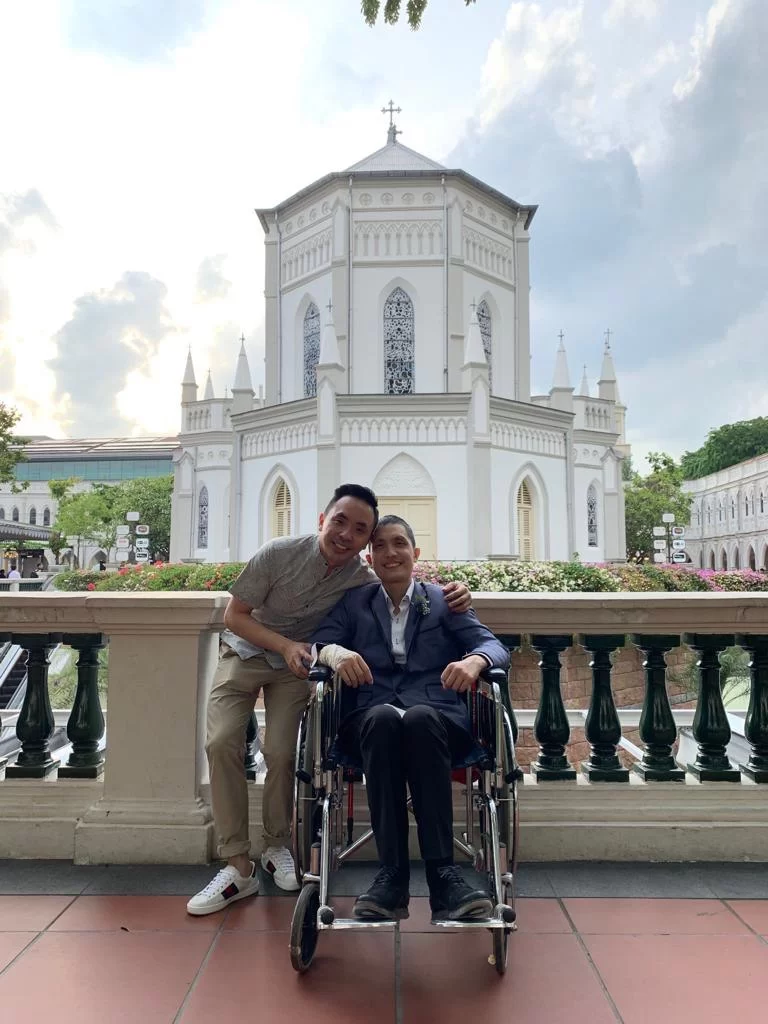
The author with A at Chijmes Singapore
Ethics
A is, by nature, a good person. If he were a Buddhist, he would be one that kept to his precepts relatively well. I always encouraged him to remind himself of all the good things that he had done, and he had also not intentionally harmed anyone in his life.
This constant reminder of him being a good person also helped him remind himself that he is a good servant to his God.
That recollection itself had helped him overcome his guilt and fear of death. I told him, “Whatever happens, you have a good report card to show to God”, and he often gave a peaceful smile, knowing that he led a good moral life.
Generosity
As for generosity, I told A to recall all the good things that he had done for others and his church. A was an active volunteer of his church. He was also an active missionary who went to various countries to help the underprivileged.
Even when he was fighting the cancer battle, he was generous with his time and was always keen to share his faith and company.
Wisdom
Wisdom was the part that I found hard to explain to him. In Buddhism, wisdom is about realising the 4 Noble Truths (4NT). I was thinking very hard about how to help A to arouse this mental state. One night, as I was reflecting on the 4NT, it then came to my understanding that this whole Dhamma journey is about letting go.
When one realises the 4NT, it becomes about letting go of all greed, ill-will, and delusion. The more you let go, the less you suffer. I told A that he had to let go of any expectations, his body, and eventually his life.
He must Let God. Whatever the journey was, God would have a place for him when his mission was done in this world. A found peace in this and said that he finally understood “Let Go Let God,” which was our favourite phrase.
The journey ends
A few days before his passing, I asked A if he would be ok if I were away for a week as I was the organiser of a meditation retreat. He said he would be okay, and he was at peace and ready to return to heaven at any time.
He cheekily asked me to share merits with him in the retreat and said that he would look out for me when he is in heaven.
That night, I was preparing to rest for the day at the retreat centre. As I was dozing off, I was awakened by a bright light at the corner of my bed. I saw the light and felt extremely peaceful and joyous.
I returned to my sleep and didn’t think much about it as I was exhausted. A few minutes later I received a text from his close friend, stating that A had passed on peacefully in his sleep a few minutes earlier.
When I saw the text, I was at peace and there was immense joy in me. I know A had passed on well and he is now definitely in a good place.
The next morning, I felt a deep sense of gratitude. I am grateful to my dear friend for allowing me to be part of his journey of passing on.
I am grateful to the Dhamma as I have witnessed the power of its teachings. It truly transcends space, time, and even people. If one is willing to listen and accept it, one will truly see the fruits of it. Dhamma is truly Ehi Passiko!
Wholesome Wednesdays (WW): Bringing you curated positive content on Wednesdays to uplift your hump day.
What’s one way we can view Ghost Month? Beyond joss papers and prayers, we can understand how we can die well. Today we cover lessons from a Dhamma practitioner who faced death with ease and also what we can do when life seems to fall apart.
1. 10 Dhamma lessons that helped me in the last months of my life 2. Can life fall into place when it feels like falling apart?
10 Dhamma lessons that helped me in the last months of my life
cr: Unsplash
Summary
Ann Le, a mindfulness trainer and member of Thich Nhat Hanh’s Plum Village community, shares 10 lessons that helped her in the last days of her life. She was hospitalised when sharing these short snippets of wisdom. She would then pass on after months of hospitalisation. We liked it because we could feel her wisdom and bravery in the face of death.
“Practice the habits of happiness in daily life when things are still okay”
Wise Steps
When was the last time you practised happiness in daily life?
If tomorrow was our last day, will we be content with doing all that we wanted to? Life is uncertain.
Can life fall into place when it feels like falling apart?
Cr: Unsplash
Summary
When life falls apart, it can be overwhelming and difficult to know how to cope. While there is no one-size-fits-all solution, there are ways to start putting your life back together. Einzelgänger, a philosophy youtube channel, shares a Buddhist story and how we can apply it to our lives.
” So, the best thing he could do is to find joy in his darkest hour, something that, as opposed to his predicament, lies within his field of control.”
Wise Steps
Reflect on the last time change led to something positive and negative in your life. Have hope that situations do change. Hang in there
Remind yourself ‘this too shall pass’ in both good and bad times
TLDR: We have all said goodbyes at some point in our lives. Does it always have to be a sad occasion? How can we better deal with goodbyes? Wilson reflects on his departure from loved ones and friends.
Departure (4 Oct, 08:00am)
Knowing that I only had one month left, it felt like there were so many people to meet and so many things to do. The outpouring of love and kindness from the people in my life gave me an indication of the quality of relationships that I have forged in my time here.
However, I could not help but wonder about the intentions behind these gestures.
I felt a tinge of guilt for thinking that all these were more for them than for me, that these helped them to make peace with my eventual departure.
I struggled with myself, “My friends and family seemed to assume that they have a right to ask for whatever time I have remaining. Yet, it also feels wrong to tell people that I want more time for myself and to reject their kindness. Also, how can I make assumptions about their intentions? That reflects more about how I view the loved ones in my life.”
As the end drew near, I thought I would feel sad, nervous or even excited. Interestingly, it just felt like the end of every other day that I have lived so far. I guess maybe I have prepared enough and that the end just feels like it would come sooner or later anyway.
Or maybe it is because I’m still on the way to the other side and that it will all start to sink in once I arrive.
At this point, I want to take the chance to thank the people in my life for loving me, helping me to learn and grow and eventually, letting me go with your heartfelt well-wishes. I think that is one of the greatest gifts I have received. Thank you all.
~The End~
Oh, you are still here? After reading the previous few paragraphs, you may be thinking, “This Wilson has gone crazy already. Say until like he’s dying like that.”
Or maybe you are texting me now to scold me for scaring you. Hehe, please forgive me for deciding on such a dramatic and possibly triggering way to start the article. 😅
To set the record straight, I left Singapore for Japan to study and do research for the next 1.5 years. I do hope that the opening captured how I felt about the similarities between going overseas for a long period and dying.
However, if you are still cross with me (and understandably so 😛), I hope the rest of the article explains well the thought process of this weirdo here.
There are many ways in which we may leave this world. It could be sudden, leaving you shocked like a deer in headlights. Or you would have an idea of the end drawing near, giving you some time to make preparations.
I was reminded of a quote by Paul Kalanithi in his book, “When Breath Becomes Air”, which described his journey of facing his mortality as a surgeon himself: “I began to realise that coming in such close contact with my own mortality had changed both nothing and everything. Before my cancer was diagnosed, I knew that someday I would die, but I didn’t know when. After the diagnosis, I knew that someday I would die, but I didn’t know when. But now I know knew it acutely.”
I feel blessed to be given the chance to say my goodbyes and to feel the love and care of my loved ones. It made me think about how I would ideally like to leave this world and how I could live my life so that when my time is up, it would reduce the suffering for myself and the people around me.
Celebrating Departures
While I mentioned the similarities between going overseas and dying, I noticed a major difference.
When it comes to going overseas, it is usually celebrated. However, when it comes to dying, it is mostly grieved. You may retort, “Of course lah! Dying is a permanent goodbye leh. You go overseas we can still visit each other what.”
Also, people also tend to celebrate deaths if the deceased had lived till a “ripe” old age. Even the choice of words betrays our value judgments on the importance of living a long life.
To me, this often-quoted phrase captures my attitude succinctly: “Life is not measured by the number of breaths we take, but by the moments that take our breath away.” I think it may be also because I believe that I would not be able to live a long life due to my extreme levels of carelessness.
With all these said, I am not proposing that we ignore the fact that others may be grieving over departures in their lives and therefore, trivialise the suffering that they are experiencing.
It is perfectly normal to experience sadness and grief as a response to loss in our lives, be it due to death or otherwise. However, we can also choose to respond to those by celebrating the life of the deceased.
For me, I had the idea that at my funeral, guests would be invited to note down a favourite memory that they shared with me. They can then probably laugh together at the silly things that happened in my life, including falling into the swan lake at the Singapore Botanic Gardens and getting into a tussle with monkeys at the Penang Botanic Gardens.
Preparing for Departures
How should we then prepare for departures, be it our own or others’, going overseas or dying? Instead of considering the plethora of things that one can prepare to make the departure easier, I think it would be good to focus on something manageable that we can do regularly.
The Buddha encouraged his disciples to use separation and death as part of 5 themes to reflect upon to support them in their spiritual practice.
“Bhikkhus, there are these five themes that should often be reflected upon
… by a householder or one gone forth.
1. ‘I am subject to old age; I am not exempt from old age.’
2. ‘I am subject to illness; I am not exempt from illness.’
3. ‘I am subject to death; I am not exempt from death.’
4. ‘I must be parted and separated from everyone and everything dear and agreeable to me.’
5. ‘I am the owner of my kamma, the heir of my kamma; I have kamma as my origin, kamma as my relative, kamma as my resort; I will be the heir of whatever kamma, good or bad, that I do.’”
Initially, you may find it weird or even uncomfortable when conducting this set of reflections and that is perfectly normal since we do not usually consider our mortality as we go about our everyday lives. However, I do hope this practice can support you in living a good life, so that when the time comes to leave, for whatever reasons and in whatever ways, you are ready for it.
Summary
We often go through life without thinking about departures of different natures, possibly even avoiding the idea of departures.
The grief that we associate with departures arises easily in our minds and while that is perfectly natural, we can approach departures in a different light.
We can choose to celebrate the moments we shared with the person who is leaving while taking the chance to reflect upon separation and death to support us in our spiritual practice.
Wise Steps:
Reminding ourselves of the 5 themes that Buddha taught us help us not to take life for granted
Grief is perfectly natural; what matters is our response to it. finding the right community to support you through it is most crucial!