Why Birthdays Don’t Feel the Same Anymore

Why Birthdays Don’t Feel the Same Anymore

TLDR: Birthdays used to sting with too much waiting, comparing, and expecting. Then I learned that the best gift you can receive is the one you give back. Now every birthday, I trade candles for meaningful causes that speak to my heart from walking, fundraising, singing, and now writing. Giving back now has become the greatest birthday celebration for me to remember.
Why Birthdays Don't Feel the Same Anymore

Shortly after Halloween came my birthday. With it, the cycle of self-pity starts.

Year after year, I would torment myself with thoughts like, Why didn’t I get the gift I wanted? Why didn’t this person wish me a happy birthday? I gave such a beautiful present and surprise for someone else, and why wasn’t the same done for me?

It was all ego, comparison, and a pile of expectations wrapped up in a single day.

One that, truthfully, seven billion other people didn’t care about.

By the time I turned 24, I stopped celebrating altogether. I kept my birthday off social media. Sometimes, I even avoided posting reflections about spending it alone in a foreign city, blowing out a candle on a cake I’d bought just for myself.

I would tell myself that this was a strength, that someone would notice, that someone would see how I didn’t “need” anyone to celebrate with me. But deep down, it still hurts.

Flipping the Script on My Birthday into Giving Back

Then one day, I read Eat, Pray, Love. Something inside me shifted as the story unfolded about how Liz uses her birthday to raise money for a Balinese traditional healer named Wayan.

I realised birthdays didn’t have to be about waiting for gifts or surprises. They could be about giving (gifting) back.

Inspired, I started what I now call my “Birthday Gift Back.” It began in 2012, after I walked 375km from Bangkok to the Thai-Burmese border to raise funds for anti-human trafficking.

Since then, every birthday has become a chance to turn receiving into giving. Instead of being the center of attention, I use my “birth” day to support causes I believe in.

375 km on foot from Bangkok to the Burmese border with my fellow walkers.

I’ve transformed every one of my birthdays into what I call my “Birthday Gift Back.” Rather than focusing the day on myself, I use it as an opportunity to contribute to others.

The idea is simple, yet impactful: on the very day when people expect to be showered with gifts and attention, we can flip the script. We “gift” back.

We receive less so that those with greater needs can receive more.

Over the years, I’ve shared my Gift Back journeys through social media posts and updates. Each year, I tell a new story of where the donations went, who they supported, and the difference they made.

What started as something deeply personal slowly grew into a ripple. A few friends began following in my footsteps. Some even told me they’d been doing something similar on their own.

It reminded me of the Buddha’s words:

“If beings knew, as I know, the results of giving and sharing, they would not eat without having given, nor would the stain of stinginess overcome their minds.”
The Buddha (Itivuttaka 26)

In those moments, I understood what the Buddha meant on how generosity nourishes not just the receiver, but also the giver. The more I gave, the lighter I felt. The more I shared, the more joy seemed to return. Joy that multiplied in quiet and unexpected ways.

To me, every donation is like lighting a candle. One alone was small, but together they created light waves. It became a celebration that unfolded daily in November, in the ways I followed up with donors, shared updates, and tracked the impact.

The act of giving brought me so much joy, because it meant the attention was no longer on me.

Instead, attention was flowing into meaningful causes, sparking conversations about the issues I cared about, and channelling energy into communities that need it most.

The Hard Work Behind the Happiness

Honestly, it’s far more work than hosting a birthday party. There’s the planning, the supermarket runs, the heavy lifting of goods, the trips to children’s homes, and the careful documentation of every receipt — because I believe in 100% transparency to donors.

Then there’s gratitude: thanking every donor, tagging them, making sure they know that their kindness mattered a lot to me.

Yes, it takes time and energy.

It also fills me with something a party never could — a sense that my birthday isn’t about one day of attention, but about creating ripples of change that last long after the birthday candles are blown out.

I’ll never forget a year when I received a substantial amount of donations but couldn’t possibly carry all the necessities myself. By chance, I met an American girl at a Free Bird Café in Chiang Mai. I asked if she could help me. Without hesitation, she agreed.

For me, I feel, “When you want something good for others, the world conspires to help you.”

At that moment, I understood what Paulo Coelho wrote in The Alchemist:

“When you want something, all the universe conspires in helping you to achieve it.”

Illness cannot stop generosity

As my health began to decline, I realised that if I wanted to continue my Gift Back movement, I had to get creative.

An illness forced me to slow down, but it didn’t silence the part of me that longed to serve, to give, and to uplift. It nudged me to find new ways of offering from where I was.

When I was going through cancer at 33, I launched a campaign I called “Raise $3,300 in 33 Days for 3 Charities.” It was my way of turning hardship into hope. Each dollar raised felt like a seed planted. Every seed carried the potential to grow into something far bigger than my illness.

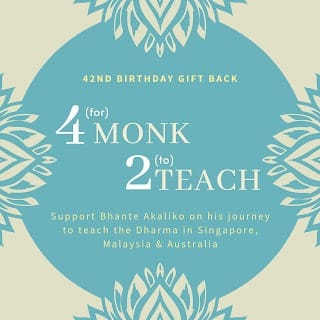
Another year, I created “4(For) Monk 2(To) Teach & Travel,” a campaign supporting Bhante Akaliko’s Dhamma teaching trips to Malaysia and Australia. I had the honour of travelling with him from Singapore into Malaysia, serving as his kappiya (short for kappiya-kāraka, a monk’s assistant).

Being by his side and watching him spread Dhamma and lead retreats, I reflected that generosity is not just about money. It’s also about time, presence, and the willingness to support something meaningful.

Before health became an obstacle, I poured myself into another campaign I called “34 Good Deeds” on my 34th birthday. That year, I performed one of the good deeds in the form of a charity concert to raise funds for a school supporting Burmese refugees in Southern Thailand. 

A dear friend generously sponsored the venue, giving me a stage to fulfil my birthday Gift Back. Standing under the lights, singing each song with intention, I felt every note carry a meaning far deeper than entertainment.

Looking back, that night remains one of the most fulfilling and unforgettable memories of my giving journey.

Reflecting on my birthdays, I see a common thread running through all these efforts: illness may have changed my pace, but it never diminished my desire to “gift”.

If anything, being ill deepened the desire. Service doesn’t always have to look the same: it can evolve, adapt, and flow with what is given.

Do what you can with what you have at where you are. It’s a motto I keep close to my heart.

The charity concert I performed when I was 34. Together we raised funds that truly made a difference.
The publicity poster I designed for my 42nd Birthday Gift Back Campaign.

The publicity poster I designed for my 35th Birthday Gift Back Campaign.

One of the most memorable Gift Backs was when I travelled to Khura Buri, a small town in southern Thailand near the Burmese coastline. For my 35th birthday, I dedicated 35 hours (though it could have been much more) to volunteering at the school I had raised funds for back in 2013. 

It was deeply moving to witness the impact of where those donations went — the bright smiles of the children, the education that opened their world, even the simple but essential lessons like learning how to brush their teeth with confidence.

Seeing how lovingly each student was cared for made my heart swell. It felt as if the “gift back” had come full circle, returning in the form of pure, innocent joy.

My Body Is Weak, but My Friends’ Generosity Keep Me Going

Of course, I couldn’t resist reaching out to my friends for support once again.

Thanks to their generosity, we were able to provide milk, stationery, toothpaste, toothbrushes —  all the small but essential items the children needed. I even went ahead with a playful idea to create school uniforms in rainbow colours, each shade representing a different age group or grade.

Those few weeks of volunteering as a teacher brought me immense happiness. Watching the children’s smiles, steeping in their energy, and simply being part of their world filled me up with joy.

Even now, I sometimes wonder how they’ve grown, where life has taken them, and whether they would still remember me.

Taking a break from the lesson and soaking in the pure joy with the children.

The new school uniforms I initiated in different colors, made possible by my friends’ donations.
The last day of my volunteering work when I took a group photo with each class. This is one of the four classes I taught.

Looking back now, my birthdays are no longer about self-pity. They’ve become milestones filled with meaning and purpose.

Soon it will be my birthday, and this year feels different.

Not because of the number on the calendar, but because it marks the start of a new chapter.

Living with the inability to eat, along with the many complications of this disability, has weakened my body in countless ways.

Yet, through all of this, my spiritual endeavors refuse to be dimmed.

My Dhamma work remains my anchor—steady, grounding, and unwavering. Guiding me through each wave of challenge with purpose and clarity.

My 45th birthday ‘Gift Back’ campaign poster

For my 45th birthday Gift Back this year, I created a campaign called “For(4) Me to Fight (5).” The “4” was for me, but the “5” carried a double meaning: it stood for writing, and also for fight — the fight I carried forward through my words.

This year, turning 45, I like to honour my journey as a queer Buddhist writer.

Writing became my medium, a way to process pain while offering something meaningful to others.

For the past year, I have found myself reflecting on my health and the limits it brings. I no longer have the same strength or energy to be at the forefront of sharing and doing the Dhamma work the way I once did.

Perhaps that’s life’s gentle way of guiding me towards a new path. Writing has become a beautiful way to stay connected, to keep giving, sharing, and serving, even from behind the scenes.

Even when my body struggled, my voice could still reach out, connect, and give back through writing.

Now, I want to share them more widely, to give back to the community that has inspired me, and to queer vulnerable folks still searching for belonging in spiritual spaces. 

So instead of birthday gifts, I invite you to celebrate with me through my writings:

  • Subscribe to my Substack, read my articles and reflections — and if your heart (and pocket) allows, consider pledging as a supporter:
    👉 kyleneo.substack.com
  • Support the Dharma Kueen Mini Zine — sponsor its printing and distribution to the LGBTQ+ community:
    👉 dharmakueen.com/minizine
  • Explore my books on my website — if one speaks to your heart, bring it home:
    👉 dharmakueen.com

Your support amplifies queer Dhamma voices, helping to build a more inclusive spiritual space. A space where Buddhism and queerness don’t just coexist, but shine together.

Through my writing, I hope to build a more inclusive and universal space of connection, where even those outside the LGBTQ+ community can find resonance.

After all, the heart of Dhamma is awakening. That journey belongs to all of us, no matter who we are or whom we love.

This year, my birthday wish is simple: may no one, and no mind, be left behind.

Originally published in Substack under Birthdays don’t feel the same anymore. Edited for Handful Of Leaves.


Wise Steps

  • Flip the Spotlight: On your next birthday (or any day), turn “What can I get?” into “What can I give?”
  • Give from Where You Are: Whether through time, presence, or words. Adapt generosity to your capacity.
  • Let Your Light Ripple: Every act of giving, however small, becomes part of a larger wave of compassion that outlasts any candle flame.
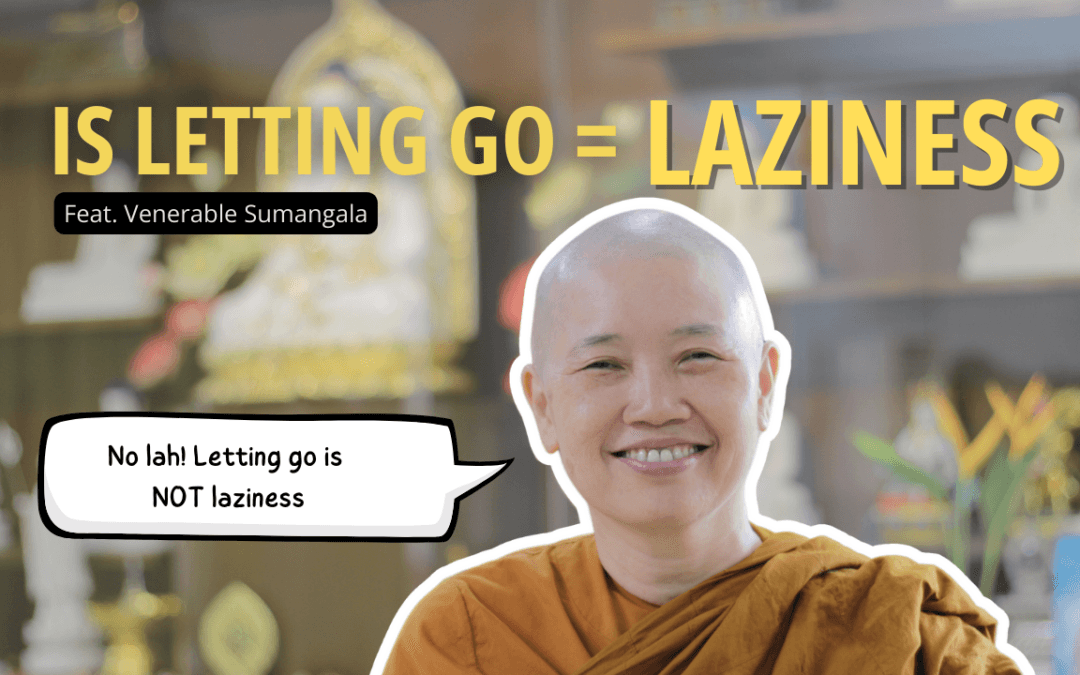
Ep 56: Is Letting Go = Laziness? ft. Venerable Sumangala and Soon

Ep 56: Is Letting Go = Laziness? ft. Venerable Sumangala and Soon


Summary

In this episode of Handful of Leaves, Venerable Sumangala shares insights on the practice of letting go and renunciation, emphasising the importance of inner transformation and understanding suffering. She explains how letting go of attachment to ego and external perceptions leads to true freedom and happiness, while still pursuing goals with a balanced approach.


About the Speaker

Venerable Sumaṅgalā Therī is the Abbess of Ariya Vihara Buddhist Society and is an advisor of Gotami Vihara Society in Malaysia. She is one of the recipients of the 23rd Anniversary Outstanding Women Awards (OWBA) 2024, in honour of the United Nations International Women’s Day.

She holds a B.A. in Psychology and in 1999, she completed her M.A. in Industrial and Organizational Psychology, both from Universiti Kebangsaan Malaysia. Furthering her academic and spiritual education, Ven. Sumaṅgalā Therī obtained an M.A. in Philosophy (Buddhism) from the International Buddhist College, Thailand in 2011.

Her formal journey into monastic life began in 2005 when she left the household life to become an Anagarika at the age of 19. Her ordination as a Dasasil (akin to a Sāmaṇerī) took place in November 2008 under the sacred Sri Mahābodhi at Bodhgaya, India. On 21 June 2015, she took her higher ordination under the guidance of preceptor Ven. B. Sri Saranankara Nāyaka Mahāthera – the Chief Judiciary Monk of Malaysia, and bhikkhuni preceptor-teacher Ayya Santinī Mahātherī of Indonesia.

In 2015, she pioneered the formation and registration of Ariya Vihara, Malaysia’s first Theravāda Bhikkhunī Nunnery and Dhamma Training Centre. In 2019, she received a government allocated land for the building of the project with construction to commence in the first half of 2025.


Key Takeaways

Letting Go of Ego

True liberation comes from letting go of the ego and not creating more attachments to identity, fame, or success.

Understanding Suffering

The Four Noble Truths guide us to understand that suffering is a result of attachment, and by letting go of desire, we can end suffering.

Balancing Desire and Detachment

Achieving goals and success is natural, but it is important to not become attached to the outcome. Focus on the process and the wellbeing of others.


Transcript

Full Transcript

[00:00:00] Venerable Sumangala: If we live by how other people perceive us, we never live our life.

[00:00:06] Cheryl: Welcome to the Handful of Leaves podcast.

[00:00:08] Cheryl: My name is Cheryl, and today I have a surprise guest host joining me, Soon.

[00:00:14] Soon: Hi everyone. it’s good to be here.

[00:00:18] Cheryl: So today we have a very interesting topic, which is called letting go of becoming. And sometimes the practice is described as going against the flow. And living in the material society seems to be opposite from the peace and zen of the spiritual practice. It’s a lot of becoming to do, milestones to achieve.

[00:00:39] Cheryl: So join me with my co-host, Soon, as we find out about we can balance letting go with the gettings, achieving and becomings of the world. We will speak to Venerable Sumangala, who is a fully ordained nun of 10 vassas to learn more. She is also the president of Ariya Vihara Buddhist Society, Malaysia’s first Theravada (add b-rolls) Bhikkuni Nunnery and Dhamma Training Center, and she is also an advisor to Gotami Vihara Society in Malaysia.

[00:01:09] Cheryl: Welcome, Venerable Sumangala.

[00:01:11] Venerable Sumangala: Thank you.

[00:01:12] Cheryl: You’ve mentioned in previous interviews about your journey on why you became a nun, and one quote that really struck my heart was that you said, when one has a glimpse into the noble truths, it is natural for one to be a renunciant in the Sangha rather than wanting to become a nun.

[00:01:32] Cheryl: Can you please share more on this?

[00:01:34] Venerable Sumangala: Actually from the question itself, we can see there are a few keywords. First is renunciation and then the wanting. Renunciation, in Buddhism is not just about giving up material things, but it’s actually an internal transformation. It’s an internal transformation rooted in insight, means something you have seen directly into the nature of reality. This nature of reality in common word, we say suffering. But I think if we look deeply is the constant change of everything. And also there’s an end to that. To an end to suffering. So when one actually deeply understands the 4 Noble Truths, seeing there is suffering in our life, not life is suffering, yeah? So two different things. There is suffering. So this suffering doesn’t exist by itself. There is a cause to suffering. So if you know the cause, then if you can eliminate the cause, then of course there’s no suffering. So therefore there’s an end to suffering. There’s a way, a gradual training that we can practice that can end our suffering. Because most of us, what we look forward is to be happy, to be free.

[00:02:46] Venerable Sumangala: So we must know how to get there. And the Buddha has provided us this path. Renunciation means we let go attachment and desire more easily when we understand this. True renunciation stems from wisdom and insight in the nature of suffering and working towards ending that suffering. But where else when we want to become, then it is suffering itself because we are actually attached to the idea of identity, fame, and name.

[00:03:20] Venerable Sumangala: And so therefore, it is so important that when we seek for something, the practice is very important. The inner transformation is very important so that we truly see the reality. And then from there, I think renunciation will take its own place. So true liberation actually comes from letting go of the ego, not creating more ego. We may aspire, but then the working on it, the practice is very important.

[00:03:48] Soon: Thank you Venerable Sumangala for that sharing. We are just curious, what’s the most difficult thing that you have let go of and was there any insights and wisdom that helped you, “Okay, it’s time to let go.”

[00:04:00] Venerable Sumangala: At that time actually for me is just to make my mother feel comfortable, but the spirit in my heart is actually burning to be very firm that, you know, that will be my path. One of the learnings that I have about this letting go and from lay life and how people view about life and renunciation too. So, for example, last time when I was still a layperson, I went for a pilgrimage tour to India. And we have this opportunity to shave, and that time I think it was still quite new. That was around 2003.

[00:04:34] Venerable Sumangala: Before that I have the idea of shaving and I used to take my long hair and look at a mirror to see how I looked like. But then when the opportunity came, I kind of hesitated. Because at that time I’m a branch manager and it’s very near to New Year. I’ll be meeting a lot of people, a lot of social function, and then how could I probably answer people, right? So the first thought is that, should I, should I not? Second time again, I was still pondering, but then suddenly my friend told me, she said, “I think you will shave”. I started to reflect. It’s because I’m looking at how people look at me after I shave, so that deterred me. But then interestingly, after the shaving, when I came back to Malaysia, I learned a lot about perception, about ego.

[00:05:26] Venerable Sumangala: First thing when my neighbor met me, she looked very taken aback, something must have happened to me, so I greet them as usual. Good morning, she answer back. And then when I go to the office, I dressed as usual with a bald head. And my executive was very shocked. And then business partners, suppliers, they get very shocked too, because in their thinking, is that what happened to Ms Ong at that time?

[00:05:54] Venerable Sumangala: And for business people, we love sensual pleasures, entertainments. So by looking at that, they will think that people who shave, maybe something shocking happened to their life or traumatic, whether they have gone out of their mind a little bit, or they heartbroken or they have something that’s wrong.

[00:06:14] Venerable Sumangala: When my bosses, we have dinner and then they bring their wife. The first thing they ask me, they say, “miss Ong, since when you are so bold, you know, fashion”. Because they’re into fashion, so their perception is about fashion. So it is very cool, you know with the bald head.

[00:06:31] Venerable Sumangala: And then my boss, “why you shave your hair?” Because for him he has only little hair on his head. So everyday he has a comb and combs to cover his head, and there you are with very nice hair and then you just shave and then get bald. So he wished me, I wish you know your hair grow fast.

[00:06:49] Venerable Sumangala: Actually many different responses. And when I met one uncle in a supermarket, and he approached me, he said, “oh, sister, is your hair related to Buddhism?” I said yes. Then I told him that I went for a pilgrimage and then I didn’t know him and he didn’t know me, and he asked me, “would you like to come to my house?

[00:07:11] Venerable Sumangala: I have a Guanyin of about 500 years old. Would you like to come and have a look?” and there are other people, they shave and when they go back, the mother actually give them a house arrest, thinking that they will go forth, so they just lock them up.

[00:07:26] Venerable Sumangala: Everywhere they go, they follow. And I reflect back. It’s just a haircut, but can you see how people respond? If they think of sickness, they will think that they’re sick. If they’re into fashion, they think you are so cool. And then if they don’t have that, like, my boss the hair is so little and then they see, aiyo, why you give up your hair? So you can see actually how we perceive, how we live by other people’s perceptions.

[00:07:50] Venerable Sumangala: And I think the understanding that I have is that if we live by how other people perceive us, we never live our life. In understanding the truth, I think this is a very important thing because we always have that ego and that ego seeks to be validated by others. So how are we going to find peace and happiness?

[00:08:10] Venerable Sumangala: So letting go oneself, I think is the best of letting go because you no need to hold on to the idea of our self, an identity or image to be taken care all the time because of how other people perceive you, not how you are actually,

[00:08:29] Cheryl: I’m just thinking how we can integrate that into the daily life.

[00:08:35] Cheryl: Most people spend most of the time building their careers, so that identity also become very entrenched in what they achieve, the successes and failures that they bring. How can one practice letting go?

[00:08:46] Venerable Sumangala: Letting go, it’s not about abandoning everything. Letting go is internal insight that sees the true reality of what is. Let go of gripping on something or idea or attachment to an outcome.

[00:09:02] Venerable Sumangala: We keep thinking about the outcome or the success. When we have this idea, it makes us feel very tight and tense and stressed. Everything we do needs desire. Can you see when a person is sick, they don’t have any desire, then nothing happens, right? That in our normal life, even desire is a path under the four roads of success, or ways of success. The first one is chanda, means you must have the aspiration. So in this way, we have a duty to be done because we are still a human. We need to work for our bowl of rice. And therefore we must have the drive.

[00:09:41] Venerable Sumangala: Yeah. We must have the drive to do something which is in accordance to right livelihood. Letting go doesn’t mean we don’t do anything or we give up everything and then become a person who’s like redundant. No, we still have desire, we still do good things. We still also have our goal to be achieved. Let’s say if you are worker, we are paid to do our duty well. So the Buddha also advised us, we perform our duty to the best of our ability, skills. Therefore from there, I think it will lead to good result. And from the good result, it’ll be commensurated with legitimate reward. So it is a natural process.

[00:10:23] Venerable Sumangala: There is an order. For even work, for achieving wellbeing, our wealth. So all those need our desire to work well. But that desire doesn’t lead us to attachment. For example, in the company, and we start to have this idea, “I want to be promoted”. Yeah, the word “I want to”– “I”, the identity is there, “you want”.

[00:10:46] Venerable Sumangala: And so when we do that, then it’ll cause us a lot of stress. When I was working, after five years they interviewed me, “what do you think you will become three years from now?” You know what I write there? I said, “to be happy and to make others happy.” That’s all that, right? Right. That was what I think important in life.

[00:11:08] Venerable Sumangala: But when I work after five years, they have promoted me to become a branch manager. I contributed my part, my knowledge, my skill. I do it well. I do my best. It doesn’t mean that my desire for success is not there, but it’s just that I’m not attached to it, and the process is more important. We already set the goal, then we work on the way to achieve that goal.

[00:11:34] Venerable Sumangala: Then we just let that be the goal, because as we work on it, the goal is coming, the results are coming. We don’t keep thinking about the goal, (but) not doing the part or the necessary actions to achieve the goal. And secondly, in the process of achieving the goal, always remember that we work in harmony. Sometimes we want to achieve the goal, we forget about the process. So the people that work with us, we don’t care. We just want to achieve the goal. So we push them, we stress them out. Then achieve the result is not as what we think. We must always think our wellbeing and the wellbeing of others, and together we can achieve it.

[00:12:13] Cheryl: Letting go is not laziness. And I think you also really embody that, even as a monastic right now where you have so many projects, that you’re running, being the Bhikkuni Training Center and the Gotami Vihara Society. Would you be able to share an example how you are able to go of the outcome while still having that desire to progress the development of female monastics?

[00:12:41] Venerable Sumangala: Actually when I embarked on this path, I felt that monastic life would be the best in continuing this journey. At the same time, then I realized that I have the ability and capacity to also share and to help others who are keen on this path.

[00:12:58] Venerable Sumangala: So in the past, we will have to search on our own. Because we know that the Bhikkhuni revival took place in 1996, so it’s still very, very young, about 20 over years. And I think the best part of it is our lead chief. He’s one of the senior monks who has took his compassionate duty to make this happen in the world.

[00:13:22] Venerable Sumangala: So we are very fortunate in Malaysia in a way that we have a senior monk that who is well known, very respected, who took this path to establish the four fold assembly again. In the past, we only have three. Now we have four back as what the Buddha has set up. People sometimes ask me, “Venerable. Are you not stressed? There’s so many things that’s ongoing.” Sometimes I reflect that when we need to prepare, then we look at the capacity first. When I see that, when my capacity is able to cover additional things for the wellbeing of others, then I think it’s time to execute. Then I will do it.

[00:14:00] Venerable Sumangala: We start with like Ariya Rainbow Kidz program for family Dhamma education. Then we have more people and more capacity. Then I train some of them to also help out. And then after that, then I extend for retreats, then longer retreats and then camps, and then to now Ariya monastic and laity training program.

[00:14:21] Venerable Sumangala: We also look into that because the whole Malaysia, we don’t have any center specifically for the Bhikkhuni. So without a Bhikkhuni center, without a sīmā, then we would not be able to have this capacity to provide the proper way of renunciation and also for the training. Yeah. So it is so important.

[00:14:43] Venerable Sumangala: So the lead chief actually told me that in order for the Bhikkhuni order to flourish, we must have a training center for them, and we must organize a proper training program for the Bhikkhunis. You need to have somebody to lead, and then you mobilize other people to come together. Those like-minded people who also seek for this kind of practice.

[00:15:02] Venerable Sumangala: We are also very fortunate in a way that some of the Bhikkhu Sangha, they all come to also guide us, support us rejoicing with our good development and practice. Yeah, so don’t attach to it, do your best, and when a thing comes, we just pick it up. And then after it’s finished, then we go to the next. Rejoicing with every good things that we do, bring us a lot of energy and happiness.


Special thanks to our sponsors:

Buddhist Youth Network, Lim Soon Kiat, Alvin Chan, Tan Key Seng, Soh Hwee Hoon, Geraldine Tay, Venerable You Guang, Wilson Ng, Diga, Joyce, Tan Jia Yee, Joanne, Suñña, Shuo Mei, Arif, Bernice, Wee Teck, Andrew Yam, Kan Rong Hui, Wei Li Quek, Shirley Shen, Ezra, Joanne Chan, Hsien Li Siaw, Gillian Ang, Wang Shiow Mei, Ong Chye Chye, Melvin, Yoke Kuen, Nai Kai Lee, Amelia Toh, Hannah Law


Editor and transcriber of this episode:

Hong Jia Yi, Ang You Shan, Tan Si Jing, Bernice Bay, Cheryl Cheah


Get connected here:

Telegram Instagram YouTube Facebook

Faith In Buddhism: Which Of These 3 Faith Types Do You Belong To?

Faith In Buddhism: Which Of These 3 Faith Types Do You Belong To?

This is an abridged chapter from Buddhist Scholar Sylvia Bay’s Book on Faith. You may find the book here


TLDR: Buddhism is nowadays taken to be ‘scientific’ with little need for faith. Have we got it wrong? Which type of faith do you identify with? Blind, Knowledge, or practice? Sylvia shares more

Faith is not a static mental state. Faith can strengthen (or fade). Right knowledge and clear understanding will strengthen faith. 

1. ‘Blind’ Faith 

When we first declared ourselves to be Buddhists, the odds are that at that time, we didn’t really know much about Buddha or his Teaching. What little we knew then was probably hearsay or as tradition dictated. 

We were likely to be caught up with the dos and don’ts of the rites and rituals. What to do at the temple or monastery? How to bow? How to chant? What offerings to make? And so on. Our faith might or may be transactional. 

We “pray” to Buddha and show our devotion by making offerings so that we will be blessed with success or be able to ward off misfortune. We may have all kinds of wrong understanding: ‘Buddha is god’, ‘Buddha can save me’, ‘just pray to Buddha and all will be fine’. 

Even worse, we may be afraid of asking questions because we think that it is ‘bad kamma’ to do so. Blind faith is superficial and fragile as it rests on ignorance and fear. This type of faith cannot withstand life’s inevitable disappointments and setbacks. It will be at constant risk of falling away. 

2. Knowledge-based Faith 

The faith that Buddha spoke about that is critical for spiritual growth is grounded on knowledge and a thorough understanding of the teaching. 

The deeper the knowledge, the stronger is the faith. 

Now, we must all start somewhere in terms of gathering knowledge. Buddha’s advice was to approach a teacher that you have respect for. Because of that positive chemistry, you will be willing to keep an open-mind and give him the benefit of the doubt. Because of your attitude, your mind is pliant, receptive and attentive. 

That helps you to register the Dhamma properly and remember it. What you can remember, you must reflect thoroughly and compare the teachings against your observations about life’s experiences and your mind. 

Only when the Dhamma makes sense, because it is consistent with what you have observed, will you embrace the teaching fully and confidently.

From the above, it is clear that Buddha had expected his followers not to just accept his words at face value but to have an enquiring mind and ask questions, challenge assumptions, think critically, and make thoughtful conclusions. These are high order cognitive processes. 

He said that they should accept his teachings only after they are satisfied that Dhamma makes sense from their own observations about their mind and life’s experiences. 

3. Practice-based Faith 

Ultimately, Buddha’s Dhamma is not an intellectual exercise. It helps the practitioner to understand the true nature of the mind such that he can overcome feelings of dukkha and is able to live more happily. 

It is not easy to get to a state where one can see the mind’s true nature. It may require fundamental changes to one’s habits and behaviour. One must make a serious effort to overcome one’s negative instincts and obstructive habits. 

Hence, the next level of faith development is practice. You must be ready to deliberately and thoroughly weave all aspects of his teaching into your daily life. And you keep applying the training discipline until your mind settles into a new equilibrium, with new knowledge about itself and its habits. 

When that happens, the practitioner would find himself becoming a kinder, gentler and wiser person, more content, happier and less caught up with ego and desires. 

As your understanding of the Dhamma deepens because of the practice, you will experience more periods of peace in your waking moments. Once the Dhamma is not just an abstract concept but a way of life, faith will grow exponentially. 

You have confidence that you know how to shape the mind because you understand how it works. 

You feel empowered. 

You no longer feel helpless in the face of changing external or internal conditions.


Wise Steps:

  • Pause and reflect. Where do you currently stand now in your Buddhist faith? Are you comfortable with where you are right now?
  • Ask yourself, ‘How can I go from understanding the teachings to realising them?’. Take active steps to grow your circle of spiritual friends to support your journey
  • Associate with wise teachers, explore and find teachers to learn from. Those who are worthy of respect and conduct themselves similar to how the Buddha or disciples would behave.