What happens when a startup founder takes Buddhist precepts seriously — not just in meditation halls, but in high-pressure boardrooms and tough layoff conversations? In this candid episode, we speak with Ying Cong, co-founder of Glints, on what it means to lead a company without losing yourself. He shares how his practice of the Dhamma has shaped everything from how he hires and manages people, to how he navigates co-founder conflict and difficult decisions — all while trying to be firm in kindness.
About the Speaker
👤 Ying Cong is a long-time meditator and the co-founder of Glints, a leading career platform in Southeast Asia. Over the past decade, he helped scale the company from an idea incubated by JFDI to a regional startup featured in major publications like The Straits Times and Yahoo News. As Glints’ former CTO and current machine learning engineer, he has worked on recommender systems, fraud detection, and data infrastructure—though he jokes that most of it is just “glorified data cleaning.”
His Dhamma journey began in his teenage years and continues to deepen through regular meditation, observing the precepts, and periods of monastic training in the Thai forest tradition. He is quietly exploring how to balance the responsibilities of lay life with the path of practice.
Key Takeaways
Holding the five precepts builds deep trust
While startup life often celebrates “hustle at all costs,” Ying Cong stuck to his precepts — even when pitching investors. Over time, however, this radical transparency became a strength. Colleagues began to trust him deeply, even sharing difficult truths others couldn’t access.
Culture is shaped by how you show up, not what you say
From hiring to meetings, people look to the leader to understand what’s “normal.” When Ying Cong opened up about uncertainty and shared his misgivings, others followed suit. But when leaders modelled secrecy or pure task-focus, people shut down.
Every employee is carrying something
After managing 40–50 people over 11 years, Ying Cong observed something simple yet powerful: “Everyone is suffering, to some extent. The only question is how much they show you.” Being present and listening with care — not just for what’s said, but for what’s held back — often reveals what’s really going on beneath performance issues or disengagement.
Transcript
Full Transcript
[00:00:00] Cheryl: Has there ever been a moment in your career where you were not able to hold your five precepts?
[00:00:06] Ying Cong: No. No. It’s been, that was my inviolable principles, uh, ever since, uh, I was young. I have, okay, there are situations where I’ve come close.
[00:00:24] Cheryl: Welcome to the Handful of Leaves podcast, a Southeast Asian platform sharing Buddhist wisdom for happier life. My name is Cheryl, the host for today’s podcast, and my guest today is Ying Cong, who is the co-founder of Glints recruitment platform that has expanded to eight markets.
[00:00:46] Cheryl: I just wanted to catch on a word that you said, you know, treating people, uh, your team like a family.
[00:00:50] Ying Cong: Mm-hmm.
[00:00:51] Cheryl: Right. In one of your articles you wrote about how you always struggled a little bit about personal boundaries.
[00:00:59] Ying Cong: Ah, yeah.
[00:01:00] Cheryl: So, like, you know, you are friendly with everyone, but you also don’t want to be too close.
[00:01:04] Ying Cong: Yes. Yeah.
[00:01:05] Cheryl: How did that work with treating everyone as family?
[00:01:09] Ying Cong: I’ve since stopped adopting that lens, uh, when it comes to colleagues and you treat your employees as family, um, there’s a lot of unspoken assumptions around that. So one of it is that they will never, never leave you. Right? And, and in this lifetime at least they’ll stick to you through, uh, thick and thin and also vice versa.
[00:01:31] Ying Cong: You will never abandon them. Hmm. But it’s just not realistic in a company, right? People do, uh, underperform for various reasons. Sometimes they perform very well in the first few years, and then their motivation shift or the job scope change. In a startup, you’re always changing. You’re growing, right, and the roles expand very quickly.
[00:01:48] Ying Cong: And it does come to a point where even the people that you cherish the most, sometimes they can’t live up to the job scope or you can’t live up to their expectations and you have to have that conversation to leave. When I was treating my employees as family, um, those conversations were much harder.
[00:02:05] Ying Cong: I tend to avoid them, um, because who would ever fire your own brother or sister? It’s like, it’s very heartless thing to do, right?
[00:02:12] Ying Cong: Yeah. Yeah. But then when in a company setting, actually the more heartless thing to do is to let them to continue to underperform in a role where, you know, they’re no longer suited for. Because their self esteem will start taking a hit. And the company doesn’t benefit from it.
[00:02:28] Ying Cong: And you also, um, compromise on the other employees who depend on them. Yeah, so, so I started to draw that boundary, like, okay, we treat each other with respect, right? We also build that relationship at certain times where we are outside of work, but when it comes to work, there’s a clear boundary about, okay, this is what you have to perform, uh, and this is what the company can give to you, right?
[00:02:50] Ying Cong: So you have to make those boundaries, underlying boundaries very clear in your mind, and also when you talk to the employees. Um, but of course the close danger of that is it becomes too transactional.
[00:03:01] Cheryl: Mm-hmm. Yeah.
[00:03:02] Ying Cong: It becomes like, oh, you gave me this, I give you that.
[00:03:03] Cheryl: Mm-hmm.
[00:03:04] Ying Cong: Right. So it just becomes a balance. You do have to, at some certain moments, you do find that relationships, like during one-on-ones, don’t just talk about work. Mm-hmm. I know some managers do that. They just talk about what, just what you got done, how can I help you to get the next thing done?
[00:03:17] Cheryl: Yep.
[00:03:17] Ying Cong: Right. Um, but the best managers I’ve seen, they are also sensitive to the employees underlying needs.
[00:03:23] Cheryl: Mm.
[00:03:24] Ying Cong: And once you, once you do that, when I’ve been, I, I think I managed maybe close to 40, 50 people on and off across the 11 years. Right. And I, I noticed one thing is that everyone is suffering to a certain extent. Mm. Um, it is just about how much they tell you about it. Mm. Right. Even the happiest and cheeriest employees, the most upbeat ones, there’s always something that’s bothering them.
[00:03:46] Cheryl: Mm.
[00:03:46] Ying Cong: Right. And it can be very obvious things, very immediate thing like, oh, my immediate family member passed away or is having a illness. Or it can be very subtle things, sometimes they just can’t really articulate it. Mm-hmm. Like for a lot of my employees when I was running the Vietnam team, they felt that maybe the strategy wasn’t too clear.
[00:04:04] Ying Cong: Right. But it’s a very underlying feeling and they don’t know what the next direction is for their lives because of this. So there’s some uncertainty.
[00:04:11] Cheryl: Mm.
[00:04:11] Ying Cong: And when you talk to them and you really listen, uh, with your heart then these kind of things start to bubble up.
[00:04:17] Cheryl: Mm. Yeah.
[00:04:17] Ying Cong: Because they will first tell about their work. That’s a very immediate thing. And they’re tell about immediate family life. They’ll tell you about facts. Mm. But you can just see in the way they talk to you where they hesitate a little bit or, um, they have this little bit of holding back about telling you certain things, and that’s when you can sort of pick up, oh, okay, maybe certain things are not going all too well over here.
[00:04:38] Ying Cong: So then you can ask. So you ask them for permission, “I can ask you about this?”, and then they give you permission and you can talk about it.
[00:04:44] Cheryl: Wow. Yeah. Yeah. I, I think, wow, the people under you are very lucky to have you. Someone like you as a manager who really listens and want to understand them in a holistic way. Yes. Yet being firm in being kind. Yeah. Not just nice by showing respect to them.
[00:05:02] Ying Cong: Imagine right when you’re under a lot of pressure from your board or your leaders above you to achieve a certain target. Then if you are not very mindful about it and in what conditions, sometimes you’re not mindful, especially about relation, the softer stuff like, uh, you, you are maybe seen as too soft, if you are too soft to your employees too, and then you are trying to just push that down to the next level, right?
[00:05:24] Ying Cong: But then for me, as part of that whole, you know, journey of transformation, like what the startup journey meant to me, one of the things I also realized is that, you know, that connection that you have people.
[00:05:35] Cheryl: Mm.
[00:05:36] Ying Cong: That is actually what makes me come alive. Mm. No matter how momentary it is, how fleeting it is. Mm. As long as I come in the contact you and there’s a, there’s a personal connection. Mm. Right. That actually makes the day very meaningful to me. Yeah. Yeah. So little things. These are little things. These are little things.
[00:05:51] Cheryl: Yeah. Nice. And how do you translate individual meaning, individual significance to a team or even a regional team?
[00:05:59] Ying Cong: Yeah, that is the difficult part. Um, because you realize things are very difficult to change and the hardest thing to change of all is other people. Even, even though they are working in a hierarchy under you, right? You were hired, uh, they were hired by you. Uh, it is very hard to change people.
[00:06:18] Ying Cong: Right, though, uh, you can influence a certain culture. So the way I look at it is: culture — when you hire people, they usually fall within a certain range. So let’s say, let’s say for me, I do value people who are very open and transparent, who value connection, uh, who are also quite, uh, on the ball about their task, right?
[00:06:40] Ying Cong: So you can break it down into certain sort of knobs that you see, like in a culture. So like transparency, there are cultures that are very transparent and cultures that are very opaque, right. Then being on the ball: there are cultures that are more task-oriented and more relationship-oriented. Mm-hmm.
[00:06:53] Ying Cong: So each of these things that when you hire people, they fall within a certain range. Mm. And then how you act as a leader day to day influences how, where they fall within that range. Mm. Yeah. Because when people come into any certain setting, um, any certain social setting and company is one of them, they tend to look up to the leader to set the tone.
[00:07:13] Cheryl: Yeah.
[00:07:13] Ying Cong: Because they’re not, they, they’re not the ones who founded this company. They don’t know what to, to, to think or to feel yet,
[00:07:19] Cheryl: or what’s acceptable.
[00:07:20] Ying Cong: Or what’s acceptable. Yeah. What’s, what’s the norm. So they look up to the leader for a range of what the norm is as well as their peers. Yeah. So I find that if I model the behavior that I want to see in my employees, where I’m very open about sharing about my misgivings or my feelings or things that I thought about the strategy that I’m not so sure about, then it really opens them up to share also their misgivings.
[00:07:44] Ying Cong: Right. And they become more vulnerable at the same time. I also seen it the other way around when we hire new leaders and these leaders have a very different setting from me. Right. More task-oriented, a little bit more opaque. Right. And then people start to clam up.
[00:07:57] Cheryl: Right.
[00:07:58] Ying Cong: They’ll be more efficient in the short term, but they’ll clam up in the long run. And, and so it is really, it does come down from the leader. The leader, how you model your behavior in meetings, in all your interactions. It will trickle down, uh, to the, to the whole employee base after, after a certain time.
[00:08:13] Cheryl: But do you ever run into the, I guess, hiring fallacy of hiring people that are more like you? Mm, yeah. Yes. And yeah. Then how do you counter that? For example, you know, you are giving the example of the leader who was very different.
[00:08:26] Ying Cong: Yes, yes.
[00:08:27] Cheryl: But I’m sure he also brings with him a lot of benefit.
[00:08:32] Ying Cong: That is, that is one of the difficult part about… like you can never be perfect. So there’s a reason why we hired that leader and he’s still with us, and because he’s making impact in a certain way. The problem… yeah, we made the problem in the beginning.
[00:08:46] Ying Cong: We hire a lot of people who are very, uh, friendly, very warm. And, uh, a a flip side of that is that you tend to not address fundamental problems in the company so head-on.
[00:09:00] Cheryl: Mm.
[00:09:00] Ying Cong: Yeah. So, yeah. So we brought on this leader because, uh, he was a good contrast to us. Mm-hmm. Yeah. He could, right in the first interview and the first meeting, he really made it very clear to employee base, okay, these are the problems that I see in the company that I feel we have to address.
[00:09:14] Cheryl: Mm-hmm.
[00:09:15] Ying Cong: Right? But then the balance that he need to strike is that he has to abide by certain inviolable principles that you want to have as a company. So one of the inviolable principles that we realize that we want to have, because there are people who violated them, is that you want to do this in a constructive spirit. Do it in the spirit of “let’s build this back together”.
[00:09:35] Cheryl: Mm.
[00:09:35] Ying Cong: Because we have hired leaders who also have that critical mindset, very objective, but they have the mindset of, oh, “everyone in the past they did a bad job.” Mm-hmm. Right? “Let me take this all down. And I do it my own way.” Right. It is not a collaborative, constructive, “build this together” kind of mindset.
[00:09:52] Ying Cong: And that’s caused a tremendous amount of damage in the culture, in the business. Yeah. So to answer your question, to summarize it very succinctly, right, is you want to have a base of inviolable principles, sort of like a, in Buddhism we have the five precepts that are inviolable. Yeah. Right. The foundation.
[00:10:10] Ying Cong: But then above that base you can have very different configurations and that gives you contrast and that gives you diversity as a leadership team. Yeah.
[00:10:19] Cheryl: Beautiful. One very interesting thing that I want to ask you: has there ever been a moment in your career where you were not able to hold your five precepts?
[00:10:29] Ying Cong: No. No. It’s been, that was my inviolable principles, uh, ever since, uh, I, I was young. I have… okay, there are situations where I’ve come close.
[00:10:42] Cheryl: Mm-hmm.
[00:10:42] Ying Cong: And usually the principle about not lying.
[00:10:45] Cheryl: Mm.
[00:10:46] Ying Cong: There’s the principle that we are taught not to lie, but actually if you read the sutta more closely, actually there’s some variations of it where there’s stronger forms of it, where you don’t even tell white lies or you don’t embellish the truth and you try not to, you don’t gossip also.
[00:11:02] Ying Cong: Right. Nothing that’s divisive. So I come close to that when you have to pitch to investors and, and I, I made a mistake where I was sharing too openly about all the problems in the company. I remember there was this one investor meeting where my co-founder brought me and they were pitching AI, yeah, as one of the, uh, one of the value propositions or the competitive advantages of Glints, and then I just came into the meeting and this investor asked me, “Hey, so how’s the AI?” Then I say, “Oh, not very good yet. Still a lot of things to work on. Very basic at the moment.”
[00:11:36] Cheryl: Oh no.
[00:11:38] Ying Cong: Then my co-founder like, just face palm silently in the back and after the meeting he told me, “Hey, can you don’t do that or not? Doesn’t help my case at all.” The investors did join, uh, still invested eventually because of other reasons. Yeah. So I had to learn to manage that.
[00:11:56] Ying Cong: Right. So I still… but I still hold my line. I wouldn’t tell a, an explicit lie. Mm. But I would see the situation and actually the Buddha did talk about this, like, what’s the right thing to say at the right time?
[00:12:07] Cheryl: Mm.
[00:12:07] Ying Cong: Right. So I, I know that wasn’t very helpful to my co-founder at, at the very least. Right. So I, I learned that there are many ways you can present the facts that’s still being truthful.
[00:12:18] Ying Cong: Right. But it’s more aligned to what this, what the situation cause for. Mm-hmm. Right. Yeah. So, so I learned in, in certain meetings I would say, uh, when you ask about the situation of the AI, I tell them, “okay, this is the current foundation that we are building and this is where we, we feel like we can get to. And this, uh, this is a roadmap to getting there.”
[00:12:36] Cheryl: Mm.
[00:12:36] Ying Cong: Instead of just being saying, “oh, we’re not there. It’s very basic.”
[00:12:39] Cheryl: Yeah. It is about packaging the truth in a way that’s beneficial for yourself and others. Yes. It’s a very difficult, um, thing to balance, especially when there’s so much pressure to, to get some investors money and, and all that.
[00:12:56] Cheryl: But have you seen how the five precepts protected you in the workplace?
[00:13:02] Ying Cong: Yeah, it’s protected me in other ways. I think the biggest one is when you are consistently truthful, and when sometimes to your own detriment, then people will trust you actually.
[00:13:14] Ying Cong: Mm, yeah. People will trust you. So the people in my company know me as like the principal who, who was a monk before. And, and they do trust me with very, uh, some very personal sharings.
[00:13:27] Cheryl: Mm.
[00:13:27] Ying Cong: Because they know that I always tell them, I always share the truth, even when it’s ugly from the management team or the leadership team, from a strategy perspective.
[00:13:37] Ying Cong: I tell them, okay, this is what exactly is difficult for the next phase that we are going into. I still remember, um, this, this also during the COVID period, uh, where we have eventually to, to lay off, uh, a portion of employee base in order to save the company. PR/ marketing team person, she wanted me to lead that message first, right?
[00:14:00] Ying Cong: Because in the past, uh, we, we had slightly different, slightly different approaches like with me and my co-founder, my CEO. So he’s more polished, right? Mm-hmm. You try to frame the message in a way that’s palatable, um, easy to digest for the employee base. So in the past, for example, the PR crisis, you try to frame it in a way that saying that, okay, yeah, we stand strong.
[00:14:21] Ying Cong: It wouldn’t affect us so much. But then my approach was slightly different and I was like, okay, this is exactly what happened. This is exactly what we screwed up and this is what we can do better. Mm-hmm. Right? And I find employees over time, they, they respond to the second way better. Mm-hmm.
[00:14:37] Ying Cong: Right? Um, when you, when you treat them as intelligent human beings, they also respond in kind. They’ll see you as someone trustworthy. Right. So, so yes, it is helped me in that way. So we find that many times right when employees leave us, it is not because, the company was going through difficult times.
[00:14:54] Ying Cong: Mm. It’s because when we go through difficult times and we didn’t tell them the whole truth. Mm. Then that’s when they felt like the trust has been broken. Yeah. There was a period in time when our, after our Series A, uh, before our Series A, we were running out of cash. We were actually down to two months of payroll and it was a team of 15 people.
[00:15:10] Ying Cong: And we sat him around the table and we, I, I… and we told them very, very honestly. We only have two months of payroll left. We’re not sure whether we can close this next round.
[00:15:20] Cheryl: Mm-hmm.
[00:15:21] Ying Cong: But if you want to leave, you can. We are, we can leave on good terms. We can pay you the last two months of pay.
[00:15:27] Cheryl: Mm-hmm.
[00:15:28] Ying Cong: And then everyone stayed. Mm-hmm. Everyone stayed for that. The reason because we were honest and, and they wanted, they wanted to stick through to see what happened next. Mm-hmm. But then there were periods where we were less than honest, less than open about what’s going on in the company.
[00:15:41] Ying Cong: Like a leader left, right, because of some mismanagement on our part. And we didn’t tell them the full truth. We told them, oh, this person left because of their personal reasons. Mm. And people just immediately after the announcement come ask me, “Hey, is that true or not?”
[00:15:56] Cheryl: They know you will tell the truth.
[00:15:57] Ying Cong: “Tell me the real truth.” So I tell them.
[00:16:03] Cheryl: But can you also tell me about the biggest disagreement that you’ve had with your co-founders and how did you use Buddhist principles to overcome that?
[00:16:12] Ying Cong: The biggest one, the hardest one was when our third co-founder, uh, left us, we split. So we started off with three co-founders and we ran it for five years, and then we, around the fourth to fifth year, my current CEO, Oswald, and this co-founder who left, they started having major disagreements around vision, right? Where the company should go. That’s the biggest one, but also the underlying one that has been pegging them is difference in philosophy.
[00:16:44] Cheryl: Mm-hmm.
[00:16:45] Ying Cong: Um, this other co-founder who left, he was more process-driven. He’s much more about being very scrappy and going for quick wins. Right. Whereas Oswald, he’s about the bigger vision, where we can go in the long run and let’s not do things just for this small quick win in the short run. Yeah. And it is both perfectly valid, right. Um, both have very valid approaches.
[00:17:06] Cheryl: And what was your philosophy?
[00:17:08] Ying Cong: Me. Back then I was just interested in building the tech. Mm. Right. So I was like the neutral third party. Sometimes I come in to try to manage it, but unwillingly, begrudgingly. Uh, so I was also caught in between both of them.
[00:17:19] Cheryl: Mm.
[00:17:19] Ying Cong: Right. Uh, but this was building up for quite some time already. Even when we first —
[00:17:23] Cheryl: simmering.
[00:17:23] Ying Cong: Yeah. Just simmering in background, you know. When we first started the company, we already knew there were some differences, but we didn’t, we thought, okay, you can, people are really like, you can, you know, just be resolved over time.
[00:17:32] Ying Cong: So we just started building and building and building until eventually there was this, uh, internship business where we are helping polytechnics do internship trips to Jakarta, to different Southeast Asian markets. And we were charging for that. It was doing a good, a good amount of, uh, cash flow but that was it. They can’t, the business, you know, is not scalable. It cannot grow.
[00:17:54] Cheryl: Mm.
[00:17:54] Ying Cong: So this co-founder, like who eventually left right, he wanted to keep growing, growing that, trying to keep pushing and putting more resources in it. Um, but Oswald and I saw that, okay, maybe it, it’s quite clear this can’t scale, um, but we avoided a conversation for a while. Um, we just skirted around it and say, Hey, can you, yeah, this, there’s this problem, but you just keep running and see where you can go.
[00:18:16] Ying Cong: And then eventually the, the truth was very obvious. It can’t, it can’t grow anymore and we have to, uh, shut it down in order to grow this other part of business, which is more promising.
[00:18:25] Ying Cong: And it became very personal because this was his idea, this was his baby, and it was like him versus us, kind of a dynamic, uh, at the very end. So there, there came a point where we felt like, eventually Oswald and him couldn’t work together anymore. And now I was caught in between and they asked me to decide, oh, what should next step be?
[00:18:46] Cheryl: Oh no they (push the responsibility) taichi it to you to make the tough decision.
[00:18:48] Ying Cong: Yeah, because I was a neutral third party right. So I was caught in between and I really didn’t know what to do. It was, it was so, such a difficult, I was close friends with, uh, both of them. And then I thought, okay, in such situations, what would the Buddha do?
[00:19:05] Ying Cong: Like what, what would I be taught when I was learning from my teachers in the past? How would they approach this kind of situation? And first of all, what I did was, um, I, I first took away the emotions. Just from a very detached point of view, look at, from the business fundamentals, what’s the path that we will approach.
[00:19:21] Ying Cong: Mm-hmm. Right? And that, that came much more naturally to me because of the meditation practice. You’re always taught to, at a certain point, look at your emotions. Look at feelings from a third person’s point of view. Mm. Okay. Yeah. How much suffering is it causing you? And I was doing that for the business.
[00:19:37] Ying Cong: Mm. Then after I made the business decision, it is around how do you then execute that business decision in a way that’s the most compassionate, uh, to both parties, to everyone involved. And, and, and, and that was the approach I took. So you, you first approach it with wisdom, a little bit more calculated, but with wisdom then you then apply it with, uh, compassion after the decision has been made.
[00:20:01] Ying Cong: Yeah. So that’s the approach I took, I first told everyone, this is the, the cold hard facts, right? We can’t avoid this. This business cannot grow. This is where it’s more promising. Uh, this is where we need to go. Right. And then it was about, uh, approaching with them in the, in the most compassionate way.
[00:20:18] Ying Cong: So it’s like telling the co-founder, “I know that you have built this for this, this amount of time. I know it’s your baby and we acknowledge all the efforts that you put in. Um, but this is why I think we cannot go on any further.” Mm.
[00:20:29] Cheryl: Right.
[00:20:29] Ying Cong: So, and then
[00:20:30] Cheryl: so compassion seems to me, um, is by acknowledging the effort that a person put in. Yeah. Um, and showing a lot of gratitude to the, to what they’ve done and contributed.
[00:20:39] Ying Cong: Correct.
[00:20:39] Cheryl: Anything else?
[00:20:40] Ying Cong: Correct. Correct. I think those two actually go very far already.
[00:20:44] Cheryl: Yeah.
[00:20:44] Ying Cong: Because, I’m not sure, if you have been in the business world for 10 years, you realize that sometimes it is in quite short supply just acknowledging a person’s efforts, being grateful for what they’ve done. Right. Um, and also it’s, and also acknowledging that the friendship between both of you isn’t affected by this decision. Right.
[00:21:03] Cheryl: Is it really though?
[00:21:07] Ying Cong: For me, it was true, like I kept it because a big part of why sometimes people don’t dare to make these kind of decisions about letting people go or shutting down a business is because they are affected. They’re afraid that this person might feel, uh, excluded, right, or left out. And I’ve been on the other, I’ve been on the receiving end too, when I have to, I’ve been informed that my business unit has been shut down.
[00:21:27] Ying Cong: Mm. Right. And the biggest fear that I have is, well, I lose my, uh, my identity in this group where they start to reject me. Will I be, will I be ostracized? Yeah. So that is something that you have to assure, uh, right up front also. Yeah. So this is a part of that connection. You, you start to see these fears when you are open to that person’s, uh, inner, inner thoughts and inner feelings.
[00:21:50] Cheryl: Yeah. Wow. And that really reminds me about a sutta about metta, which is, I think it’s in the Dhammapada. Mm-hmm. Where, you know, all beings just like us, fear death, fear pain. Yes. And only want to be happy. Yeah. Um, I think we will find a quote later and insert it somewhere here. Yeah. Um, but yeah, really being able to see the same fears that you have, um, exist in other people, even in difficult situations.
[00:22:19] Ying Cong: Exactly.
[00:22:19] Cheryl: And speak to that.
[00:22:20] Ying Cong: Exactly. Exactly, exactly. Yeah. For me, one of the biggest change that helped with that empathy right, was when I stood down as a CTO. Uh, and then, uh, I was leading a small team, and then there were, then, now I stood down, stood out that position again from complete management perspective, and I played a individual contributor role. Mm. And from a very conventional perspective, that seems like a demotion.
[00:22:44] Cheryl: Mm. Right.
[00:22:44] Ying Cong: But for me, it would just open up so many perspectives. Now I see things from also an individual contributor’s point of view. Mm. And I can empathize a lot of what the leaders say, how, how it actually affects the employees.
[00:22:55] Ying Cong: Mm. Right. There are a lot of fears that I have as leaders, uh, actually the employees have it by a slightly different form. Right. So, so to me that was very eye-opening, being able to play different roles and then you can see, oh, this is what they, how they felt when I say that, okay, now I’ll approach it differently the next time. Yeah, yeah.
[00:23:12] Cheryl: There’s a massive learning ground when you take on all the different hats without the ego of like, oh, this is demoting me. Correct, correct, correct. I’m co-founder.
[00:23:20] Ying Cong: Can always lean on the co-founder title.
[00:23:25] Cheryl: I’m very inspired by Ying Cong’s sharing and how he applies various aspects of his business from growing a, a team, leading a team and even to navigating disagreements between his co-founders and what I’ll be taking away is to have a giving competition with my friends and my colleagues. So thank you very much Ying Cong for coming on today’s episode. I hope you join us again. So, so to all our listeners, see you in the next episode. Stay happy and wise.
Buddhist Youth Network, Lim Soon Kiat, Alvin Chan, Tan Key Seng, Soh Hwee Hoon, Geraldine Tay, Venerable You Guang, Wilson Ng, Diga, Joyce, Tan Jia Yee, Joanne, Suñña, Shuo Mei, Arif, Bernice, Wee Teck, Andrew Yam, Kan Rong Hui, Wei Li Quek, Shirley Shen, Ezra, Joanne Chan, Hsien Li Siaw, Gillian Ang, Wang Shiow Mei, Ong Chye Chye, Melvin, Yoke Kuen, Nai Kai Lee, Amelia Toh, Hannah Law, Shin Hui Chong, Dennis Lee
When the layoffs started, I thought I was untouchable. As a high performing recruiter at one of tech’s biggest firms, I had it all – a comfortable life, the travel, and the premium free food. My career was a large part of my identity.
Then the dreaded town hall happened. “We have to make some difficult decisions…” my boss announced grimly at 12am. Turns out I wasn’t so untouchable after all. Getting laid off at 27 felt like a scathing breakup text from someone you thought you’d marry.
Those first few months were rough. With no job routine to cling to, I zamboni’d between the fridge and doomscrolling Linkedin day after day (who does that, right??) , wallowing in self-pity . Who even was I without the prestigious job title and firm’s colourful T-shirts? A nobody, that’s who.
But as the weeks drifted by, something shifted. Buddhism teaches that nothing is permanent – all phenomena, including our careers and identities, are constantly changing. With no emails pouring in at all hours, I started rediscovering hobbies that gave me joy simply for joy’s sake – talking long walks at 9am on a weekday, going on long meditation retreats, and having catchup with the old and new mates I’d been too “busy” to see.
The Buddha emphasized the importance of spiritual friendship and community for our well-being. Freed from the golden handcuffs of constant performance, I reconnected with my true, non-office bredren who reminded me of my humanity beyond my job description. We laughed, reminisced, and soaked up all the wholesome inklings I’d been quashing.
That’s when it hit me – my career had become an all-consuming, cruchy cage without me even realizing it. Like many Singaporeans, I had succumbed to the toxic view that my career is my identity. By fixating intensely on my career, I’d neglected the very delights that nourish the soul – close friendships, playful passions, and savouring small joys. No wonder I’d been numbing myself with endless grunt hours and gallons of overpriced flat whites!
Buddhist teachings, like those shared on the Handful of Leaves podcast, remind us that clinging to any temporary state causes suffering. As the guest Amy shared, it’s crucial to find joy and purpose in your work itself – not just chase external success metrics. I had lost sight of my deeper “why” amid the rat race.
Don’t get me wrong, I’m stoked to be gainfully employed again. (Rent don’t pay itself, amirite?) But getting laid off unshackled me from the toxic workplace I’d imprisoned myself in. These days, in line with the Kalama Sutta’s advice, I rely on my own discernment rather than society’s career fixations. I no longer rigidly self-identify as just “XXX, techie .” I’m exploring different roles and companies that align with my values for long-term fulfillment, not just for a fancy performance review.
If you’re stuck in that same toxic grind, here are 3 wise steps:
Prioritize purpose over promotions. Nurture playful inklings and community interests beyond corporate ladder-climbing.
Invest in nourishing friendships, as the Buddha taught. Surround yourself with people who remind you of your multidimensional humanity.
Regularly pause and realign. Reflect on whether your current role aligns with your core values and allows space for continued learning and growth. Be willing to pivot if not.
Now, I’m not saying you need to totally disengage from your career either. For many of us, our work is a key part of how we contribute to society and find a sense of purpose. There’s value in applying ourselves diligently to our professional callings when it aligns with our interests and values.
The CEO of a social enterprise improving education access for underprivileged kids may rightfully view their career as integral to their life’s mission. A passionate surgeon might find profound meaning in honing their craft to save more lives. If your career allows you to have a positive impact in an area you care about, by all means, lean into it!
The key is to avoid letting your job totally subsume your identity to the point of spiritual stagnation. Make sure you’re still nurturing other areas of life like family, friends, hobbies and personal growth. But if your work itself is a positive force that energizes you, embrace that too in balance.
At the end of the day, our sense of self-worth should stem from our full, enriching life experiences – not just our job titles or salaries. My layoff was an abrupt yet invaluable wake-up call to stop deriving my entire identity solely from my career persona.
Sure, I’m back in the daily grind. But this time I’m consciously allowing space for the people, passions and simple joys that make life feel purposeful beyond any office role. Getting laid off allowed me to realign my priorities with Buddhist wisdom – and ultimately craft a more sustainable, fulfilling existence that positively impacts the world while nourishing my whole self.
Our careers are What We Do, not Who We Are. The layoff was a Buddhist wake-up call – a reminder to realign my self-worth with my deepest values beyond any office role. Sure, I’m back hustling now. But this time, it’s a more purposeful pursuit allowing space for life’s true treasures outside of just my job.
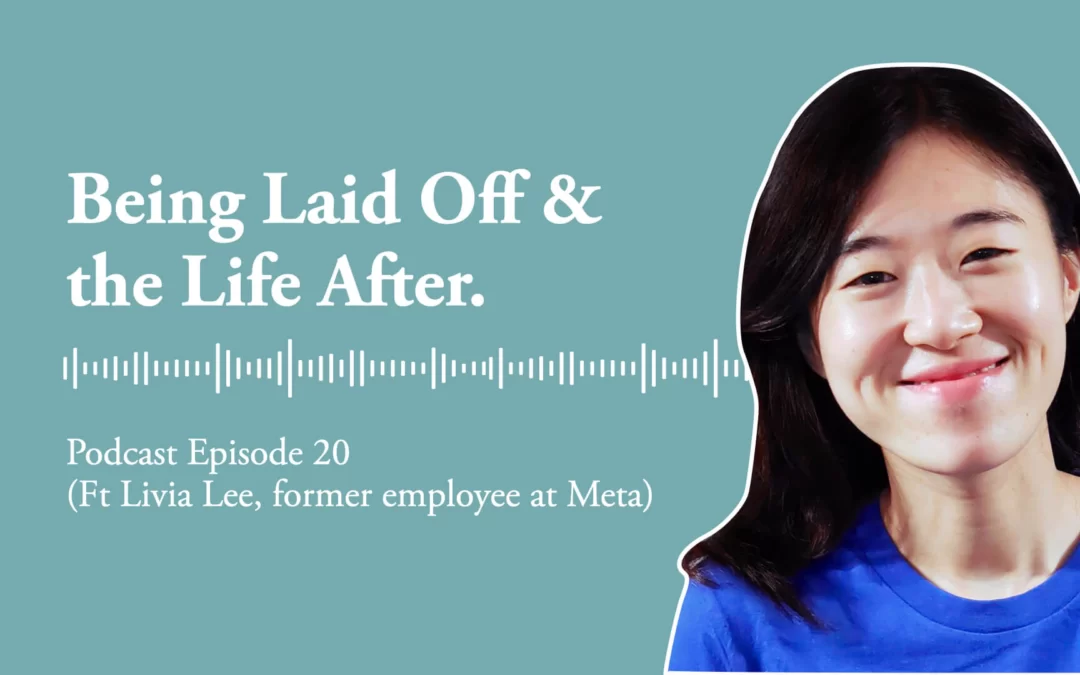
Amidst market turmoil, a looming recession and the Russia Ukraine war, the number of global tech layoffs has been rising at an alarming rate. These layoffs are also hitting really close to home. Singaporean employees are getting axed from top tech companies such as Microsoft, Twitter and Meta. This year alone, we have already seen 850 tech companies laying off a total of 136,000 employees so far, and this number has been rising gradually across the months. My name is Cheryl, and welcome to the Handful of Leaves podcast, and we speak to Livia today on the topic of layoffs. Livia was an ex- Meta Diversity Programme Specialist, and is one of the 11,000 people who are impacted by the layoffs in meta globally. I will be speaking to her about her experience, what has she learned throughout this entire layoff journey, and how can others take care of themselves in an uncertain job climate. And of course, how can you be a helping hand to friends and others experiencing a tough situation like this.
Cheryl 01:12
Hi Livia. Welcome to the podcast.
Livia Lee 01:16
Hi, Cheryl.
Cheryl 01:17
Being laid off is something that not many people are proud to have as a badge of honour. I mean, if you see LinkedIn, everyone is talking about how they get promoted, how they move on to the next amazing project. But when it comes to something like layoffs, you know, it’s very, very difficult. Not many people are very brave to share about it. So thanks. And I think we can speak a little bit more about your experience, especially because you experienced it firsthand. So maybe tell us, how did you find out? When did you find out that you were going to be laid off?
Livia Lee 01:47
I actually have a couple of thoughts on this. I think LinkedIn has changed. I think this whole layoff experience has actually changed LinkedIn, right? Like LinkedIn used to be the place where people only share positive news and people only share, “Hey, you know, I got promoted,” “Hey, I got this new certification,”. But I actually liked the fact that people are being a lot more honest. On LinkedIn these days, I feel like being laid off is no longer like you say, it is no longer a badge of shame. And there’s a lot more transparency and I actually really like how LinkedIn then becomes a source of support. As far as I have known, I’ve almost only known LinkedIn to be a positive influence. So many of my fellow friends, fellow colleagues, come on LinkedIn to talk about their layoff experience. And almost immediately there’s this like, massive, you know, show of support, love, people in the extended network and past colleagues coming on saying,” I’m so sorry to hear this, how can I help? So yeah, I actually think LinkedIn has been actually a very, very supportive tool.
Cheryl 02:54
I agree. I do see a lot of encouraging posts online as well, where managers are just advocating for the good people in the team. Just very happy to share even though they’re, they’re in challenging spaces. Tell us a little bit more about your your experience of being laid off.
Livia Lee 03:11
Let me be honest, right, no layoff experience is pleasant. Let’s just be honest about that. I would say that my layoff experience is maybe a little bit different from most other people’s because, first of all, I sit in the recruiting team. And a lot of times recruiting tends to have an early sense for these things. Because we are closer to growth headcount, and when budgets are tight, and costs cutting becomes a priority, recruiting headcount has to be one of the first few that will be pulled back. We’ve known that something’s up for many months. And, of course, that ties up together with a company’s financial situation, which, you know, of course, we report quarterly. But I think for the Meta layoffs, specifically, there was a big leak in the Wall Street Journal four days before it actually happened. I woke up on a Monday morning to this big news. To some extent, you know, we knew that it might come, we knew that there was a high likelihood it will come, we just didn’t know when or we didn’t know how deep.
Livia Lee 04:47
I think when this was leaked in the Wall Street Journal, there were rumors at the time, on whether it was 11%or 10% headcount? Of course, we knew it will come to us, you know, and so it was a very tumultuous time. I did need Monday to myself to, you know, just get through my own emotions.
Cheryl 05:10
Monday was the day that you heard of the leak?
Livia Lee 05:15
Yes, Monday of that week, it was on The Wall Street Journal then, of course, the news came through on many different other news channels. Tuesday, Wednesday, I made it a point to go into the office. I think that was actually very helpful to be able to be there in person with some of my fellow colleagues and teammates.
Livia Lee 05:37
I would say that, there’s probably three big factors that, you know, affects how a person experiences layoff.
How the company executed it.
Whether your manager has prepared you if they even can.
How your team responds.
And I think the third, for me was very important, because I think it helped to have people around me, who didn’t necessarily take a very big doom and gloom response of the situation. I think in a team where a lot of us felt, you know, come what may (and appreciating that) it’s been a good run. So I think there was a lot of the approach that we had. And in fact, nobody really knows what’s going to happen. Some of us sat together, and we were making semi-serious jokes about, you know, what would you do afterwards? And I think some of us were talking about, now I can go and start that business that I always wanted to do, or I can go, you know, pursue that, like property agents certification, you know, hey, that markets going well. You know, my childhood dream was going to be a window washer.
Cheryl 07:00
Window washer, the one that is like Spiderman.
Livia Lee 07:02
Yeah, you know, It’s fun to look into, like office windows and to teach people and to wave and, you know, surprise them in meetings. It’s fun, you know. I always wanted to be a grocery clerk, you know, go to NTUC and help people to pack groceries. And I always thought that was that was a fun job. You know, those those sorts of things. I think a little bit of human never hurts. And I think there were some jokes about how, “Oh, my card doesn’t work on the printer. That it, my system access is locked in. I’m out.”
Livia Lee 07:40
But I think it was definitely also big pockets of sadness, for sure. There were teams that got together and people were crying. People were hugging people, coming in and clearing the desks. Like, I’m not even kidding. I think that’s to the extent that we knew that this was going to hit our organisation hard. It was hard because being in APAC working for a US company, we may not get the news at the same time as other regions do. So turned out that our region had to wait a full 12 hours, before we were going to get our news, and that was going to come to us at 6am on Thursday. On Thursday morning, we had no idea what time, but about six I got my email. And yeah, you know, fortunately, by the time, we had set up our various respective team Whatsapp group chats to stay connected.
The first emotion I felt was actually gratitude. And so pretty much the moment I knew, you know, my first text was in the group chat was, you know I’m really, really grateful to have been able to work with such an amazing team.
Cheryl 08:53
Wait, so just to check that gratitude is not like corporate BS, but something that you really mean?
Livia Lee 09:00
I’m sure that sometimes it’s corporate BS. I’m blessed that at least, you know, I think in Meta and our organisation, the people that we have been able to work with are really truly amazing. Like, I could not have asked for a better team, or a better manager. And, yeah, teams are really, really close where I was. And that’s actually what made it hard, because it really felt like the disbanding of family. Honestly, I think even now, it’s been more than 30 days, a lot of us are still in touch, you know, sharing job opportunities. Even now, yes, a lot of people are still looking for a job, even especially the ones that need it.
And yes, we think the general sentiment is, the saddest part is that we know that it will be difficult to find that kind of family feeling again, finding those teammates that are so supportive of you your work and who are really invested in you being successful and that was so collaborative. That type of environment was very unique to the culture that we have built in our organisation. And it’s, you know, it’s kudos to the leaders. But of course, it makes it even harder, you know, when so many of us are let go. In our organisation, it was definitely the majority was let go.
Cheryl 10:22
I find it very beautiful, because even in the lead up to the day that you got laid off itself, there have been so many different kinds of emotions that were present, even from the jokes that you were telling, some people were using maybe the, dark humour, you know, they kind of jokes as a coping mechanism, perhaps to cope with how they’re feeling. And it’s complicated, because first, you didn’t hear it from your manager first. You hear it from a leaked article. So that is bound to give you a little bit of feelings as well.
But what bubbled up was gratitude. And I can really see even from your eyes when you’re speaking, you’re just really like, kind of remembering very fondly of how precious the team was, as well as how you know you are not able to easily find it in any other organisation as well. And actually, even till this day, because I do have a lot of friends as well who are impacted by this. I see on their IGs, the colleagues continue to be a very, very strong support system for them that they hang out with each other to go through this.
Livia Lee 11:26
Yeah, I actually think I almost think it’s a blessing that happened en masse, because it means that we can be there for each other. One of the first things that happened was, you know, when we all of course, had access to each other’s contact, a lot of WhatsApp group chats were set up. And so those actually become a very strong source of support. A lot of post events, or post layoff questions and uncertainties can be verified there.
Livia Lee 11:59
I mentioned the three factors, right, that I guess, affect a person’s level of experience. And although I think first of all, we are very blessed that our severance was generous, and I definitely am grateful for that. It helps, especially for those with families to feed.
But of course, I think there are a lot of additional measures that will impact people who are in a less certain situation. So for example, I am local. So thankfully, I don’t have to worry about my ability to stay in the country. But I have many, of course, many other friends and colleagues who are on working visas. And whether it’s an employment pass or a different type of pass, then the next question is, well, how is the company able to support thankfully, for our company,they did have government support. For instance, for an employment pass. Once that’s ended, you only have 30 days to find another job. I think fortunately, in our situation, the will be converted to a short term visit paths. And that will actually extend another 90 days for them to be looking for a job after your last day of employment. But, then the next catch is that a lot of this is happening over the Christmas period.
Cheryl 13:14
Most companies are not hiring.
Livia Lee 13:17
Most companies are not hiring towards the year end. B. This is the time when a lot of people want to go home and see their families on a short term visit pass on a single entry visa, basically, you can’t come back, you know, it wouldn’t be granted. This means a lot of people have to stay in the country. And you know, of course, prioritise your job search, right, and the market is saturated with laid off talent. It’s not ideal, but you know, at this point, any kind of support helps. Yes, then there are a lot of you know, logistical questions, you know, benefits questions, a lot of those things. So, again, having everyone around you helps, you know, because then we can do things like collect questions, we can do things like share responses. So, yeah, it’s definitely been very, very helpful.
Cheryl 14:07
And I think the thing with also having a group of people in a mass layoff is that it helps a little bit, I guess, in not taking things personally, for example, like if you’re fired, then it could be very much obviously, because of my performance. But in this case, where you see even the top talents are also being let go, it really helps you to, I guess, cope a little bit better. Knowing that this is something that is not personal to you your identity or your performance.
Livia Lee 14:37
Yes, definitely. The first few days were definitely the hardest, although there, there are all these lists circulating for you to voluntarily put in your information but you really only know who are the people you care about that are impacted by reaching out directly or by word of mouth.
Livia Lee 14:55
I guess the hard part of that is that it does become tiring, I won’t deny. And I think for me, for example, I’m a borderline extrovert introvert, and I do get energised from the people around me. Whereas, I do have other friends and colleagues were impacted, who honestly felt WhatsApp fatigue setting in very, very fast. And it does become tricky for them when you know everyone responds to a layoff differently.
Livia Lee 15:39
First of all, there is definitely denial in a lot of cases, and not everyone is ready to share externally that, “yes, I was one of the many who was laid off. Yes, I need help.” And a lot of people don’t know what to say and don’t know how to respond to all these very, very kind messages.
When someone reaches out to you with a genuine message of you know, how are you? Are you okay? Are you really going to reply to them saying, “No, I’m a nervous wreck. I’m like, you know, on my floor, crying because I don’t know, I just lost my job. I don’t know if I can keep my rent. I don’t know if I can stay in the country, I don’t know how I can support my family?”
What are you really going to say?
Cheryl 16:17
Yeah, because when we talk about work, it seems like it’s just one aspect. But to many, many people, work is the anchor for so many other things. It gives people the freedom to pursue what they are passionate about on the side, it helps with the family, paying off bills, and for some, it’s even the identity for them. It is their entire self esteem that is built around it. So definitely I can understand when you when you mentioned everybody takes it differently and hits home very, very differently as well for every single person.
Just out of curiosity as well. Where do you place work in your life? And how does it tie in with your personal identity?
Livia Lee 16:57
Deep question. I’m gonna have to think about this one. I think it’s a huge part of really, I think not just my own, but you know a lot of other people’s identities. Frankly speaking, a lot of us spend at least nine hours at work, if you’re in a full-time job. Yeah. So I think work going well, has a very, very big bearing on you know, your own mental overall mental mental wellness and mental health. And I guess your overall happiness as well. I’ve noticed myself that when things go well at work, I’m actually better equipped to deal with difficult things that (other aspects of) life will throw at you. For instance, I’m in a better position to be there for other people as well, when work is going well for me. And on the flip side, you know, when the work or career situation is not going well, it really becomes challenging too. For instance, I know that my ex and I used to argue a lot when either one of us was unemployed. And once, even both of us, that was not great.
Cheryl 18:18
So it almost seems like how work goes is like the foundation of how you show up in other aspects of life?
Livia Lee 18:26
Yes, I think so. And sometimes I actually think that you could see it the other way around where you know, your own mental state will affect how you how you view and how you respond to your job and your work. Honestly speaking, if you have a crappy boss, if you have unsupportive stakeholders, and you’ve got so many obstacles being thrown at you, there’s only some extent to which you can say, “Oh, let me be Zen about it.”
Cheryl 18:54
Yeah, 100% Yeah.
Livia Lee 18:56
So I think when you have exciting challenges at work, you know, when you’re thriving, you know, when you have good colleagues that did that you can work with, it really puts you in a better space, just overall in life.
Cheryl 19:11
But I think that is also very scary, right? Because then your happiness or your balance, your Zen-ness is very dependent on these external factors. And these external factors are always changing. So it’s almost as though you’re anchoring your happiness on a very unstable leaf that is constantly shaking.
Livia Lee 19:32
What an analogy.
I would agree with you only now because I’m out of a job but you know, it’s not necessarily true. You know, there are a lot of people in very, very stable careers, you know, I think, in the government, for example, here we will call it a steel rice bowl, right? Because that’s where people sign up for, that stability. People sign up for that kind of, you know, being part of a big organisational structure that will allow you to put food on the table no matter what happens.
Cheryl 20:01
But is that ever guaranteed? Nothing can ever be guaranteed, right? What if, what if there’s a war that breaks out in Singapore? You can say, Yes, I join it for 90% certainty, but there’s always that 10% or 1% uncertainty that is bound to happen, because that is just how life is right?
Livia Lee 20:21
And I think that’s where, you know, Bruce Lee says, be like water. You just kind of have to go with what life throws at you, right. But I think that there are really a lot of people who conscientiously carve their career path, to give themselves that certainty. And similarly, on the other side, you know, you have, for instance, serial entrepreneurs who choose risk, and who choose the ability to take those big bold steps all the time, and may make big risky investments, because of the epic returns.
Yes, you are, right, we do peg a lot of our life to this big external factor of work.
Livia Lee 20:59
And that’s where I actually always say when it comes to planning your career, being conscientous about how you carve that out, and how you plan your next steps. One of the books that I actually really, really love, it’s actually called Designing Your Life by two Stanford University professors, and it was something that really, really helped me, because it really allows you to apply design thinking, or design principles to your career.
Livia Lee 21:32
One of them is things like, you know, being able to develop blueprints to experiment before you really plunge into something to fit in. And part of that is, for instance, laying out, say, right now, in exactly where you are, in this moment, if you were to develop three brand new five year plans ahead of you, what would they look like?
It could be continuing a corporate job, it could be starting this new business or dream that you always wanted to pursue, or it could be something else entirely. And I actually think this is a very, very good time, especially for those who are laid off to really take that step back, because we almost have a forced pause. And I guess, what is the best way to make use of this forced pause, right, is to really take the chance to reevaluate, what you’re going to do next? And how is that going to allow you to invest in your future self?
Cheryl 22:31
And how has that looked for you with the nine to 12 hours being taken away, right, like time that you could be occupied at work? Now, you just have this void there.
How has things changed for you? And how are you reevaluating your priorities? Or do you already know them?
Livia Lee 22:47
First thing I did when I knew what was gonna happen was to craft for myself a 3 day plan, a one week, to help me determine what do I want to achieve in the first three days or the first one week or the first month?
And part of that involved A, you know, of course, you know, writing all my LinkedIn recommendations and thanks and all these things. But of course, part of that was also to evaluate my options. Within my first week, I wanted to know what those options could be. And within my first month, I wanted to be able to have done the research to evaluate, to elaborate a little further on those options. One of the big options that I’m leaning towards right now is to really take the time to go into my masters. And I know that a lot of people don’t have that luxury or that option. Because, of course, then pursuing your next full time job is is a big priority for a lot of people for sure, out of necessity.
Livia Lee 23:49
There are other people who actually might, you know, want to spend more time with family and then start to go into part time options and things like that. But for me, I never had a concrete certification in my area of work. That means, you know, HR and anything related, and I actually did think that this is a good time for me to pursue that. Especially because right now the market is maybe not in a great space. So hopefully in the next you know, 12 to 18 months, this will allow me to know to really give me a better grounding for my next hopefully 10 to 20 years of my career.
Honestly, this just becomes a big undertaking too, to sit down and really evaluate all your different options locally, regionally and globally. You know, what is financially prudent and what is literally safe as a female Asian, considering living abroad, like what are the safe options and looking up, you know, gun laws in different states and all these things. All of that comes into the picture, right?
Cheryl 25:01
So I feel that, you know, what you have mentioned seems very daunting, very overwhelming. There’s so many considerations that you have to think about, you have to dig deep and ask yourself the questions, identify what your priorities are. Were there any questions that helped you immensely in your self reflection, to decide what the next steps could look like? Or make things a little bit clearer now that you’re in this forced pause moment in your life?
Livia Lee 25:28
Yes. Number one, what are my new priorities? What are they going to look like?
First of all, can I afford the time? Can I afford the money to go into, you know, pursue further education? What is that going to mean for my family? And how much time can I afford to be away? For example, should I pursue a full time or part time? And what is that going to mean financially? What is it going to mean for, again, for my family? Where can I do it? Or where do I need to do it? Do I even have the option to do it outside of Singapore.
Livia Lee 25:28
But over and above this whole studying piece, it’s been a really good time. It’s allowed me to pursue different things. For example, I started rock climbing for the first time.
Cheryl 26:14
I didn’t know you started it for the first time.
Livia Lee 26:16
Yeah, I never have. And now I could actually say yes to social activities or different sorts of, you know, workout options, that, you know, people might have invited me on, but I never really had the time to go for. I realised that it changed the way I relate to my friends. I do now actually have a lot more time to spend with the people who are important to me. I’m actually in the headspace to really pay them 150% attention because my head is not like cluttered with all the things that are pressing at work.
Furthermore, I think this is actually a time when my family has decided “hey, why don’t we actually explore during that renovation that we wanted to do 10 years ago, when we never did.” Maybe some of the things that we wanted to do, right, when we were really, really busy, but you just never really had the time or attention to do it. And now you can afford the energy.
Cheryl 27:08
I think from your sharing, I got two points. And I thought it was very, very interesting. So the first is that I really liked the term that you use – “forced pause.” And I feel it’s so crucial, because a lot of times, we are busy, and we take pride in being busy, and that can actually be a coping mechanism for us to choose the path of certainty and a path of stability.
Sometimes what you really want, what your heart truly desires is something that maybe is very scary, and it feels very fearful. So you just kind of push it away, push it away and use “busy” as a justification or excuse to, you know, not face it. But now that you have the forced pause, all these things come up, and you actually think about it as like not too bad of an idea to consider this path. Precisely because you don’t have anything to lose, it opens up so many more things for you (to try).
Livia Lee 28:02
Absolutely. Like, I know, your listeners can hear me nodding like crazy at every word. I think the opening up of a lot of options is actually what surprised me. Because, you know, you may feel like you have a void or vacuum to fill. And honestly, it’s actually very easy to get busy doing not much. I think you choose your path, right? Sort of like a jigsaw puzzle, right? The different pieces that you can bring into your world and the analogy of filling your jar with the big rocks. You choose carefully the big rocks that you put into your life right now and it can actually be very, very fulfilling too.
Cheryl 28:41
For me, it’s really helpful, especially when you say that there are different parts of you that are important and meaningful to you that starts to become a little bit more obvious. And why that’s meaningful to me is because I think for me, I’m pretty much a very black or white person at some times. So for me, it’s either you have work, or you have no work, life is great or life is shit. It’s comforting to find out that when there’s no work, there’s other things that will still make life a little bit better and your life is not complete shit.
Livia Lee 29:17
Oh, yeah, I mean, friends, family, physical health and nutrition. You’re right, like the forced pause of being laid off actually forces you to realise or turn to all these other areas of.
Cheryl 29:31
Absolutely. And I also wanted to share something that you reminded me of, which is there’s this Sutta called the Salattha Sutta, which is basically meaning like the two arrows discourse and it’s very interesting. So, the Buddha compared two people right, so one who constantly reflects on the nature of impermanence, the nature of life, as you know something that is very impermanent, things are always changing, and one person who doesn’t reflect on any of this.
Cheryl 30:01
So both of them will get hit with one arrow, because that’s just the nature of life. That is the arrow of suffering, the kind of suffering that is, you know, when you age, when you grow old, you have sickness, or just the suffering of not getting what you want, or getting the things that you want, separated from you. So this is the nature of life, and both these kinds of people will get the same first arrow.
Cheryl 30:28
But the person who doesn’t reflect, the person who doesn’t understand that this is the way things are, they will get hit by the second arrow. And the second arrow is where in layman’s term is more like “you complain lah, you you just kind of sit in your shit for a while.” But like in nicer terms is called like sorrow, you have lamentation and you have pain that adds on as a second level of pain.
Cheryl 30:51
So the Buddha did share that whenever we are in these kind of situations where things don’t go the way we want, reflect that these are just part of life. And sometimes we just gotta accept it.
Very interestingly, I think he also did share these 8 things in life that is very subjective to the nature of change, the nature of like, coming and goings. These eight wins, which are in pairs: pain and pleasure, gain and loss, status and disgrace, praise and blame. So when you get gain, when you get praise, you don’t delight too much. And when you have loss, you have disgrace, you have blame, you know, that’s just something that will go away, too.
So I just thought to share that, as I think how we naturally tend to react in all sorts of emotions (due to these winds blowing in all directions) is as per the second arrow. But in your case, I do see how you really in a way rise through it and really see the good, see the silver lining, and allow for pockets of new things to just come up to you and surprise you in a way.
Livia Lee 31:50
So sweet of you here, Cheryl. I love those analogies. And to be fair, I would say that the first thing is part of getting through the hard part is not fighting it. Yes, absolutely, don’t allow yourself to continue and, you know, being hit by the second arrow to like dwell on that pain.
But I think part of not dwelling, is actually not denying it in the first place. I think that’s the hard part. And one of the very important parts of, you know, grief, (because frankly speaking this is like mass trauma). There’s like, literally news delivered overnight typically in an email, that even if it’s written as nicely as possible – it is still a difficult email to receive. Especially in Asia, one of the things that we tend to do is to hide or to deny our emotions. And I actually saw that in a lot of the responses that I got from people, right, which was, “how are you, hope you’re okay? Here’s, here’s a job opportunity, send a link.”
Livia Lee 34:44
One of my first big emotional releases was when I first received the message from someone who was still in the company and was feeling immense guilt, and her message to me was, “Hey, I saw that your profile is deactivated, this was so upsetting. I’m angry, I’m frustrated, this should not happen to you…” She gushed on and on about our partnership and how she enjoyed working with me and how she felt. It was her ability to name the way she felt about the whole situation that really had an impact on me that I was very surprised by. Being able to name her emotions allowed me to look at mine, and say, you know she’s right, I’m frustrated and I’m angry too and that was all bittersweet, and that was the first time I cried. And that was 3-4 days later. I feel that release was important.
Being able to see that for yourself and not deny the complexity of your emotions allowed me to move on from what you call the shithole, which the cesspool of negative emotions.
It was confusing for alot of people, the hard part is first identifying what you’re going through and not allowing it to be a pity party, and embracing the opportunity and the silver lining for sure. I think part of it also involves looking at it face on, and not saying “Oh, I can’t afford to feel all the negative emotions, and focus on being productive or happy.
Cheryl 34:49
or being grateful only.
Livia Lee 35:04
That becomes toxic positivity. That’s also not great.
Cheryl 35:07
Yeah. 100%. Yeah.
Livia Lee 35:09
But yeah. And then, like you said, all the elements are true of the human condition. Right. And, you know, it’s not healthy to be stuck only the negative portion. But it also isn’t healthy to be stuck on, you know, all the positive parts of things, because that’s who we are. Right?
Cheryl 35:26
Yeah, yeah, that’s not the nature of life. If you only pretend to see the bright side, you have to embrace both the dark and the bright side, and that makes you a full-fledged human.
Livia Lee 35:35
That also allows you to be honest with yourself. And that’s honestly difficult. So I actually appreciate when sometimes I meet with, you know, some of us who are laid off, some people operate better in a group, some people operate better one to one, I think the hard part is really knowing what you need. Now, honestly, I think those who need support are not only the ones who are laid off, but even the ones who are not impacted.
Livia Lee 35:59
First of all, there’s so much uncertainty for my colleagues who are left behind. So many people have left, a lot of times even leaders have left. Suddenly, you don’t know who you’re reporting to, you don’t know the new division of work.
Cheryl 36:13
Some have no managers too.
Livia Lee 36:15
Some have no managers or skip levels, you don’t know what’s going to happen to the org, a lot of times restructuring follows. And you don’t know what the new responsibilities will be, you know, towards the year end we don’t know how to do our year end planning. And so there’s a lot of uncertainty for the ones left behind.
Livia Lee 36:37
I’m actually curious to hear from you, you know, like, for for you. And you know, so many people in the industry around you who have been laid off, like, how does that make you feel?
Cheryl 36:46
I definitely do feel the anxiety at the back of my head, like subconsciously. But at the same time, I feel that I have things to do right now. And I will just put my attention there, because this is something that is way out of my control. If it happens, it will happen. If it doesn’t happen, maybe it will happen couple of years later, who knows, right? Like layoffs are part of just the working life. And even if it’s not laid off, maybe you get fired, or whatever. Any kind of worst case scenarios could always happen. So I think I’ve just resorted to just not wanting to put my time and effort into thinking about it. Because one, it is anxiety inducing for me and I don’t cope very well with a lot of anxiety.
Second, I do have my hands quite busy with a lot of things at work, so I will just take it one step at a time. Yeah, and I do definitely resonate with having colleagues who are open and you know, talking about this as well.
Cheryl 37:42
It helps you to feel less alone, and it helps you feel like we’re in this together, if we are in trouble, we are kind of in trouble together. You know, like, like a bunch of like naughty kids getting punished together. It feels a little bit better. Yeah, so yeah, that’s my experience. I don’t know maybe one year later, I talk to you. I’ll be like, what, I can’t imagine I was a recruiter.
Livia Lee 38:08
Yeah. And you’ll be telling me you’re in a much better place now doing one.
Cheryl 38:12
Eh please don’t throw shade. Some of my colleagues, listen to this. Kidding kidding. I love all my colleagues.
Livia Lee 38:23
Oh, no, but you’re absolutely right. Like, it’s there’s no point dwelling on something that is unsettling. You know, yeah, there’s no point being unnecessarily anxious or worrying about it unnecessarily. Right. That being said, if I think back to before we even knew about the layoff, one of the things that was helpful for me, was to just have a backup plan in place.
Livia Lee 38:50
The recruiting organisation tends to have a lot of foresight into what might come. And so literally, it became sort of dinner table or lunch table talk, right? Which was,” hey, you know, if this happens, what will you do?” Like you, (hopefully not like you), but up until the very last day, I too, was super, super busy. And I think one of the things that helped me to focus 100% and to continue to give my full time attention and energy at work was to know that in the back of my plan, I have a backup plan that I’m very happy with and that I can put in place at any moment. Of course, things have changed and my backup plan isn’t the same now. At that point, what I thought it would be my backup plan was to literally give myself a very well deserved break, you know, go off to one of my favourite Southeast Asian countries and go go go hike, go to different temple every day and you know, go
Cheryl 39:54
Sounds like Thailand already.
Livia Lee 39:56
You know. Of course You know, my initial plan involves, like, you know, weeks and weeks of doing this in my own little like, Zen hiding hole. What has actually happened, of course, has transpired very differently. But that is still, you know, part of like my travel plans in January. I think just having that plan that made me comfortable, and emotionally happy, and it was something that I could think of, or even semi look forward to, you know, gave me that peace of mind.
Livia Lee 40:27
And, of course, the next thing that I could look forward to us, if all goes well, this is what will happen. This is my work plan, you know, after I’m busy with like this big events, then these are all the new programmes and initiatives, I can focus on getting stuck into, like plannings, where I can look forward to at work in the following year, and all of that. So, if you give yourself kind of two bright, paths look forward to right, whether you’re laid off or whether you’re not laid off, right, it doesn’t matter what happens, then you have something to look forward to.
Cheryl 40:59
That’s actually very important, because I tend to just avoid it and not think about it and just like, hope it doesn’t happen. So yeah, I think it’s good to anchor and build some sort of certainty almost, when I have like, at least a rough plan of the two best and worst case scenarios.
Cheryl 41:17
Yeah, so that’s good advice. Thanks for sharing it because I think this is also probably very relevant for everyone. I mean, it’s just not great times for a lot of different industries. For everyone who’s facing a potential layoff or have fears that they may be laid off soon. For all the listeners. Thank you for listening to the end of our podcast today with Livia and thank you so much, Livia, for coming out and sharing your personal experience, your stories, your learnings. And if anyone wants to get in touch with Livia, feel free to reach out to her LinkedIn, we’re putting a link at the bottom. And if you liked the podcast, give us a five star review. And may you stay happy and wise. Thank you