When the layoffs started, I thought I was untouchable. As a high performing recruiter at one of tech’s biggest firms, I had it all – a comfortable life, the travel, and the premium free food. My career was a large part of my identity.
Then the dreaded town hall happened. “We have to make some difficult decisions…” my boss announced grimly at 12am. Turns out I wasn’t so untouchable after all. Getting laid off at 27 felt like a scathing breakup text from someone you thought you’d marry.
Those first few months were rough. With no job routine to cling to, I zamboni’d between the fridge and doomscrolling Linkedin day after day (who does that, right??) , wallowing in self-pity . Who even was I without the prestigious job title and firm’s colourful T-shirts? A nobody, that’s who.
But as the weeks drifted by, something shifted. Buddhism teaches that nothing is permanent – all phenomena, including our careers and identities, are constantly changing. With no emails pouring in at all hours, I started rediscovering hobbies that gave me joy simply for joy’s sake – talking long walks at 9am on a weekday, going on long meditation retreats, and having catchup with the old and new mates I’d been too “busy” to see.
The Buddha emphasized the importance of spiritual friendship and community for our well-being. Freed from the golden handcuffs of constant performance, I reconnected with my true, non-office bredren who reminded me of my humanity beyond my job description. We laughed, reminisced, and soaked up all the wholesome inklings I’d been quashing.
That’s when it hit me – my career had become an all-consuming, cruchy cage without me even realizing it. Like many Singaporeans, I had succumbed to the toxic view that my career is my identity. By fixating intensely on my career, I’d neglected the very delights that nourish the soul – close friendships, playful passions, and savouring small joys. No wonder I’d been numbing myself with endless grunt hours and gallons of overpriced flat whites!
Buddhist teachings, like those shared on the Handful of Leaves podcast, remind us that clinging to any temporary state causes suffering. As the guest Amy shared, it’s crucial to find joy and purpose in your work itself – not just chase external success metrics. I had lost sight of my deeper “why” amid the rat race.
Don’t get me wrong, I’m stoked to be gainfully employed again. (Rent don’t pay itself, amirite?) But getting laid off unshackled me from the toxic workplace I’d imprisoned myself in. These days, in line with the Kalama Sutta’s advice, I rely on my own discernment rather than society’s career fixations. I no longer rigidly self-identify as just “XXX, techie .” I’m exploring different roles and companies that align with my values for long-term fulfillment, not just for a fancy performance review.
If you’re stuck in that same toxic grind, here are 3 wise steps:
Prioritize purpose over promotions. Nurture playful inklings and community interests beyond corporate ladder-climbing.
Invest in nourishing friendships, as the Buddha taught. Surround yourself with people who remind you of your multidimensional humanity.
Regularly pause and realign. Reflect on whether your current role aligns with your core values and allows space for continued learning and growth. Be willing to pivot if not.
Now, I’m not saying you need to totally disengage from your career either. For many of us, our work is a key part of how we contribute to society and find a sense of purpose. There’s value in applying ourselves diligently to our professional callings when it aligns with our interests and values.
The CEO of a social enterprise improving education access for underprivileged kids may rightfully view their career as integral to their life’s mission. A passionate surgeon might find profound meaning in honing their craft to save more lives. If your career allows you to have a positive impact in an area you care about, by all means, lean into it!
The key is to avoid letting your job totally subsume your identity to the point of spiritual stagnation. Make sure you’re still nurturing other areas of life like family, friends, hobbies and personal growth. But if your work itself is a positive force that energizes you, embrace that too in balance.
At the end of the day, our sense of self-worth should stem from our full, enriching life experiences – not just our job titles or salaries. My layoff was an abrupt yet invaluable wake-up call to stop deriving my entire identity solely from my career persona.
Sure, I’m back in the daily grind. But this time I’m consciously allowing space for the people, passions and simple joys that make life feel purposeful beyond any office role. Getting laid off allowed me to realign my priorities with Buddhist wisdom – and ultimately craft a more sustainable, fulfilling existence that positively impacts the world while nourishing my whole self.
Our careers are What We Do, not Who We Are. The layoff was a Buddhist wake-up call – a reminder to realign my self-worth with my deepest values beyond any office role. Sure, I’m back hustling now. But this time, it’s a more purposeful pursuit allowing space for life’s true treasures outside of just my job.
In the pursuit of a fulfilling life, understanding the intricate relationship between contentment and ambition is paramount. From young, we’re conditioned by the unforgiving expectations of society to strive for the highest excellence that permeates every aspect of life, so much so that 9/10 people in Singapore are stressed. On the other hand, contentment is often misconstrued as passive acceptance, the lazy man’s shortcut, and is seen as the devil’s advocate in any successful person’s book.
This mentality is deeply ingrained and for some, contentment should not even exist. I remember a conversation with a friend while hiking the Fort Canning Park and we were debating about ambition versus contentment and could not come to an agreement. Eventually, she ended with, “Why be content? We only have one life, why settle for the present when there could be so much more the world could offer? If I were content, I wouldn’t be doing anything useful.”
Perhaps we need to dig into the highly misunderstood term “contentment.”
According to Search Inside Yourself Founder, Tan Chade Meng, who shared on our podcast that contentment is not a behavior. It is a state of mind characterized by inner peace and gratitude, irrespective of external conditions. Meaning, contentment does not mean doing nothing. Doing nothing is a behavior. Instead, as a state of mind, whether you do a lot or whether you do nothing, you can be content. You have the same state of mind.
The bizarre thing is, Meng even observes that the most content people, such as enlightened teachers he knows (and he knows alot of cool people), are the busiest people! There’s a lot of active effort to serve the community, to relieve suffering of others.
Contentment holds the delicate balance of accepting this moment as being perfect, just as it is; And yet, seeing the potential to do a lot more, and then, having saint-like wisdom, to not grasp at the outcome, because this moment is perfect, just as it is! That is right contentment.
Sounds complicated eh?
But to understand this, contentment cannot be simply viewed as an intellectual exercise. But rather, let me take you to a moment where you’re feeling happy, content and peaceful, chilling on some beach with a nice book on hand, don’t you just have the natural tendency to smile at people, be nice, help others and wish for them to thrive?
When individuals feel content with their own lives, they are more likely to have a positive outlook and be emotionally stable, which allows them to focus on the needs of others. Contentment reduces feelings of envy, competition, and insecurity, which are often barriers to serving others selflessly. Additionally, content individuals are more likely to appreciate the value of giving back to their communities and derive fulfillment from contributing to the well-being of others. This sense of fulfillment reinforces their contentment, creating a positive feedback loop that motivates them to continue serving others.
So, imagine THAT state of mind being the default? Wouldn’t we have a much happier nation and less burnout individuals?
Now, how can we apply that to ambition? Can the two interlink? Ambition clearly can be a force that motivates action and change that brings fulfilment, however the problem is most of us in the rat race only learnt to pursue it as a relentless quest – without ever achieving a state of satisfaction.
We probably have been familiar with the anger, frustration and stress when things don’t go our way, and we cannot achieve our ambitions and when things suddenly don’t go our ways, the inability to accept anything other than our goals can even make one spiteful. All this for the sake of ambition. What if there is an alternative?
Meng shares this relationship between contentment and ambition that I think can be a key to happy success:
“If you have the right kind of contentment, then you’ll be successful. It grows your ambition. If you have the right type of ambition, you will grow your contentment. The right kind of contentment is contentment based on Samadhi. And the right kind of ambition is the ambition for all things wholesome. These two work together, to reinforce each other.”
To truly grasp the dynamic relationship between contentment and ambition, let’s examine real-world examples and we begin with the legend, Mr Siddharta Gautama, or better known as the Buddha.
As Buddha embarked on his quest for enlightenment, he sought contentment not in material possessions or worldly pursuits but in inner peace and spiritual fulfilment. Through meditation and introspection, he cultivated a profound sense of contentment with the present moment, transcending the fluctuations of desire and aversion. This inner contentment provided him with the clarity and resilience to navigate the challenges and obstacles on his path towards enlightenment.
At the same time, Buddha was driven by a profound ambition to alleviate the suffering of all sentient beings. His ambition was not rooted in personal gain or glory but in a genuine desire to understand the nature of suffering and to offer a path to liberation. This ambition fuelled his tireless efforts to attain enlightenment and to share his teachings with others, setting up the fourfold monastics despite facing numerous obstacles and even enemies along the way.
Therefore, while the Buddha was undeniably ambitious in his quest for enlightenment and the alleviation of suffering, his ambition was grounded in a deep sense of contentment with the present moment and a profound understanding of the nature of reality. His profound understanding of the present moment enabled him to pursue his ambitious goal of enlightenment with unwavering determination and compassion, ultimately benefiting countless beings through his teachings and example.
Fast forward 2500 years later, this book “Good To Great” explores the traits of exceptional leaders and organisations, focusing on the concept of Level 5 Leadership. These class of exceptional leaders possess great ambition coupled with personal humility, aspiring for the greater good rather than personal glory. They’re not ambitious for their own glory, they’re ambitious to do something big for this organisation, for the world, and so on, whatever is greater than themselves.The book highlights that Level 5 Leaders are more effective precisely because their genuine dedication to a larger purpose inspires others to follow them willingly.
We don’t have to be the Buddha or Level 5 Leaders (YET!), but we can take a leaf out of their book on how to define our ambitions. Instead of pursuing goals solely for personal gain or recognition, we can aspire to make meaningful contributions to our communities, organisation, or the world at large. Sure, it’s ok to want to become a CEO or a billionaire, but take a step deeper to understand why and what it means to your values and motivations to achieve them. By defining our ambitions in alignment with a greater purpose and appreciating the present moment with contentment, we can contribute meaningfully to our communities and the world at large.
For me personally, simplicity defines ambition. I want to earn enough to be able to contribute significant time and money to causes that I find are inspirational, and do great work in lifting people up and enriching them spiritually, psychologically and mentally! Contentment fuels this ambition by recognising the perfection of the present moment, appreciating the joys of doing what I can with what I have, and building momentum, one step at a time. And while I know the road ahead has a huge potential, success is already a flavour tasted right now, regardless of how much more there is to do.
What about you? How does contentment fuel your ambition?
PJ is someone who discovered Buddhism while procrastinating as a student and later discovered Ajahn Brahm and the Suttas in the executive retreat of 2010 in Chiang Rai.
He procrastinated again on the spiritual path through various roles with the Singapore Economic Development Board (EDB), including industry development and strategic planning. He’s taking his time now working towards being a nobody.
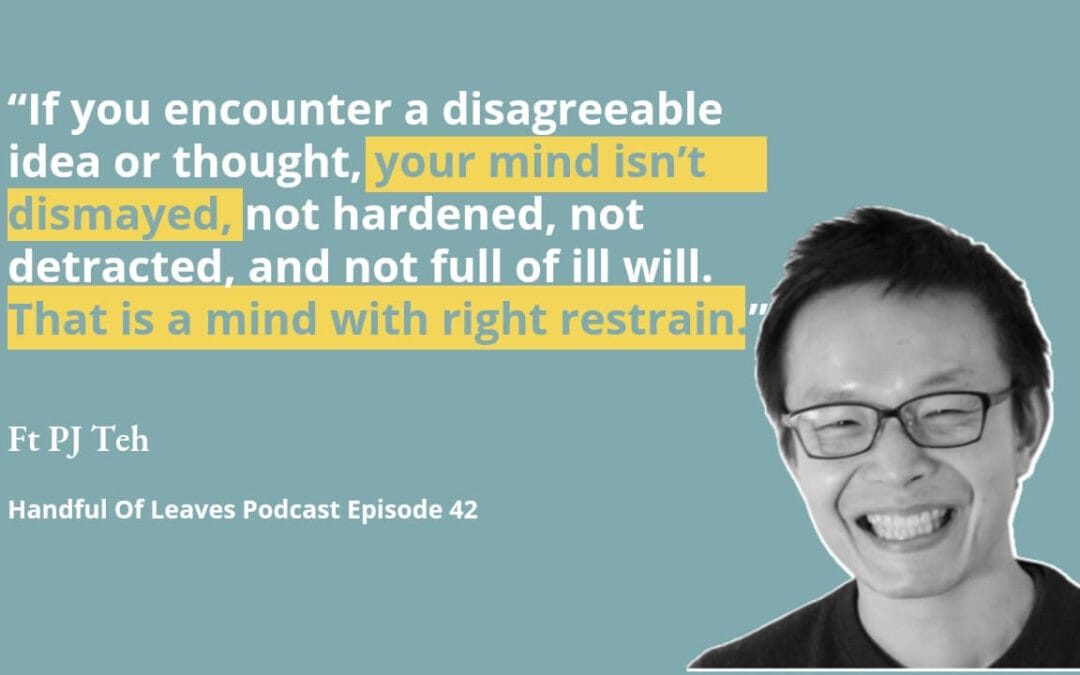
‘Restrain’ in this modern world of freedom and enjoyment seems like a curse word. So when one says restrain leads to peace, to calm and to stillness, what does that truly mean? Cheryl and PJ discusses this.
Exploring the Concept of Sense Restraint
Sense restraint stands as a fundamental principle in Buddhist philosophy, elucidating the practice of maintaining control over one’s senses to foster inner peace and spiritual development. Rooted in the teachings of the Buddha, sense restraint emphasizes the importance of mindful awareness and moderation in engaging with the external world.
Common Misconceptions
Despite its profound significance, sense restraint often faces misconceptions and misinterpretations. Some individuals perceive it as a form of suppression or denial, equating restraint with restriction. However, in the context of Buddhism, sense restraint entails a balanced approach to sensory experiences, avoiding excessive indulgence or aversion.
Amplifying the Need for Right Restraint
Cultivating Awareness and Mindfulness
At the core of sense restraint lies the cultivation of awareness and mindfulness. By developing a heightened sense of consciousness towards sensory stimuli, practitioners can discern between wholesome and unwholesome mental states. Through mindfulness practices such as meditation and reflection, individuals gain insight into the transient nature of sensory pleasures, fostering a deeper understanding of the impermanent nature of existence.
Recognizing Unwholesome Mental States
Central to the practice of sense restraint is the recognition and redirection of unwholesome mental states. By acknowledging the arising of desires, aversions, and attachments, practitioners can refrain from becoming ensnared by them. Instead of succumbing to impulsive reactions, individuals cultivate the wisdom to respond with equanimity and discernment, thereby breaking free from the cycle of suffering.
The Solution: Practicing Right Restraint
Mindfulness Techniques for Sense Restraint
Practicing sense restraint involves employing various mindfulness techniques to anchor one’s awareness in the present moment. Breath awareness, body scanning, and mindful observation of sensory experiences enable individuals to develop a non-reactive stance towards external stimuli. Through consistent practice, practitioners cultivate a sense of inner calm and tranquility, transcending the fleeting fluctuations of the mind.
Wisdom over Willpower
Contrary to conventional notions of restraint as an act of sheer willpower, Buddhism emphasizes the cultivation of wisdom in exercising right restraint. Rather than forcefully suppressing desires, individuals employ discernment and insight to navigate the complexities of sensory perception. By discerning the impermanent and unsatisfactory nature of worldly phenomena, practitioners gradually loosen the grip of attachment and craving, paving the way for genuine freedom and happiness.
Testimonials and Success Stories
Personal Experiences of Sense Restraint
Countless individuals have attested to the transformative power of practicing sense restraint in their daily lives. From overcoming addictive behaviors to cultivating greater inner peace and clarity, personal testimonials serve as compelling evidence of the profound impact of right restraint. By sharing their experiences, practitioners inspire others to embark on the path of self-discovery and spiritual growth.
Case Studies on the Impact of Sense Restraint
In addition to personal anecdotes, case studies offer valuable insights into the practical applications of sense restraint in various contexts. Whether in the realm of addiction recovery, mental health management, or interpersonal relationships, case studies highlight the efficacy of mindfulness-based interventions in promoting holistic well-being. By examining real-life examples of successful outcomes, individuals gain confidence in the transformative potential of practicing right restraint.
Tools and Resources for Practicing Sense Restraint
Meditation Practices for Mindfulness
Meditation serves as a cornerstone practice for cultivating mindfulness and sense restraint. Guided meditation techniques, such as breath meditation, loving-kindness meditation, and body scan meditation, provide practitioners with invaluable tools for developing present-moment awareness and mental clarity. Through consistent meditation practice, individuals strengthen their capacity to observe and regulate their sensory experiences, fostering a deep sense of inner peace and contentment.
Educational Materials on Buddhist Principles
For those seeking a deeper understanding of sense restraint and its philosophical underpinnings, a wealth of educational resources is readily available. From books and articles to online courses and workshops, aspiring practitioners can access a treasure trove of teachings on Buddhist principles. By immersing themselves in the wisdom of the Dharma, individuals gain profound insights into the nature of desire, attachment, and liberation, empowering them to cultivate right restraint in their lives.
Conclusion: Embracing Right Restraint for Inner Peace
Summary and Call to Action
In conclusion, sense restraint emerges as a potent tool for cultivating inner peace, wisdom, and spiritual liberation. By understanding the importance of mindfulness, wisdom, and moderation in sensory engagement, individuals can transcend the confines of craving and aversion, discovering profound freedom and happiness within themselves. As we embark on the journey of self-discovery and transformation, let us embrace the practice of right restraint with open hearts and steadfast dedication.
Final Thoughts
In the pursuit of inner peace and pure mind, the practice of sense restraint offers a path of profound transformation and liberation. Through mindfulness, wisdom, and compassionate self-reflection, individuals can navigate the complexities of existence with clarity, equanimity, and grace. As we cultivate right restraint in our daily lives, may we awaken to the inherent beauty and goodness that reside within us, realizing the boundless potential for healing, growth, and awakening.
Buddhist Youth Network, Lim Soon Kiat, Alvin Chan, Tan Key Seng, Soh Hwee Hoon, Geraldine Tay, Venerable You Guang, Wilson Ng, Diga, Joyce, Tan Jia Yee, Joanne, Suñña, Shuo Mei, Arif, Bernice, Wee Teck, Andrew Yam, Kan Rong Hui, Wei Li Quek, Shirley Shen, Ezra, Joanne Chan, Hsien Li Siaw, Gillian Ang, Wang Shiow Mei
Editor and transcriber of this episode: Cheryl Cheah, Susara Ng, Ke Hui Tee