TLDR: What does independence in Buddhism look like? Zeb shares how awareness, compassion, and acceptance help him to experience some liberation from suffering in daily life.He also discovers what the Buddha’s half-smile represents to him.
Quick quiz, it is the month of August, what comes to mind? Fireworks may come to your mind since it’s the month of the celebration of Independence in 3 countries in Southeast Asia. The 3 countries are: 1) Singapore Independence Day, which is observed on the 9th of August; 2) Indonesia Independence Day on the 17th of August; and 3) Malaysia Independence Day on the 31st of August, respectively.
For me, independence refers to experiencing the fruits of the Dhamma, liberation from the suffering of daily life. Gaining ‘independence’ from the grasp of suffering.
This August, I wish to share my experience with you on how awareness, compassion, and acceptance can help you realise ‘independence’. When we can free ourselves, we are freer to free others of their suffering in turn. As a bonus, I would like to share what the Buddha’s half smile represents to me.
Awareness helps us stay on course:
If we are not aware of what is on the ground that may trip us over, we may suffer serious injury. Looking at suffering when we are suffering can make the pain seem endless. But if we look deeper, we may note that there are two levels of pain.
The Buddha uses the parable of the 2 arrows, with the first arrow being the actual pain, while the second arrow is our reaction to the initial pain. Knowing the difference between them brings to mind that “pain is inevitable, but suffering is optional.”
We suffer because we are afflicted by the three poisons in Buddhism – greed, hatred, and delusion. We suffer because we are greedy and desire more. We want that extra serving of ice cream when we are already full leading to unwanted stomachaches.
We suffer because we are angry that we missed out on the popular Taylor Swift concert tickets purchase, while our enemies got lucky. We suffer because we are lost in our own delusional thinking that we should not have to suffer in life.
We ignore the 1stNoble Truth, that “There is Suffering.”
When we are aware and realise how we are afflicted by the three poisons, we may have a chance at suffering less.
We are less caught up with the pattern of clinging, pushing away, or being lost in our faulty thinking that life is unfair just because we suffer in our daily life.
I lost my job as a Counsellor in June 2023. I practised letting go of my desired identity as a healer. I accepted the emotional turmoil that I experienced as I faced the loss of my coveted career. I saw the pain of losing my job and discerned to not burden myself with additional suffering, by playing the blame game.
Pain is pain, we do have to honour the power of pain in its ability to overwhelm our senses. In meditation retreat practice, we are encouraged to watch pain in earnest mindfulness, because pain is also subject to the law of impermanence. Yet the truth remains that some pain may take a little longer to go away than we can handle.
A strategy I found to be helpful in cases where the pain was overwhelming was to apply compassion to myself.
The traditional phrases that we can use to apply compassion go like this: “May I be free from pain and suffering.”
Just reciting the compassionate phrase repeatedly, can have a calming and relaxing effect on us, and I observed that my pain slowly reduces in its intensity, because I was not so tense and uptight about the pain anymore.
I know it works for physical pain because I have not once, but two different hospitalization experiences in the past 4 years, with a combined hospital stay of 26 days in total!
I became an unwilling participant in observing human pains, both of myself and others, in a hospital setting. I am also grateful to have excellent medical care at Singapore’s Hospitals.
Using my medical pain – being hospitalized, was a valuable lesson in understanding suffering. I observed that I can choose to suffer less because I was able to apply mindfulness and compassion in facing my pain with much patience.
There are limits to what painkillers can do to mitigate the pain. I tried to observe the pain mindfully, but my mind was just too confused and distressed under the cocktail combinations of physical pain, painkillers to manage the pain, and the mental pain of being alone in a hospital ward.
I tweaked the compassion phrases to “May I be free from pain and suffering, as much as possible,” given that the strongest painkiller was only capable of dulling the pain so much, and I cannot realistically expect the pain to disappear.
Surprisingly, or unsurprisingly, when I notice that I am more relaxed and accepting of the pain, the suffering naturally reduces in its intensity.
Acceptance of our reality:
The 1st Noble Truth states that “There is Suffering.” No need to run away from suffering. We are not choosing to embrace unnecessary suffering, but we learn not to run away from inevitable suffering.
We are learning not to add the 2nd arrow of suffering, on top of the 1st arrow of pain.
When suffering arises, we can watch it mindfully, and observe the ever-changing nature of the physical, emotional, and mental nature of the suffering.
Acceptance is not about being a defeatist, it is instead a courageous act, to accept reality for what it is. It is having the inner confidence that one can tackle whatever things life throws at us. Of course, we are armoured with the Wisdom of the Buddha’s teaching, to have various practices such as Mindfulness, 4 Brahmavihārā, and Forgiveness, to help us face and overcome the challenges in life.
With mindfulness, I pay attention to my ever-changing thoughts and emotions about the loss of my job. Sending loving kindness to myself, I try to maintain a positive mindset with the inevitable change.
Practising compassion, I strengthen my empathy for myself and others who are affected by layoffs and retrenchment.
I remain joyful for those who have a job now, for they are not suffering from the uncertainty of job loss.
And I try to stay equanimous, knowing that change is inevitable in life and that I will be employed in due time, with the right effort placed in my job search process.
Finally, I try to forgive myself for being less office politics savvy which may have led to my job loss; and I resolve to continue to learn and get mentoring to up my game in the workplace.
Hence, I suffer less, by having the wise understanding that there is suffering in life and recognising that it is not a personal failing to face suffering, or that I am being punished by some invisible beings out there.
I also want to thank and express my anumodana (gratitude) towards my kalyāṇamitta (spiritual friends) who have inspired me to continue learning and practising the Dhamma.
My spiritual friends reminded me of the impermanence of life’s ups and downs, and that I would suffer if I were stuck in holding on to my perceived identity loss of a Counsellor when I lost my job; but by turning to the Dhamma, I can find some solace and further deepen my understanding of the suffering and impermanence of one life’s status.
The half smile:
As I journey through life and the inevitable challenges in life, by practising the Dhamma, I come to understand the Buddha’s half smile, as realising, and accepting the suchness of life that there is nothing that I need to push away or to cling to and that is okay.
When I am secure in my acceptance of the Buddha, Dhamma, and Sangha in my life, I too smile contentedly like the Buddha, that I will have both wisdom and compassion to meet life challenges resolutely, with calm and ease.
The ultimate independence:
In conclusion, I hope the above personal sharing inspires you to continue to practice the Dhamma to attain the ultimate independence, which is Nibbana (Enlightenment). If we practice the Dhamma, we can find moments of mini-independence and freedom, that will help buffer against our day-to-day living stressors.
Whatever small amount of ease and lightness in our life that we can glean and experience, it will surely continue to build upon our faith and practice in the Dhamma.
I wish you too will have a taste of experiencing liberation and smile like the Buddha’s half smile. Sukhi hontu – May you be well and happy.
Wise Steps:
Explore how you can practice Mindfulness and Compassion in recognising and enduring the minor inconveniences in life.
See if you can adopt the Buddha’s half smile in accepting the inevitable challenges in life.
If you are in a position to support your friends who are in career transition, extend your help. You may refer to this past HOL article by Livia Lee for additional ideas to support those who faced layoffs.
TL;DR: Pei Jing muses about his two retrenchment experiences and the Dhamma lessons he took away: 1) save up a quarter of your salary when you do earn; 2) investigate and understand your suffering; 3) do good; 4) play up your strengths.
If there is a relatively unique experience that I can claim, which even the Prime Minister of Singapore can’t lay claim to, it is probably the fact that I have been retrenched before. Not once, but twice.
P.S. Pei Jing has his own blog! Read more of his muses here.
My first retrenchment
The first layoff was in May 2008. The call came when I was at my desk, in the investment bank’s office at Two International Finance Centre in Hong Kong.
On a good day, from my office, you could see clearly across Victoria Harbour into Kowloon. But most of the time, we were working for such long hours that I almost took the view for granted.
“Please come up to this meeting room.”
I knew what it was about, but I was so tired from pulling the all-nighter the night before that I felt numb.
I entered the meeting room and saw the Managing Director of my team seated with a stranger I didn’t know. “This is X from HR”, said the MD.
What happened next was a bit of a blur. But it was unmistakable that I was getting laid off. I suppose I only had myself to blame. When my direct boss asked me what I was going to do with my annual bonus, I told him that I was going to leave to study. So now I was getting laid off right before the bonuses were being paid off.
“What happens if I don’t accept this retrenchment amount of two months salary?” I asked. “Then you’ll get nothing,” said the HR lady.
So I signed, but not without some anger as the annual bonuses were 6 months and above. When I passed the form to her, she reminded me, “Please remember that you’re not supposed to disclose the amount to other people.”
I was angry.
Angry at the fact that I was given a pittance. Angry at the fact that I was made to work an all nighter just before they laid me off. Angry that they also laid off other colleagues who were extremely hard working but kept those who were well connected to the rich and powerful. Angry at the lies they had told us.
Up until the last moment, they kept telling us that they won’t lay off first-year analysts.
But I was also curiously happy because that one year of investment banking was miserable.
My parents came up from Singapore to visit me in Hong Kong once. Yet for the entire fortnight, they saw me a grand total of five meals, as I was tied up with work. When they left, they had gone to the trouble of buying some ginseng to brew, and kept telling me to watch out for my health.
My usual working hours were from 9am to 3am on weekdays. On weekends I would go in around 12pm to 1pm, often staying until 3am.
The salary was really high (HKD 55,000, which was around S$11,000 back then or $14,000 in today’s value) but this was an insane cost on my life. So I had planned to leave anyway. When I surrendered my Blackberry, I was told that I was the only one who was smiling as I did so. And why not? That device was torture.
Unlike my other peers who were laid off before me,I was allowed to stay in the office to say bye to people before I left for good. “The others”, I was told, “went up to the meeting rooms and never came back to our floor. Their secretaries then packed their stuff into boxes, which was mailed to them.”
I bid farewell to my buddies, but also to the assistants and other colleagues, before I walked off home to sleep. My manager came to say bye, with tears in his eyes as he said sorry.
What was the point of saying sorry when he had already pulled the trigger? At that point, I thought he was just trying to make himself feel better and I couldn’t wait to leave his presence.
An unusual encouragement
On the way home in Central, Hong Kong, I came across a very unusual sight.
There were multiple regular beggars (mostly from mainland China), especially on this particular overhead bridge that I crossed daily. The way they begged was almost comical: one grey-haired lady kept kowtowing profusely at every single pedestrian who walked past while there’s another regular who just bowed down and never looked up.
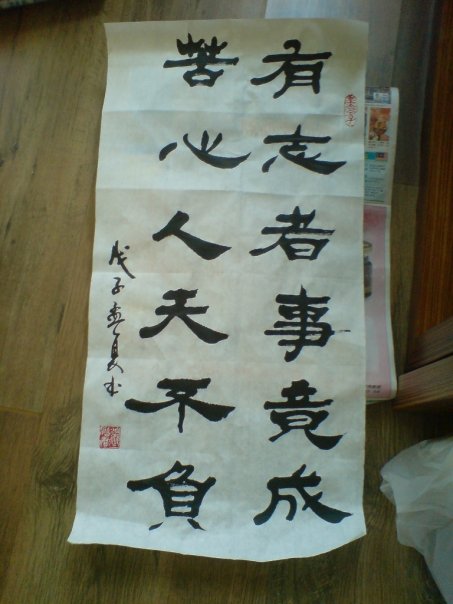
This guy I met was not a regular. He was armless and handless but he was focused purely on his calligraphy. His calligraphy was amazing: his skill with his two stumps was much better than most able-bodied Chinese I know.
Incidentally, the calligraphy he wrote was especially apt for my retrenched state of being. The broad meaning of the phrase is, “Those with a will/direction, will definitely succeed. Those who suffered (for their will), Heaven won’t abandon them.”
First set of couplets I received from the calligrapher.
There were pretty high odds that I was getting laid off. Rumours had been going around that my ex-firm was not doing well and there would be layoffs. Colleagues who had experienced layoffs in other firms told me, “you just wait. They will fire all the locals but protect their own.” As someone who had zero political connections, I was expecting to be laid off anyway.
But the odds that, at the very moment I was walking home from being retrenched, an ARMLESS and HANDLESS calligrapher will be writing THIS phrase … ? It was encouraging, and perhaps a sign.
I stood there watching him work and said to him after a while, “Your calligraphy is beautiful! How much is this piece?” I thought he was going to say something ridiculous but to my huge surprise, he said, “Whatever price you think this is worthwhile.”
On the spot, I offered him a sum of money (that I cannot remember) and also commissioned him to write up my school motto ‘To strive unyieldingly’ (“This is a saying from I Ching”, he said, which turned out to be true.) Both pieces are now framed up at my parents’ home.
(This was my special commission to him after I walked back)
Same fate, different outcomes
Even though I had not been particularly deliberate in saving up money, I still had enough after my retrenchment that I estimated I could keep my apartment and live the way I did for easily another six months and then some. In the worst case, I was prepared to just dump everything and return home to Singapore.
That’s when I heard the story of Y, an ex-colleague from the same firm. Y was laid off earlier than me. Unlike me, Y wasn’t smiling when she gave up her Blackberry. When I met Y with other friends at a meal, Y clearly looked distressed and asked around if anybody knew of any banking job opportunities.
A mutual friend later shared that Y had only half a month of rental left in her bank account. I was shocked, “Huh? What did she spend her salary on??” It turned out that Y had spent almost her entire salary on not just branded bags, shoes, designer clothes, but also massage packages, spa treatments, pedicures & manicures (which she had bought by a lump sum package because it was “cheaper”).
The mutual friend also told me that Y had a habit of urging everyone around her to spend money, because “you’re a banker, you can afford it!”
Never did Y realise back then that she could not afford to lose being a banker.
The second retrenchment
One year later in April 2009, my second layoff was much less dramatic.
I had left Hong Kong and joined a proprietary trading firm in Singapore, which was started by two Irish proprietary futures traders. It was a small outfit of less than 12 people, based in UOB’s building.
When we first joined, they told us we each had a Profit & Loss (financial statement) with a S$15,000 downside limit. Over the months, the downside limit reduced to $12,000, then $10,000. By the time I got laid off, my account loss was around $9,000.
After I made my final losing trade, I got called into the office, was told “it’s not working out”, and was then asked to leave. This time with no retrenchment benefits at all.
A few months later, the firm wrapped up its operations in Singapore. And a few months later, it wrapped up for good.
[Years later, I read Michael Lewis’ book “Flash Boys” and recognized what had happened to our firm: we were basically bled dry by high frequency traders. We would hit the offers, only to be filled in at prices that were significantly different from the offers we hit.]
No more “fooling” around
This second layoff had no “divine signal”, no signs of encouragement. As the American saying goes, “fool me once, shame on you; fool me twice, shame on me.”I was beginning to wonder if the finance industry was fooling me twice. I wondered if I should continue or I should find something that is more meaningful beyond aiming to make rich people richer.
My initial instinct was to try and apply what I learned at the trading outfit, but it is different when you are a retail trader versus at a professional outfit: the lag times are even greater; there are significantly larger margins you have to pay and there is almost no “edge” (i.e. advantage) you have in the market.
Most importantly, my psychology was also fraught: I needed to make money, which magnified the emotions and made trading harder.
After a few months of trying to trade my own account, depleting my savings, and feeling emotionally exhausted from chasing money for its own sake, I decided to apply only to public service jobs. I wanted to spend my time working on something more meaningful. That was how I started my decade-long career in the public service.
What I learnt from retrenchment
Looking back, I think there are a few lessons that I drew from my two retrenchments, which might help others who are facing impending retrenchments. Where appropriate, I have also included excerpts from the Buddhist texts.
Pre-Retrenchment: Always have some savings, ideally a quarter.
Startup funding is measured in time. Every startup that isn’t profitable (meaning nearly all of them, initially) has a certain amount of time left before the money runs out and they have to stop. This is sometimes referred to as runway, as in “How much runway do you have left?” It’s a good metaphor because it reminds you that when the money runs out you’re going to be airborne or dead.
For any individual, I would recommend saving up a runway of at least 6 months of your monthly necessary expenses, excluding your long-term savings. That gives a lot of psychological freedom, because you are not in a state where you need to make money. That freedom was what I had during my first layoff but not during my second layoff.
Take a balanced approach to your budget
But one also shouldn’t go to the extreme of hoarding without any expenditure at all! Nor should one spend too much (like my ex-colleague Y). Instead, you need to strike a balance in your personal finances, avoiding both extremes.
And what is accomplishment in balanced finances? It’s when a gentleman, knowing his income and expenditure, balances his finances, being neither too extravagant nor too frugal. He thinks, ‘In this way my income will exceed my expenditure, not the reverse.’ It’s like an appraiser or their apprentice who, holding up the scales, knows that it’s low by this much or high by this much. In the same way, a gentleman, knowing his income and expenditure, balances his finances, being neither too extravagant nor too frugal. He thinks, ‘In this way my income will exceed my expenditure, not the reverse.’ If a gentleman has little income but an opulent life, people will say: ‘This gentleman eats their wealth like a fig-eater!’ If a gentleman has a large income but a spartan life, people will say: ‘This gentleman is starving themselves to death!’ But a gentleman, knowing his income and expenditure, leads a balanced life, neither too extravagant nor too frugal, thinking, ‘In this way my income will exceed my expenditure, not the reverse.’ This is called accomplishment in balanced finances.
Then what should you use your wealth for? Make yourself happy and pleased first, followed by the people around you.
Then King Pasenadi of Kosala went up to the Buddha in the middle of the day, bowed, and sat down to one side. The Buddha said to him, “So, great king, where are you coming from in the middle of the day?”
“Sir, here in Sāvatthī a financier householder has passed away. Since he died childless, I have come after transferring his fortune to the royal compound. There was eight million in gold, not to mention the silver. And yet that financier ate meals of rough gruel with pickles. He wore clothes consisting of three pieces of sunn hemp. He traveled around in a vehicle that was a dilapidated little cart, holding a leaf as sunshade.”
“That’s so true, great king! That’s so true! When a bad person has acquired exceptional wealth they don’t make themselves happy and pleased. Nor do they make their mother and father, partners and children, bondservants, workers, and staff, and friends and colleagues happy and pleased. And they don’t establish an uplifting religious donation for ascetics and brahmins that’s conducive to heaven, ripens in happiness, and leads to heaven. Because they haven’t made proper use of that wealth, rulers or bandits take it, or fire consumes it, or flood sweeps it away, or unloved heirs take it. Since that wealth is not properly utilized, it’s wasted, not used.
Suppose there was a lotus pond in an uninhabited region with clear, sweet, cool water, clean, with smooth banks, delightful. But people don’t collect it or drink it or bathe in it or use it for any purpose. Since that water is not properly utilized, it’s wasted, not used.
In the same way, when a bad person has acquired exceptional wealth … it’s wasted, not used.
When retrenched: remember the Noble Truths
When you are being retrenched, it can feel like a punch in the gut. A million questions and emotions will be flying through your head, “What do you mean I’m being laid off?” “I need this job to feed my family.” “Why am I fired but not that lazy ass on level 26?” for etc.
The next thing to recognise is that your mind’s first reaction is to flee away from the suffering as fast as possible, either through denial or repression. Your mind is also likely to be defiled by negative emotions like anger or a strong desire to be somewhere else.
Consider the (First Noble) truth: life is suffering. To be born is to suffer, to exist is to suffer, as taught by the first sentence in this passage from the Buddha’s First Sermon:
“This noble truth of suffering should be completely understood…”
By seeking to understand your experience, you might ask yourself, ‘Why am I suffering? What’s the cause for this suffering?’ At a fundamental level, the (Second Noble) truth is, your suffering is caused by you wanting or craving something.
“Now this, bhikkhus, is the noble truth of the origin of suffering: it is this craving which leads to renewed existence, accompanied by delight and lust, seeking delight here and there; that is, craving for sensual pleasures, craving for existence, craving for extermination.
The original Pali word for “craving” is taṇhā, which is also the word for THIRST.
The following is a useful guiding question. Anytime you’re suffering, ask yourself, ‘What is it that you want?’ That wanting is the cause of your suffering, because…
“Now this, bhikkhus, is the noble truth of the cessation of suffering: it is the remainderless fading away and cessation of that same craving, the giving up and relinquishing of it, freedom from it, nonreliance on it. [In Pali: yo tassāyeva taṇhāya asesavirāganirodho cāgo paṭinissaggo mutti anālayo.]
These are the four ways of letting go, of not wanting:
Caga – giving, generosity;
Patinissaga – letting go;
Mutti – free, releasing;
Analaya – Non-reliance, not-resting, not-sticking, a “Teflon mind”.
I would double down on caga. In fact, when you’re retrenched, I would strongly encourage you to volunteer and just give your time: go out of the house and do some volunteer work for a cause that inspires you. Because that makes unstealable wealth for you!
Make more unstealable wealth.
The Buddha gave this great definition of wealth that cannot be stolen from you, which I’m calling ‘unstealable wealth’.
“He has a hundred thousand gold coins, not to mention the silver!”
“Well, Ugga, that is wealth, I can’t deny it. But fire, water, rulers, thieves, and unloved heirs all take a share of that wealth. There are these seven kinds of wealth that they can’t take a share of. What seven? The wealth of faith, ethical conduct, conscience, prudence, learning, generosity, and wisdom. There are these seven kinds of wealth that fire, water, rulers, thieves, and unloved heirs can’t take a share of.
When you’re retrenched, it can sometimes feel tough. ‘My dream job was taken from me! Oh, that lovely (employment benefit) that I loved!’
The Buddha’s definition of unstealable wealth reminds us that there are things that cannot be taken from us. You probably gained a lot of knowledge from your work: that’s not something that can be taken from you (except by time).
For example, I learned how to do financial valuation models in banking (which has made me extremely skeptical about all financial projections!), but I also used some of the trading-comparable techniques in analyzing companies when I started work in the Economic Development Board.
Also, your acts of generosity, kindness, compassion, all cannot be stolen from you by others, nor removed by your ex employer. It’s something you have done before, and belongs to you. To exercise generosity, kindness, and compassion, to keep your Five Precepts and ethics, all these require no money to do! So what’s stopping you from making more of this “unstealable wealth” while you’re unemployed?
Even if you feel that somehow this unemployment situation was due to your bad kamma, you can’t get rid of bad kamma by “burning” it or just “tolerating” it. All the more, you should go out and just go good!
Suppose a person was to drop a lump of salt into a small bowl of water. What do you think, mendicants? Would that small bowl of water become salty and undrinkable?”
“Yes, sir. Why is that? Because there is only a little water in the bowl.”
“Suppose a person was to drop a lump of salt into the Ganges river. What do you think, mendicants? Would the Ganges river become salty and undrinkable?”
“No, sir. Why is that? Because the Ganges river is a vast mass of water.”
“This is how it is in the case of a person who does a trivial bad deed, but it lands them in hell. Meanwhile, another person does the same trivial bad deed, but experiences it in the present life, without even a bit left over, not to speak of a lot. …
From the discourse above, we learn that you don’t burn bad kamma: you dilute it to the point where the bad kamma is like a lump of salt in a Ganges river of goodwill and good kamma.
You focus on making good kamma, on the positive, on the joy that arises from the intention (more in the latter). The more good kamma you make, the less your bad kamma from the past is going to impact you.
Again, the Buddha has some great advice on the kamma leading to long life, health, beauty, influence, wealth, status and wisdom:
“Master Gotama, what is the cause and condition why human beings are seen to be inferior and superior? For people are seen to be short-lived and long-lived, sickly and healthy, ugly and beautiful, uninfluential and influential, poor and wealthy, low-born and high-born, stupid and wise. What is the cause and condition, Master Gotama, why human beings are seen to be inferior and superior?”
“Student, beings are owners of their actions, heirs of their actions; they originate from their actions, are bound to their actions, have their actions as their refuge. It is action that distinguishes beings as inferior and superior.”
…
…This is the way, student, that leads to short life, namely, one kills living beings and is murderous, bloody-handed, given to blows and violence, merciless to living beings.… This is the way, student, that leads to long life, namely, abandoning the killing of living beings, one abstains from killing living beings; with rod and weapon laid aside, gentle and kindly, one abides compassionate to all living beings.
…
… This is the way, student, that leads to sickliness, namely, one is given to injuring beings with the hand, with a clod, with a stick, or with a knife….This is the way, student, that leads to health, namely, one is not given to injuring beings with the hand, with a clod, with a stick, or with a knife.
…
… This is the way, student, that leads to ugliness, namely, one is of an angry and irritable character…and displays anger, hate, and bitterness…. This is the way, student, that leads to being beautiful, namely, one is not of an angry and irritable character…and does not display anger, hate, and bitterness.
…This is the way, student, that leads to being uninfluential, namely, one is envious…towards the gains, honour, respect, reverence, salutations, and veneration received by others….This is the way, student, that leads to being influential, namely, one is not envious…towards the gains, honour, respect, reverence, salutations, and veneration received by others.
… This is the way, student, that leads to poverty, namely, one does not give food, drink, clothing, carriages, garlands, scents, unguents, beds, dwelling, and lamps to recluses or brahmins.…This is the way, student, that leads to wealth, namely, one gives food…and lamps to recluses or brahmins...
Tips on Looking for a New Job
When looking for a new job, it is useful and important to know what you’re looking for or not. It’s also important and useful to know what you’re good at or not: this depends whether you’re just starting out in your career, or you’ve more experience.
If you’re just starting out, I think you should just try different things and learn from your experience. For example, I learned from my two layoffs that:
(a) I hated the investment banking lifestyle;
(b) I really didn’t have a knack for day-trading futures;
(c) After a while, the pointlessness of making rich people richer really wore me down.
With time and experience, you know what your strengths are and that then allows you to figure out where and how you should play to your strengths in your future jobs.
I’ll end with this beautiful Buddhist parable of a quail playing to its strengths, outwitting a hawk. May you be a quail that finds your clods of soil!
“Bhikkhus, once in the past a hawk suddenly swooped down and seized a quail. Then, while the quail was being carried off by the hawk, he lamented: ‘We were so unlucky, of so little merit! We strayed out of our own resort into the domain of others. If we had stayed in our own resort today, in our own ancestral domain, this hawk wouldn’t have stood a chance against me in a fight.’—‘But what is your own resort, quail, what is your own ancestral domain?’—‘The freshly ploughed field covered with clods of soil.’
“Then the hawk, confident of her own strength, not boasting of her own strength, released the quail, saying: ‘Go now, quail, but even there you won’t escape me.’
“Then, bhikkhus, the quail went to a freshly ploughed field covered with clods of soil. Having climbed up on a large clod, he stood there and addressed the hawk: ‘Come get me now, hawk! Come get me now, hawk!’
“Then the hawk, confident of her own strength, not boasting of her own strength, folded up both her wings and suddenly swooped down on the quail. But when the quail knew, ‘That hawk has come close,’ he slipped inside that clod, and the hawk shattered her breast right on the spot. So it is, bhikkhus, when one strays outside one’s own resort into the domain of others….
Wise Steps:
Aportion a quarter of your salary towards your savings when you are employed.
If you were retrenched, try to understand your suffering using the Noble Truths.
Yield your mind to perform acts of generosity, goodwill and letting go. These form the ‘unstealable wealth’ that retrenchment can’t even take away from you.
Recognise your strengths and play up to them when searching for your next job!
Does applying Buddhist principles of compassion and kindness make you a walking doormat at the workplace? PJ Teh, a former Strategic Planning manager at EDB, challenges that view and gives us points to think about, in this mini-article series.
TLDR: We spend more than a quarter of our adult lives at the workplace. Knowing how to choose your workplace can either build or destroy your character. Choosing the right people, and culture, and asking the right questions is crucial!
Principles in the financial world and the Dhamma
The term Dharma/dhamma is something that brings up the mental image of a Californian long-haired hippy with incense and drugs, spouting free-love, with flowers in their hair.
In reality, the term Dhamma is simply a set of conditionality or principles: this can be seen from how they are described, which are usually sets of conditionality i.e. if A happens, that allows B to happen, etc.
So that is why in my mind, “Applying Buddhist Principles at Work” is the same thing as “Applying the Dhamma at Work”.
Ray Dalio, a famous hedge-fund manager, who wrote a best-selling book “Principles” gives us further insight into the workplace. His book is about the principles he used to grow Bridgewater Associates into one of the largest funds in the world: that is a kind of Dhamma for hedge funds (and decision-making), with many overlaps with Buddhist Dhamma.
Instead of ‘lazily’ applying the Eightfold Path and Four Noble Truths, I’m taking a first-principles approach to the Dhamma at Work, but without necessarily being MECE (mutually exclusive, collectively exhaustive). These are decisions and actions that anybody probably needs to act on, at work.
These are my personal views on the matter, so please feel free to look at it differently. 🙂
I should also caveat that these Buddhist principles might not make you rich or conventionally successful. But you will probably sleep well at night, and probably suffer a lot less, and be happier!
The following decisions need to be made by anybody with regard to any workplace.:
Choosing a workplace
How to look at issues and matters, and how to decide
How to treat people at the workplace
How to conduct oneself
This article will cover ‘Choosing a workplace’ with subsequent articles covering the other areas.
Choosing the place where you spend a quarter of your adult work life
A workplace is an environment where your mind will be in, for a substantial amount of your life.
A week has 168 hours: a typical work week takes up anywhere from 42 to 120 of those hours, which is 25% or more of your total time. That’s where your mind will be at.
What happens at work also spills over to the rest of your life, shaping your mental state for your week. Hence, I think choosing a workplace is perhaps the most important decision to make.
So how should we choose a workplace? I have a few factors to consider.
1. Choosing the people
The first factor to decide about a workplace is the people you’re going to be working with. You become the people around you.
This was so important, that Ananda (who was the Buddha’s personal attendant) was rebuked by the Buddha for saying that the good friendship was only half the Holy Life:
When a bhikkhu (monastic) has a good friend, a good companion, and a good comrade, it is to be expected that he will develop and cultivate the Noble Eightfold Path.
The same consideration applies to choosing our colleagues.
Why is it so important to choose your colleagues carefully? This is because of anatta, or non-self: if there truly is a self that was fully in control, then the environment wouldn’t impact any individual.
But precisely because anatta or non-self is true, we humans are influenced easily by the people and environment around us.
Choosing the workplace, especially choosing the people you work with thus helps shape our own minds and conditions.
2. How do I know if the culture is right for me?
Related to this, is whether the culture of the team and workplace you’re joining is a good or bad culture. How do you know if it’s good or bad? And good or bad, with reference to what?
Choose a workplace culture with reference to your state of mind, and your progress on the Eightfold Path.
If you go to a workplace and you end up having a lot of strong desires, that’s probably not good.
Nothing below a five-star hotel
When I was working with a previous employer in finance, an ex-boss said to me “You know, PJ, I can never stay in a hotel less than five stars, and on a plane less than business class.”
I was horrified and asked why. She said, “because I am so used to this, that anything less is really uncomfortable.”
It was suffering for her, basically, because the financial industry had norms that were extremely expensive. And that’s when I realised that the industry was Super Samsara!
That’s when I decided I had to leave because I also noticed that many of my colleagues and peers were not happy, not very healthy, and used their high pay to “buy happiness” outside of work, indulging in all kinds of expensive things.
The layoffs happened
When we were laid off due to the financial crisis, I heard an ex-colleague had cash for only half a month’s worth of rent in her bank account, because she had spent all her income on spa packages, pedicure packages, gym packages, branded clothes, bags, drinks, expensive dinners, etc.
So she was desperate to get another high-paying job as a banker, even though the market was flooded with retrenched bankers.
My own state of mind back then was extremely unhealthy: strong desires, bad-tempered, and lacking sleep (I was working 90-120 hours a week).
Even though it has taken ten years to get back to the base-level salary I earned in the investment bank, I still think it was the right decision to leave (or rather, to get laid off).
The Buddha gave this advice on how to choose a place for a monastic:
Buddha: Take another case of a mendicant who lives close by a jungle thicket. As they do so, their mindfulness becomes established, their mind becomes immersed in samādhi, their defilements come to an end, and they arrive at the supreme sanctuary. But the necessities of life that a renunciate requires—robes, alms-food, lodgings, and medicines and supplies for the sick—are hard to come by. That mendicant should reflect: ‘…I didn’t go forth from the lay life to homelessness for the sake of a robe, alms-food, lodgings, or medicines and supplies for the sick… they shouldn’t stay there.
This advice isn’t just for monastics but is applicable to anyone who is intent on walking the Path.
What’s perhaps most interesting is the subsequent instruction from the Buddha. When your meditation, mindfulness and practice aren’t good, due to your environment,
That mendicant should leave that jungle thicket that very time of night or day; they shouldn’t stay there.
That’s how important the Buddha placed the effect of a place on one’s mind.
Asking the human mirrors you live with at home
How should you apply this learning, if you don’t really meditate nor keep precepts?
A simple way is to ask the people who live with you: are you becoming more gentle, kinder, and compassionate? Or are you becoming more of a pain in the ass to live with?
That will tell you how your mental cultivation is going. If your workplace is causing you to be more irritable, have strong sensual desires, and crave more material things, then you’re probably in the wrong place.
And if you see that a workplace is full of people with big egos, anger, strong sensory desires and material things, those workplaces are probably the places to avoid.
Wise Steps:
Understand the impact of colleagues on your mind and choose them wisely. Which of your colleagues improve your mind, and which do not?
Check-in with the people you live with if your character has improved or worsened since you joined your firm; this is one of the best indicators of whether you chose the right place. What do they say?