Editor’s note: This article is adapted from PJ’s website. Do check out his past articles on tackling the workplace over here, here, and here.
On 19th October 2022, I flew back to Singapore after spending three months at my teacher Ajahn Brahm‘s retreat centre Jhana Grove and monastery in Serpentine, Western Australia.
Since then, I’ve been asked quite frequently about what I learned and “gained”, which I’ll attempt to summarize here. Below are the 11 things I’ve learnt.
(Graphic image warning: Please note that learning point 8 has a few graphic pictures of a decaying dead kangaroo. You may quickly jump to point 9 if you are easily affected.)
1. A much clearer & experiential understanding of how suffering works.
Expectations, wanting, hopes, plans, etc. are a huge barrier, because of the Second Noble Truth: wanting causes suffering. During this retreat, I think I’ve let go more of the expectations & wanting to re-experience the life-changing yo-yo-jhana in 2010, which I’ve written about here and here . And if I wanted anything, whether it was the beautiful breath, or silence in the mind, or nimittas, or jhanas, that wanting always led to suffering.
So towards the end, I was deliberately cultivating the mantra of “Good enough”. Heavy rain while walking to the monastery? Good enough. Restless mind while sitting in the morning cold? That’s more than good enough!
And that really helped and worked: there was a lot less suffering when I was developing this mindset of being “contented and easily satisfied”, instead of striving with strong wants.
It’s not all perfect: there were definitely days when it felt like walking into a perfect storm. The lowest point I experienced was towards the end, on a Monday. For the whole of Monday, I struggled with a very, very restless mind: I could barely sit. It was, as Ajahn Chah (Ajahn Brahm’s teacher) described, “you can’t move forward, you can’t go backwards, you can’t stay where you are”.
I’m experienced enough to know that restlessness is the mind being discontented with the present moment experience. So I tried to make peace with the present moment experience and tried to be unconditionally kind and gentle to my own mind. That caused my mind to kinda go into a kind of split, where a less-critical, more-loving PJ was having a dialogue with a very fault-finding, very discontented PJ:
Loving PJ: There there! It’s ok to be discontented. You’re not enlightened yet!
Fault-Finding PJ: Of course it’s easy to say that!
Loving PJ: Remember Ajahn Brahm’s instructions? Just make peace with the suffering, be kind, be gentle…
Fault-Finding PJ: Of course it’s easy for Ajahn to say that! He’s the MOZART of meditation, whereas you are still playing Twinkle Twinkle Little Stars! You can’t even watch your stupid beautiful breath, for goodness sake!
It just spiralled downwards from there, into outright fear and despair. I was reminded of the episode in the Buddha’s passing, when his attendant Ananda cried out of despair. I understood what he felt because I felt this deep fear of what will happen when Ajahn Brahm dies? Who else can I have as a teacher I am dependent on?
And there was despair because I was nowhere close to the jhanas, which are needed to really remove the defilements. And I had so many defilements … it felt like I was tasked with using a single box of matchsticks to melt an entire iceberg or glacier.
The fear and despair was very, very real, and very, very bad: I sobbed and cried my eyes out in the shower. I don’t think I have cried like this ever since my colleague Parathy died… after I finished crying, I asked my mind what it wanted to do, and went to sit and meditate, before going to sleep. The next morning, I went to ask Ajahn for advice on how to deal with such days.
Ajahn was so kind and compassionate… he kept saying “trust. you are so close“, and also talked about how, often, progress on the Path isn’t about more effort, but about finding the right place to perpendicularly cross the river. “And when you’re over, you’ll then realize how stupid you’ve been all this while, because you’ll look back and say ‘wait, that was it? That’s all it took?’ ” And that was all it took for me to gain back the trust, confidence, and patience to carry on.
2. A more experiential understanding of non-self”
The other learning is a more experiential understanding of non-self. Basically, I don’t really control my body or my mind: it is heavily influenced by the environment around me. The body is out of control, and the mind is out of control because they are all complex processes which have no single source of self, and where effects become causes for further effects. It’s all about putting the right causes in place, I.e. Right Motivation (Samma sankappa). A few episodes really highlighted this to me.
No matter how much I tried, I could not change the fact that my body is made in Singapore, and that I struggle with the cold. Cold makes my mind restless, as I am really not made for this climate. It’s quite funny because whenever it’s cold, there is automatically a soundtrack playing in my mind (for the first two months, it was the soundtrack of Crash Landing On You, because my wife and I re-watched it before I left…). But what was even more interesting was the short spell of warm weather in late September and early October: the soundtrack playing stopped in my mind, with no choice nor force at all! So it was really caused by the cold.
Physically with my body, there were a few incidents (suspect Covid; my twitching eye; body pains from sitting meditation) which drove home the point of non-self. From the Buddha’s second-ever discourse (Anattalakkhanasutta SN 22.59):
“(this body is not) fit to be regarded thus: ‘This is mine, this I am, this is my self’”, because “…if…(this body) were (my) self, this (body) would not lead to affliction, and it would be possible to have it of (this body): ‘let my (body) be thus; let my (body) not be thus’. But because (this body) is nonself, (this body) leads to affliction, and it is not possible to have it of (this body): ‘let my (body) be thus; let my (body) not be thus’. “
Basically, if your body was you or your self, then you would be able to compel it and control it to be well, not be sick, and to take on any shape or form you wish. Which you can’t.
3. Reduce the drivers of negative emotions
Much of Ajahn Brahm’s teachings are really about undermining and reducing the drivers for negative emotions, especially the overthinking mind that tenses up, comments, interferes, fault-finds, strives and tries, is ruthless, and seeks to control everything (especially due to fear).
If we do the exact opposite to the above verbs, those are the causes for future deep meditation and eventual liberation. So we should:
Relax to the Max
Disengage from commentary
Don’t interfere or do anything, because it is all none-of-your-business
Let the mind decide what it wants to do, rather than tell and control it
Cultivate contentment: “good enough”
Not try
And be kind, unconditionally.
4. Cultivating the opposite of fault-finding
Ajahn Brahm once wrote that “cultivating the opposite of fault-finding is 90% of the Buddhist practice”, and this was something I realised from the three months.
It is so easy to lapse into fault-finding and criticism of everything: I could be sitting for 45 mins, watching the breath for 44 mins, and daydreaming in the last minute, and that is often enough for me to say “that was not peaceful”! This is crazy, if you think about it, because I wasn’t really looking realistically at the whole session, but only picking out the bad parts to smear the whole thing.
I think this fault-finding is due to social conditioning: it seems “smarter” to seem pessimistic, cynical, and negative (as shared in Psychology of Money: see point 7 in the original article here). This mindset is especially prevalent in Singapore, I think.
5. Systems, Not Goals
Scott Adams’ “system vs goals” came up in my mind during the retreat, and I started wondering what was my “system”, vs the “goal” of enlightenment. My system is to keep precepts, learn Dhamma, create the supporting environment for practice around me, and meditate daily. I’ll let the results take care of themselves. Some specifics that I picked up during the Rains:
If the meditation was me largely “letting go, being kind and gentle”, then the meditation was a success, regardless of the results!
I started debriefing myself after each meditation, as part of my “system”. I ask myself these questions:
What suffering was absent? How much peace, calm & stillness was generated from the sit?
Was there letting go, kindness and gentleness in the meditation, between me and the meditation object?
Which defilements were gone? Usually for me, there’s no ill will, sloth and torpor, and doubt. The usual suspects are Kama canda, and restlessness and remorse.
7. Meditation is like taking a shit
Meditation is a lot like taking a shit: there are a lot of parallels between the two.
Both are non-self: in both processes, there is no single part you can point to, and say that’s me, mine, a self. There are also none of the accumulations of a self in any part of the processes e.g. ego, pride, expectations, will, etc.
Both are natural causal processes, where willpower & expectations are NOT necessary causal factors & are often counterproductive:
If you’re blocked in meditation, often you need more mindfulness and kindness, to unblock yourself. If you’re blocked in shitting, often you need more fibre and water to unblock yourself.
Using willpower in both cases causes haemorrhoids in your mind and in your a**
Expectations in both cases are major blockers.
Both processes are about clearing their “containers” of defilements and debris: one is clearing the mind, the other is clearing the digestive system.
Last but not least, the best sits and the best shits are effortless and joyful, and very healthy.
7. Keeping Precepts is Critical
Keeping precepts is critical for progress on the Path. This is often overlooked, especially in western meditation instructions. But this importance becomes very clear when meditation deepens, and when your mind starts to reflect the spottiness of your ethical behaviour by body, speech and mind. Let me share a story about someone, whom I’ll call PJ2. Imagine that PJ2 is single, and that he once had a very, very deep meditation experience a few years ago.
At the start of the Rains Retreat, I was discussing nimittas and jhanas with PJ2. However, as the retreat progressed, PJ2’s past caught up with him: he had not kept his precepts fully, and that caused him to feel this overwhelming sense of guilt that triggered panic attacks.
This lasted until PJ2 left, and it was very eye-opening for everyone to see how important keeping precepts are, for deeper meditation and for one’s practice.
8. Death is everywhere
Death and dying is everywhere, in the most unexpected places. In September, as a few of us returned from visiting Kusala Hermitage, it turned out that two kangaroos had been hit by vehicles just outside Jhana Grove. One of them was more decayed, while the other one was quite intact. It was very eye-opening to see the decaying and decomposition process over the weeks, which I captured by taking multiple videos and photos.
What videos and photos do not capture is the smell: that nauseating odour of death and decay, which reminds me of the very first time I smelled that odour, as a teenager helping my father clear the drowned rat stuck under our driveway.
But what the photos and videos do convey are the charnel ground descriptions in the suttas, especially the Satipatthana sutta (** CONTACT ALERT: Pics of dead things**)
The dead adult kangaroo just outside Jhana Grove
…And it had been dead for one, two, or three days, bloated, livid, and festering. They’d compare it with their own body: ‘This body is also of that same nature, that same kind, and cannot go beyond that.’ 15.1
The dead adult kangaroo had moved due to heavy rain and had decayed
Then:
…a corpse discarded in a charnel ground being devoured by crows, hawks, vultures, herons, dogs, tigers, leopards, jackals, and many kinds of little creatures. 16.2They’d compare it with their own body: 16.3‘This body is also of that same nature, that same kind, and cannot go beyond that.’ 17.1
Same dead kangaroo, much more decayed. Note how the skull has gone missing, and the skeleton has changed color.
Then:
Bones rid of sinews scattered in every direction. Here a hand-bone, there a foot-bone, here a shin-bone, there a thigh-bone, here a hip-bone, there a rib-bone, here a back-bone, there an arm-bone, here a neck-bone, there a jaw-bone, here a tooth, there the skull …
A finger fragment of the dead kangaroo by the roadside marking
Then:
Bones rotted and crumbled to powder. 30.2They’d compare it with their own body: 30.3‘This body is also of that same nature, that same kind, and cannot go beyond that.’
It is extremely sobering, especially since an adult male kangaroo is about the same size as me, to reflect that my body is truly “of that same nature, that same kind, and cannot go beyond that.”
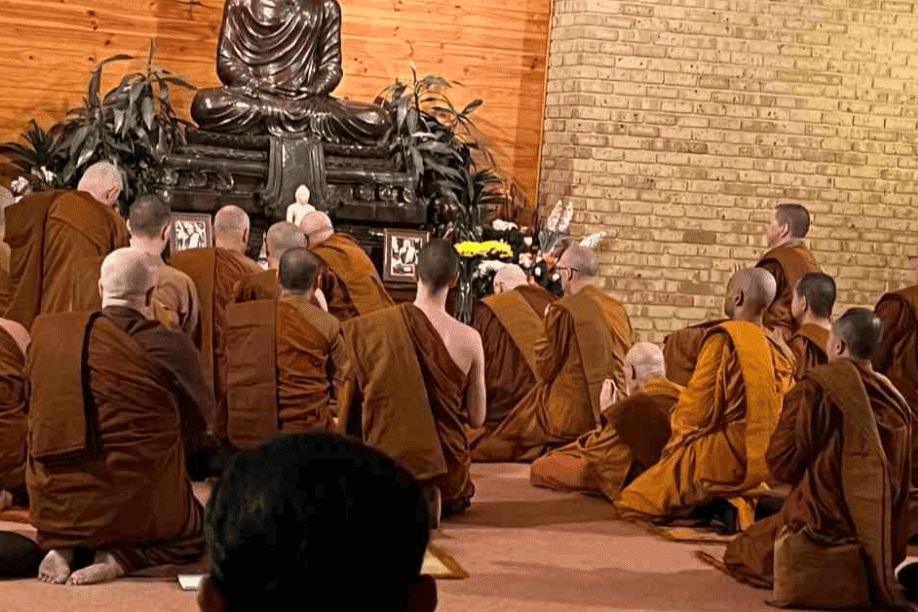
The Sangha at Bodhinyana Monastery paying respects to the Triple Gem
9. The monastic practice is the Buddha’s Training Programme
The monastic practice set by the Buddha is THE way to get to Nibbana. Before this Rains, I had doubts about this: what’s stopping me as a lay person from being able to practice towards liberation? But after three months, there is no longer any doubt in my mind that the Training Programme decided by the Buddha is the best bet to Enlightenment.
However, my conditions in life are such that, it has to be lay life for me, at least for a while: as a married man, I have to take care of my wife, but also have to take care of my parents and parents-in-law as they age.
10. Some observations of my fellow retreatants:
My “alms bowl” for three months, filled with food generously given by lay supporters of the monastery. Those lay supporters drove 1 hr each way to feed the monks and lay retreatants every day, for 3 months!
The generosity of people is astounding. For three months, I was fed by other people. Also, this group of Rains Retreatants really were very generous with helping each other out. For example, Becky would serve Ajahn tea, but also do a lot of acts of loving kindness to others. And in turn, I saw others helping her: a number of retreatants were talking to her to give her an introduction to the suttas, just before her silent retreat. Everyone was helping each other out like one big family (e.g. Gayathri making soup for Piotr, our Polish retreatant, when he fell sick a second time), which the Jhana Grove staff observed was quite unusual to our group.
There seems to be a bit of PTSD from past experiences with SN Goenka vipassana meditation: a couple of retreatants mentioned to me something along the lines of “I can’t watch the breath, because I end up trying to control it from my vipassana experience” and “I can’t watch the breath with pleasure, because my vipassana conditioning kicks in”. Which is a real pity, because the breath can be a lovely meditation object.
Dhamma vitakka (thoughts of the Dhamma) as a subtle hindrance was something that came up in a sutta class taught by Ajahn Brahm, but it seems to have been rejected by a number of retreatants. This hindrance was something I saw in my own mind: at some point, I realised that reading the suttas was actually complicating my own meditation practice, because I ended up generating a lot of questions (“Am I doing X right, like in the sutta?”) which disturbed the peace of mind. So towards the end, I deliberately cut down on my reading of the suttas, and reduced my thinking on aspects of the Dhamma.
11. The Practice isn’t just about meditation
While on a day outing with Ajahn Santutthi, abbot of Kusala Hermitage, I asked Ajahn about advice on the practice, especially since I felt stuck and stagnating in my meditation depth. He gave very good advice: “the practice doesn’t end after three months”, “the practice isn’t just about meditation”, and “just develop contentment and peace.” Which is perhaps the main takeaway I got from my three months.
Monks from Kusala Hermitage walking in a botanical garden bed of tulips
The content is extracted from the Dhamma sharing by Venerable Thubten Chodron on “A Guide To the Bodhisattva Way Of Life” Watch the full video here: https://www.youtube.com/watch?v=Agm106n9zX8
Verse 87. In an empty hut, at the foot of a tree, or in a cave, one remains as long as one desires, and casting off the suffering of guarding one’s possessions, one lives light-heartedly, without care.
Wholesome Wednesdays (WW): Bringing you curated positive content on Wednesdays to uplift your hump day.
How can we bring impact in this world? Is being a good spiritual guide the most important thing? Here are two stories to ponder over as we try our best to be a force of good in this world
1. How to make an impact? Light your own candle
2. It is not important to be a good fighter or a good spiritual guide. Here’s what is most important.
How to Make an Impact? Light your own candle
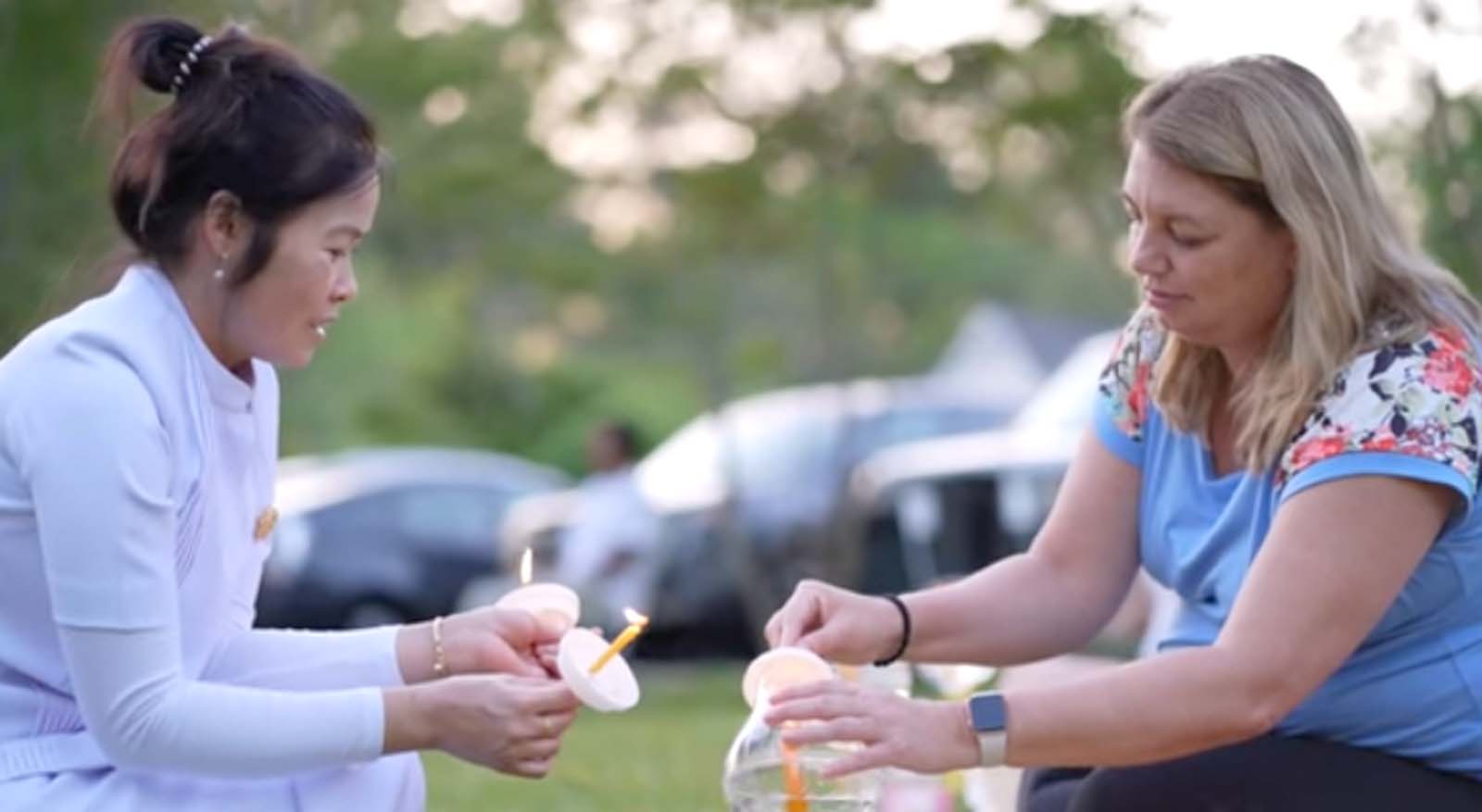
Snapshot from the video
What’s going on here & Why we like it
Venerable Nick, a Thai monk living in USA, shares about a recent Dhamma event they did on lighting candles. He shares about how we have to slowly work on ourselves to be more peaceful and kind before we try to change the world. When we can model that as a person we can shift the whole world. We like it because he beautifully explains a common ritual of lighting candles and how it ties to the practice and world peace!
“Take this concept, be very patient, and again whatever you want to help to fix the world with, try to fix yourself first”
Wise Steps
For those of us trying to change the world to be more peaceful and kind, this video gives us a good pause to look at ourselves and see where we can grow as people.
It is not important to be a good fighter or a good spiritual guide. Here’s what is most important.
Shaolin Temple
What’s going on here & why we like it
Shi Heng Yi, headmaster of a Shaolin Temple, shares on what is important for us as we walk the path and to live a pleasant life. We like this video as it is short and powerful. It resets our take on what is truly important.
“If you don’t this way of reducing the suffering of your surrounding, your suffering won’t stop.”
Wise Steps
We are impacted by our surroundings. No matter which culture, family, or religion we are in. Finding ways to relieve the suffering of our surrounding friends, family, and workplace will help us become better and happier.
TLDR: Having a set of goals to work towards gives us a sense of direction in life. Our society prizes this go-get-it attitude as a self-improvement hack; many of us strive for this mindset. However, there could be a risk of doing something just for the sake of it and we may end up beating ourselves for getting lost in the pursuit of excellence.
Many of us have been conditioned to chase something, consciously or unconsciously. We race with others to prove our worth, ever since birth – to be the first to crawl/walk/run, the top rank in class, the one to get into a famous university, the first to be office management level, the one who found ‘the one’ and have family……The list continues.
The neverending chase has been fuelled by the comparison trap we adopt from our parents, society and ourselves.
Have we ever pondered what is the source of our chasing mindset?
I was so used to the chase that I rushed from one achievement to another, not sparing time to truly soak in whatever I was doing and its outcome. After landing my first job as an accountant, I quickly enrolled on a professional certified course.
Upon completion, I thought, ‘what’s next?’. Before long, I was looking to register for a postgraduate degree.
I must admit those learnings were not in vain. I gained something out of them – both technical skills and soft skills like time-management, relational skills, self-organisation. These skills have been helpful to me in my personal and professional life. But whether or not I could use the effort on a more targeted outcome, that’s another question altogether.
To outsiders, I may look like someone with a thirst for knowledge (or paper certificate, for that matter).
Little did I know this chase was masked as self-improvement; there would always be a better thing to go for next if I don’t consciously define the outcome that I want to achieve.
This deceptive ‘self-improvement’ is not limited only to the worldly chase – I realised that I wanted to keep improving myself spiritually too. While spiritual advancement may be a sensible goal, my underlying intention was warped, at least initially.
I kept myself immersed in spiritual talks one after another. I sat meditating even when the heart refused to – just to prove that I, too, can evolve in my spiritual practice.
This spiritual chase resulted in resistance between the mind and the heart, not to mention the sense of dejection when I didn’t see the improvement I expected. Definitely not a fun experience!
The source of my chasing mindset was a sense of lacking self-worth. I wanted to prove myself a deserving human being by reaching the level that is deemed ‘good enough’. And we know that ‘good enough’ is a subjective measurement and may not serve as a good gauge.
Comparing myself today with who I was 3 years ago, for example, I can honestly say I have grown into a different and (hopefully) a better, more mature person. This is probably a better use of the comparison mind for improvement measurement.
Be kind to ourselves and others
I chanced upon an apt Dhamma talk by Venerable Ajahn Brahm on how we often hold on to ‘I need to be better’ thoughts just because everyone else thinks or expects so. Ajahn Brahm further taught that this ‘I’m not good enough’ mindset is neither kind nor helpful to ourselves.
Of course, we need to carefully distinguish between accepting ourselves with kindness and not growing out of unconstructive habits.
There could be a risk of not improving the mind under the false pretence of self-acceptance. Learn to be at peace with what we already have, then improvement would flow naturally.
Many of us may be performing good deeds and consciously express kindness to others. Doing so not only keeps the mind at peace but also elicits joy during and after the act. I identify with this definition of living a blessed life in the spirit of Mangala Sutta, when I can share and contribute what I have with others. However, with the chasing mentality, I might have forgotten about the one person who would benefit from such good deeds as well – myself.
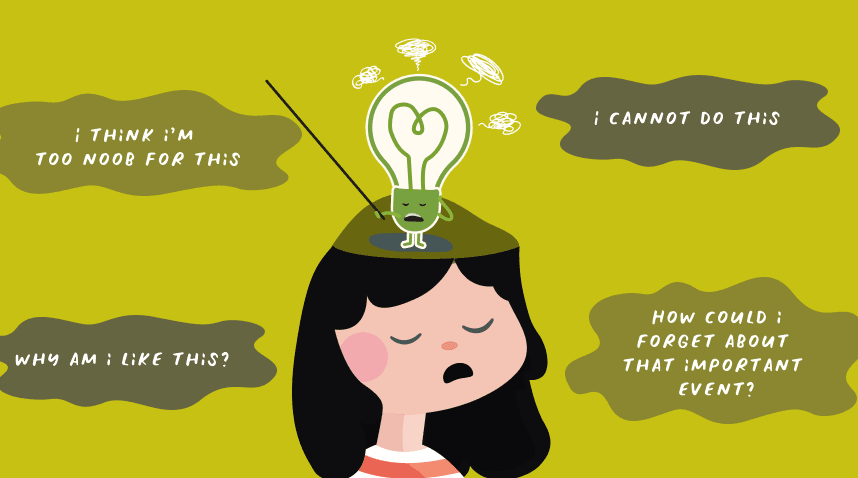
How many times do we speak harsh words inside our head when we act less than ‘perfect’?
‘Why did you do that silly thing?’
‘How could you forget about that important event?’
‘What is wrong with you?’
I probably would not say such things to my close friends or even strangers, so why do I say them to myself? Am I unworthy of the same kindness I have so freely and joyfully shared with others?
Nowadays, I decide to contemplate my pursuits with an objective mind, even if it seems like an improvement on the surface:
‘Does this course/workshop feel aligned with the heart or is there another reason why I want to join?’
‘Do I feel joyful in learning or is it another medal on my chest to show the world?’
Suffering arises when we don’t get what we want and when we get what we don’t want
I recently read separate teaching from Venerable Ajahn Chah1 on “wanting with right understanding”. The teaching explained that desire towards and away from something can arise from us as worldly beings. I find resonance to this gentle outlook towards self and am aware that setting goals can start off my self-improvement actions – but blindly chasing and grasping the desire tightly is not right either. Instead, taking action accompanied by gradual and reflective practice would be more helpful.
For example, I started this article with the intention to write about chasing struggles. It has developed into deeper contemplation of my underlying beliefs and expanded thoughts that I am sharing now.
Trying to be mindful of my wanting and not-wanting, I do my best at the moment and allow the outcome to unfold.
I realise that telling myself to let go of expectation, is an expectation by itself – another debacle to untangle!
Rather, it is much more peaceful to put in my best effort for the situation; watch the result arise and take the next step from there.
When a learning experience concludes as expected or not, I try to take time to settle down and truly embrace the event. When another learning opportunity comes, I will then be able to jump in wholeheartedly. Even if I failed, I could learn from it. Failure is just another piece of feedback! With this outlook, I hopefully lessen the suffering created for myself.
I conclude that having a goal is necessary, especially for myself and many others who are just entering the ‘real’ life of the professional and social world.
Clarity of true motivation is essential as we take on the path, paired with conscious kindness towards ourselves when the comparison mind takes a negative turn. The next time I look at others and start to put them on the pedestal with an unreasonable expectation of myself, I will remind myself: ‘remember how far you have gone’ and ‘we all have our own path to take’.
Pair working on goals with a mindful review of underlying reason in choosing these goals, it could provide clarity on the true nature of our motivation
When harsh reprimand arises within, ask if these are the words we will give to others
Refrain from punishing ourselves when we could not let go immediately. Be still, the conditions for letting go will arise.
TLDR: Once you fall in love with suffering, you won’t have to suffer anymore. Here is why and how to go about doing it.
What? Have I read the title wrongly? Fall in love with my suffering? Why would I ever want to do that? Well, to begin with, we have misjudged and misunderstood suffering.
Recently, I was invited by the Singapore Buddhist Mission to speak on How Buddhism has transformed my life? Throughout the 45 mins, I noticed most of what I talked about was how I overcame my sufferings.
Sufferings come in many forms.
“Lucky” for me, I’ve experienced many from the grief of losing my father, the guilt of not seeing my father for a year before he passed away due to my medical condition, go the physical and mental pain of my cancer treatments, I could go on and on, but that would make this article too depressing. So, why don’t I turn my sufferings around?
Suffering does not discriminate
If you take a closer look, suffering is an inevitability in life. I have not heard of anyone who has not suffered, whether it is physical or mental, we all suffer. It is bound to happen, and I’ve not heard of anyone immune to it as well.
All existence is Dukkha. According to the first noble truth in Buddhism, there is dukkha, often translated as suffering (though a sense of dissatisfaction is a closer meaning).
When I first came across the word dukkha, I didn’t pay much attention to it.
I simply thought it’s true, and it makes sense, but I didn’t heed the advice as a warning. I mean, I have had my fair share of sufferings, and I dealt with them promptly. But I neglected to pay attention to the second noble truth, which said that our constant wanting and resisting causes suffering.
What I failed to understand is my resistance to suffering when I’ve been warned. Can accepting the fact that bad things do happen in life reduce suffering? Apparently, it does.
It’s ok to not be ok.
Acceptance does not mean you are ok with it. But by reacting against the pain—resisting or rejecting it—we create unnecessary suffering. It doesn’t mean that you’ve chosen or agreed with what has happened to you.
It doesn’t mean you like panic attacks, the side effects of cancer treatments, or suffering an injustice that has happened to you or someone else.
Rather, you’re choosing to allow it to be there when you can’t change it at that moment. To make space for it. To give yourself the patience to understand what’s going on, feel what you feel, or have experienced what you’ve experienced without creating unproductive anger or anxiety.
The pain might still be there, but some of the “by-products” of the suffering will be alleviated.
Sufferings are to be embraced.
One of my strengths, or I personally like to think of as a strength, is I have the ability to go deep into my experiences and examine what is truly happening to me. My life experiences are like a school; I attend to each experience like a student in the class, waiting to see what is going on and what I can learn from it.
What I have learnt is that I haven’t become stronger after much suffering. I just feel more exhausted and weak, but I also feel more resilient towards suffering.
It’s like if I embrace every suffering, wouldn’t I get better at dealing with the unavoidable? Wouldn’t it make sense to embrace it rather than detest it?
Whenever I face any bad situation or problem that happens to me willingly and enthusiastically, it eases me into making better decisions. I feel less stressed out in dealing with it.
Suffering can be a valuable teaching.
Most of the time, we misinterpret suffering, thinking it comes from the world or the people around us. But it’s impossible for the world to cause you suffering if you don’t allow it. Also, suffering is a good thing, a kind of nourishment.
In order to be happy, you have to first find the meaning of happiness, and suffering becomes a catalyst for you to define it. It’s like using the dictionary – in order to understand happiness; you need to read up the definition of the word.
You can treat suffering as nourishment, a kind of tonic for your life that activates your willpower and allows you to discover your own strength and clarify your doubts.
For instance, the side effects I suffered from cancer treatment reminded me to stop procrastinating and postponing the things I really wanted to do. It also helped me focus on the present and discover the meaning of life.
Pain is certain, but suffering is optional.
External forces have always caused us much suffering. Although they can trigger our negative emotions, we forget that peace in the heart is also there. Our lack of awareness might be the cause of many of our sufferings, but it’s not like we can’t do anything about it.
We might not be able to control what has happened to us, but we can choose how we respond to it. So, my point here is that no matter how horrible a situation may seem, we can still stay focused in the present moment.
Being in the present moment helps us to become aware of our peaceful mental state within. We shouldn’t let bad situations rattle us into a corner and face defeat, thinking there is no way out of it.
A bad situation could be an opportunity for something good.
Sometimes, things aren’t as bad as we think they are. It just so happens that we’re conditioned by society to get what we want, and if we don’t get it, we automatically feel disheartened or disappointed.
Bad things in life can also be a stepping stone towards good things that may happen in the future.
I remember desperately wanting to secure a job which I was rejected. But that allowed me to apply and secure another job opportunity that was far greater and better than what I had expected.
Suffering doesn’t belong to anyone.
Suffering is only as bad as you want it to be. If I remove “me” from my problem, it will just be a problem and not “my problem.” Suffering no longer becomes personal; the problem is as it is.
There are no good or bad experiences. An experience is an experience if you see it for what it really is. It only becomes good or bad when we judge it.
If I know something will be bad for me, it will be bad for me. I choose to suffer; then I suffer. It all depends on how we look at things.
When we stop owning our sufferings with our egos, our sufferings will end. In Buddhism, phenomena are characterised by impermanence, no-self and dissatisfaction (dukkha). Suffering as taught by the Buddha, only occurs when there is an “I” (Self-identity), “Me” (Self-ownership), and “Mine” (feeling of a Self) due to our erroneous belief.
No-Self, or anatta is the hardest to comprehend because it is a deep-seated belief that we own our thoughts, feelings and body when in fact we are more a slave than a master to these impermanent phenomena.
We tend to attach ourselves to problems due to our egos. As a result, we make suffering a problem, my problem.
Every suffering will be worth it.
Suffering can be valuable if we can understand the underlying truth that suffering is the gateway to enlightenment. Although it does not mean we pursue suffering, it can help open the door to awakening if we become aware of it.
Pigs can eat rotten food and still find it delicious. Lotus cannot grow without the mud, and enlightenment cannot be attained without becoming aware of the causes of suffering.
Only when we are aware, can we change suffering.
Wise steps:
By accepting that sufferings are inevitable and can’t be avoided, we can learn to embrace them as a catalyst for happiness.
Treat sufferings for what they are; they don’t belong to you or anyone.
Not every suffering is bad; we can choose to look at it differently and turn it into an opportunity leading to something better.
Sufferings are worth having only if they lead us to our own awakening.