Asalha Puja, also known as Dhamma Day, is one of the most meaningful days in the Buddhist calendar. It commemorates the day the Buddha gave his very first teaching after attaining awakening.
This moment took place in Deer Park, Sarnath, where the Buddha shared the Dhammacakkappavattana Sutta with his five former companions. In this short but powerful discourse, he introduced the Four Noble Truths and the Noble Eightfold Path. These teachings marked the beginning of the Buddha’s public teachings and the birth of the community of practitioners.
Asalha Puja matters because it reminds us of the moment the path toward peace and clarity was first revealed. It invites us to revisit this moment and apply its teachings in our own lives today.
Why It Still Matters Today
The Four Noble Truths are not abstract concepts meant only for scholars or monks. They describe the reality of human experience that we all go through. There is stress and dissatisfaction. This stress arises from craving, habits, and clinging to what we want or expect. But the Buddha also showed that this stress can end, and he outlined a practical way to move toward peace.
That path is the Noble Eightfold Path. It includes how we view the world, how we speak, how we act, and how we develop our minds. These teachings continue to be deeply relevant in a world where many are searching for stability and meaning.
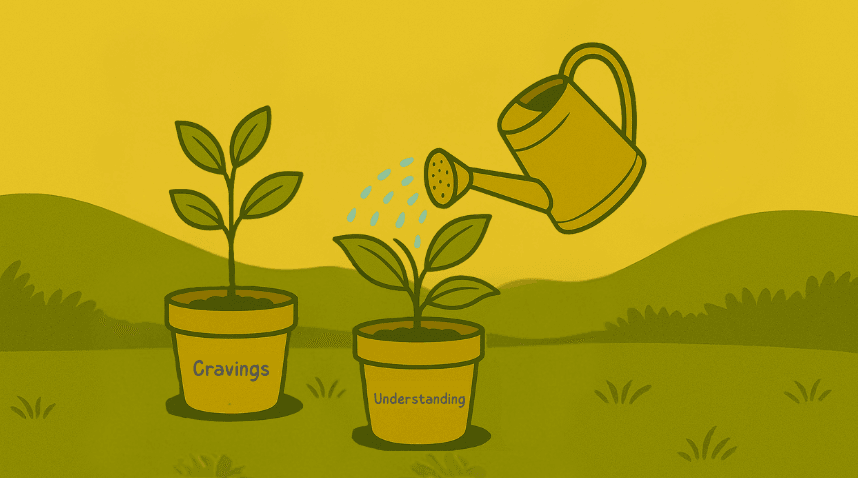
Asalha Puja is a chance to pause and ask ourselves where we are placing our attention. Are we feeding more confusion and craving, or are we slowly moving toward understanding and peace?
How Asalha Puja Can Change Your Life
This day is not only a historical reminder. It can be a turning point for how we live. Here are three ways you can mark Asalha Puja in a way that brings clarity and direction.
1. Reflect on the First Teaching
Take time to read or listen to the Dhammacakkappavattana Sutta. The Buddha’s first teaching is concise but offers deep insight into why we suffer and what we can do about it.
As you read, notice which part feels most relevant to your current life. Is it the presence of stress? The role of craving? Or the possibility of inner peace? Let this reflection guide your intention for the day or week ahead.
2. Practise One Step from the Eightfold Path
You do not have to take on the whole path at once. Choose just one aspect to bring into your day. It could be Right Speech, by choosing to speak more kindly and truthfully. It could be Right Effort, by being aware of which thoughts are helpful and which are not.
Even a small shift, like pausing before reacting or being more present in conversation, can bring a noticeable change in your day. These efforts help reduce conflict and grow more steadiness in the mind.
3. Make a Simple Offering
Offering is not limited to giving material items. It is the act of giving with sincerity and care. You might offer a meal to a monastic, support a Dhamma organisation, or simply help someone quietly and without expecting anything in return.
You can also offer your time, your attention, or your practice. A short period of meditation, even ten minutes, can be your way of honouring the Buddha’s teaching with sincerity.
A Chance to Begin Again
Asalha Puja is a chance to come back to what really matters. You do not need to do something grand or complicated. What helps most is the willingness to pause, reflect, and begin again with a little more mindfulness and care.
The Four Noble Truths and the Eightfold Path are not meant to be memorised and set aside. They are meant to be lived, in small ways, every day. And each time we remember that, we give ourselves the chance to live with a little more peace and a little less struggle.
May this Asalha Puja bring you moments of calm, clarity, and the confidence to keep walking your path with gentleness and purpose.
Wholesome Wednesdays (WW): Bringing you curated positive content on Wednesdays to uplift your hump day.
One of the key tenets of the Buddha’s eightfold path is ‘right speech’ . Sometimes, we may mistake practising ‘right speech’ as trying to never ‘say no’. How can we improve the way we say no at work so that we protect our space? In addition, how what is a quick way to understand right speech? Here are two helpful materials for us to practice wise speech at the workplace.
1. 7 tips for saying no at work without destroying relationships 2. 4 types of speech to avoid
7 tips for saying no at work without destroying relationships
Cr: Unsplash
What’s going on here & Why we like it
Amy Rigby, a writer at fingerprint for success, shares 7 tips on how to say no at work and examples that you can apply immediately. We found this useful as it highlights principles to keep in mind when extra work wanders into our inbox and we struggle between working late and being the ‘ugly’ colleagues who says no. Amy also provides ways to say no such as “ I’m honoured you asked for my help. but” or “I wish I could, but..” followed by “that does not sound like a good fit for me” or “ I am working on other projects right now”. Give it a try! You never know how much time you can save by saying no.
“You don’t have to go into great detail about why you’re declining. A simple ‘my schedule is packed this week’ is fine.”
Wise Steps
When was the last time you said no and protect your breathing space at work/ at home?
Practise some of these examples and apply them to an unreasonable request that next comes your way.
Cr: Phra Nick’s Youtube Channel on 5 tools for better speech
What’s going on here & why we like it
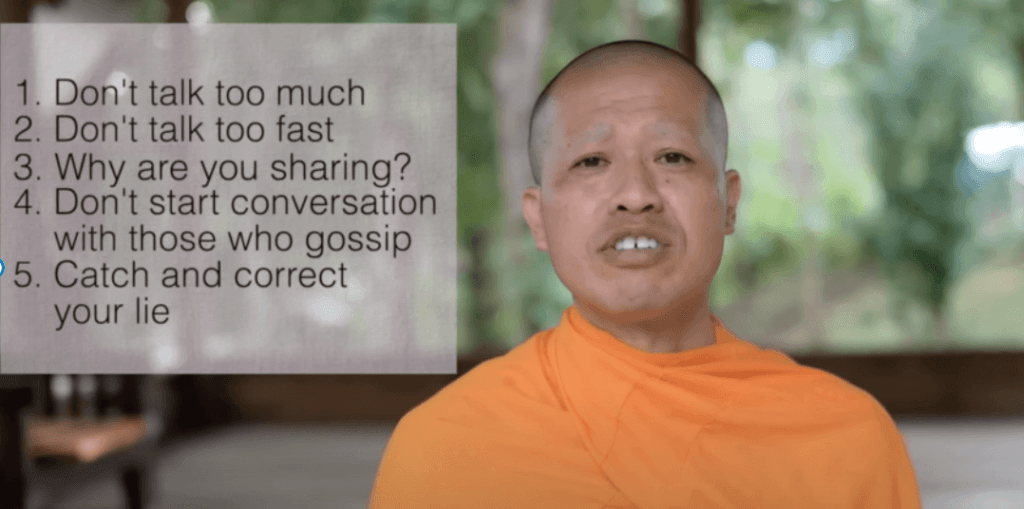
Venerable Nick, a monk living in Thailand who is active on youtube for his short videos of Dhamma, shares more about right speech and easy examples for us to understand and practice in day to day life. His calm voices guides through the Buddha’s right speech which is often missing at the workspace and in the online world. He shares 5 tools for us to practice better speech.
“Come back and check on why you are sharing what you are sharing…I am sharing this story, what is the point of that?”
Wise Steps
Contemplate: Which part of the 4 speeches do I need to improve on?
Practice: Apply the 5 tools for practising right speech for a happier and more peaceful life
This is a reflection piece as contemplated by the author based on the Buddha’s teachings. As such, it may not contain the truths as taught by the Buddha. The author hopes the reader takes away useful bits that may resonate and discard whatever parts that make no sense without any aversion.
TLDR: Our minds are seldom at peace. Peace means having lasting contentment and not being piqued by the smallest things. Yet our mind seems to know there is something peaceful beyond our mundane experiences. For this reason, our minds are always searching for a refuge.
For many years my mind searched for a refuge. Refuge means a place of safety and protection from dangers according to the Oxford dictionary. When it comes to the mind, dangers would point to non-acceptance, anger, indifference and insincerity from others. A refuge for the mind would be friendship, acceptance, love and honesty instead. The mind also seeks good repute and wealth, so that it indirectly receives respect, love, admiration and acceptance from others. Observing myself and others, I found there is not a time when our minds are not seeking refuge.
Why does the mind seek refuge?
Looking back into a faraway past, I remembered when my mind first gained consciousness of its senses.
When I was around three or four years old, I remember sitting at the threshold between the living room and the kitchen drinking a bottle of hot milk. Although I do remember glimpses of consciousness, such as being wrapped in a cloth tied to a spring attached to the ceiling. I was being bounced up and down and I think I hit my head and cried.
From the time of ‘waking up’ to the awareness of this life, I remembered being an observer to most events around me. I did not know anything except enjoying playing with the neighbours. A distinct memory of my mother crying and packing to leave home was etched in my mind as my sister tried to stop her. My sister was maybe six years old? I am three years younger than my sister, and I was at the table drinking my hot cup of milo for breakfast. I only observed and felt no emotions.
The time my mind began searching for love and safety was when my father began verbally abusing me.
He would scare me into a corner and cane me too, especially if I fell ill. I was prone to asthmatic cough and was barred from certain foods. My father’s family has a history of asthma. He scolded me because seeing a doctor would eat away his already low pay as a hawker.
My awareness of the lack of approval from my parents and their relatives was the start of the mind seeking refuge from someone or something to balance this suffering.
Back then, academic ability was highly prized and perhaps they hoped I would do well and bring them pride but I’m not a scholar.
Other reasons for seeking refuge
I was speaking of what I perceive to be my early cause for seeking a refuge for the mind.
The truth is, the mind seeks refuge due to a host of other causes too. Causes such as boredom, loneliness, belonging, disappointment, or just do something to find meaning in life.
If we look deeply, it seems the mind is incapable of being at rest for long. Action is primed in our system. Our entire system on earth – the weather, the animals and people are all acting upon one another so that not taking action, or not making a choice is not an option at all. Weather changes can disrupt our day, animals can cause us harm – in today’s terms, the harm comes from a virus. Even when nothing is disturbing the mind, it seeks a goal to feel secure.
Be wise about the refuge you seek
In The Noble Search Sutta (MN. 26), the Buddha talked about two types of refuge we seek. He called them the ignoble and noble search.
He said the ignoble search is someone seeking a refuge in what is birth, death, sickness, sorrow, defilement and ageing when he himself is not spared from these things.
The objects of ignoble refuge for the mind include spouse, children, possessions such as animals, land, the house and slaves. During the time of the Buddha, most laypeople were married with children and they were either kings, farmers, merchants or slaves. Society during that time is not very much different from our time today. We still seek a sense of security in a partner, in our children, our jobs, savings, possessions and friends.
It is not wrong to seek these things, except don’t expect them to last or be stable for a long time. They are all subject to the ravages of impermanence. What is born, will die. While alive, we inflict upon one another our defilements (greed, ill will, confusion), as what I had experienced from my parents and friends. What we possess will one day decay and become others’ belongings. It is not to despair over the lack of stability in life, but rather to know and be wise about them. Our own body and mind too are insecure things that do not last.
A noble refuge for the mind
The opposite of an ignoble refuge would be a noble refuge for the mind. In the words of the Buddha:
“Suppose that, being myself subject to birth, having understood the danger in what is subject to birth, I seek the unborn supreme security from bondage, Nibbāna. Suppose that, being myself subject to ageing, sickness, death, sorrow, and defilement, having understood the danger in what is subject to ageing, sickness, death, sorrow, and defilement, I seek the unageing, unailing, deathless, sorrowless, and undefiled supreme security from bondage, Nibbāna.”
– The Buddha, MN. 26
Nibbana is the release of the mind from always wanting (craving). Not wanting something is wanting something else. The mind, in wanting, is never at peace. There is something within us that is unageing, unailing, sorrowless, birthless and deathless. As it already exists, there is no need to crave for it, but to discover it like an archaeologist digging to find a treasure.
What is outside of us, is subject to ageing, ailments, sorrows, birth and death. We crave refuge from what is outside of us because we are ignorant of the gem within us.
Is the noble search open to lay people?
Since the permanent peace we seek is already within us, it is open to anyone who is curious, who seeks real security and stability whether one is a lay person or a monastic.
Of course, unlike a monastic, a lay person cannot devote 24 hours a day to perceive and experience this unageing, unailing, sorrowless and deathless gem in us.
What is seen is easy for the mind to believe in its existence. What is subtle and unseen, is difficult for the mind to believe in its existence. Therefore, there are a lot more lay people than monastics. However, being a lay person does not mean we cannot put the practice into our everyday lives.
How to seek the noble refuge as a lay person?
A lay person who wants to experience the peace within learns to tread The Noble Eightfold Path. The path is the practice of reflection, cultivating virtue, tranquility and wisdom. A lay practitioner can have family, possessions and a job.
Depending on a person’s seriousness in the practice, s/he can reduce outer activities, unnecessary speech and spend time meditating everyday. Also to be mindful of one’s actions and thoughts in daily life. To show patience and love whenever unpleasant experiences arise. Also, to learn not to cling to goals but to enjoy living each moment as it is.
It may sound like a tall order. But fortunately, the practice gets easier and more fun to do each time. We can become bored after attaining worldly skills such as computers, language and technical knowledge. But when it comes to living a virtuous, wise and calm life, there is no end to learning until one reaches lasting contentment, or what the Buddha said, Nibbana, which takes lifetimes.
Wise Steps:
Spend time relaxing without needing to do anything
To relax, intentionally tell your mind and body to let go and just breathe in and out
Meditate without a goal or intention
Go about your daily life relaxed without a goal, being aware that goals can easily be changed so you can flow with it.