

Dharma in the City: Can You Practise the Dhamma While Climbing the Corporate Ladder?

Dharma in the City: Can You Practise the Dhamma While Climbing the Corporate Ladder?

TLDR: The story of a Buddhist professional who integrates faith, family, and humanitarian work. Daniel Loh’s life reflects how Kamma, kindness, and clarity can transform everyday living.

Dharma in the City is a series featuring ordinary Buddhists who have spent decades in the practice, and also in service to their communities and beyond. 

Most lay Buddhists are multi-hyphenates – wearing the hats of a family member, a professional, a volunteer, a friend, and more. How do we go about the practice in a way that integrates all these different roles that we take up?

The journeys of our interviewees shed light on how Buddhist teachings have influenced and supported their diverse aspirations, roles, and occupations, all while cultivating the same path of peace.

The following interview features Daniel Loh, one of the early members of Firefly Mission, a Buddhist humanitarian organisation, as well as a Buddhist mentor, father and corporate professional in Singapore with experience that spans various fields including aerospace, management consulting, and the chemicals industry.

The interview proper/ The Paradox of Career and Contentment

Question:

Brother Daniel, you’ve been a wonderful mentor to several Buddhist youth, including myself, through the Singapore Buddhist Mission’s Mentorship Programme. I recall that we first connected when I was at a career crossroads, and I was heartened to find a seasoned practitioner such as yourself who is joyfully navigating the dual paths of lay duties and Dhamma practice. Your illustrious corporate career, along with your dedication to Firefly Mission’s humanitarian work speaks volumes of your commitment to striking a balance.

Based on your interactions with the younger generations of Buddhists in recent times, what are some challenges that they are facing, which you feel are unique to being a modern-day Buddhist? How have these insights potentially influenced your own practice or growth on the path?

Answer:  I count myself fortunate to be able to be in touch with the Dhamma from a very young age and have benefitted from it when navigating through my youth and working life.  Through the mentorship program by Singapore Buddhist Mission (SBM), I had the opportunity to mentor young professionals like yourself and others.  I rejoice to see that quite a few have the desire to get actively involved in Dhamma activities, learn and practice more. Each individual comes with their own set of capabilities, challenges and hurdles.  Nevertheless, one rather common perceived paradox is that of balancing contentment with building a career and family

I have been fortunate to apply the Dhamma in both my family life and my career, and it has helped me greatly. I see no conflict between the Dhamma and working life; skills like communication, relationships, leadership, and creating value are fully in harmony with the Dhamma.  For example, value creation as an employee.  When we have periodic reality checks to see if we have indeed created or delivered value appropriate to the monetary compensation we receive, we inevitably will be of value to the organisation.  In doing so, we avoid “taking away time”  from our employer or underdelivering on the expectations, which is also a form of dishonesty.  

The concept of Kamma (Causes & conditions) has been a key pillar in my life.  Knowing that I have put in my best efforts on something, I am not too disheartened when the results are not what I expected, nor am I too elated when it does.  The result, Vipaka , is a combination of past and present Kamma.  You have no control of the former, but can influence the latter. Living in the present takes on a clearer meaning. When something undesirable happens and I know clearly my present actions are not the cause of it, I take heart that this is a repayment of a Kammic debt.

Meditation has also helped me in many ways.  When I was working, meditation helped me calm my mind down and often, with a clearer mind, solutions to issues just came up.  However, the real purpose of meditation is to end our defilements, which I am now focusing more on.

Lessons from Interfaith Friendships

Question:

Growing up in multi-religious Singapore, I’ve often navigated differences in beliefs even within Buddhist circles. For you personally, how has your approach to interfaith and intrafaith friendship evolved over the years, and were there any key turning points or figures that shaped how you cultivate this understanding with your close friends?

Answer: Indeed, I do have many friends and relatives of different faiths. Religion can sometimes be mere labels that divide people. When growing up in my teen years, I have to admit that I sometimes tried too hard to “defend” Buddhism. 

Over the years, I have learned to accept that people will have diverse beliefs. What is more important is whether these friends show patience, tolerance, and understanding toward individuals and humanity. So instead of recognising religion, I move towards recognising the values and virtues of the individual. The Buddha’s teaching, “To do good, avoid evil, and purify the mind,” (Dhammapada 183) rings louder in my heart as I approach middle age.

I have two close friends. We are ex-colleagues, and each grew more passionate about our own different faiths. There were times we shared with each other the essence of our own faiths, often with the genuine care of a dear friend trying to help. These conversations were short-lived, as we realised that none of us were open to changing our beliefs. So we got along as good friends and simply chose to be there for each other in times of need.

I visited Mother Teresa in India in 1996 while traveling there with Buddhist friends. The fact that she was of a different faith did not in any way lessen our respect for her. We were captivated by her compassion and dedication to the less privileged. Professionally, I have taken Mahatma Gandhi’s passive resistance as an inspiration to do things differently. None of these experiences dwell on the topic of religion. As long as your friends’ and relatives’ actions are consistent with the Buddha’s teaching, “To do good, avoid evil, and purify the mind,” interfaith understanding is not a big challenge. Ultimately, everyone is seeking happiness, albeit in different ways.

Family, Faith, and the Householder’s Path

Question:

Among younger people today, family-building often feels de-prioritised, and in some Theravāda circles it can even be seen as a distraction from practice. Yet you seem to embody both devoted family life and deep Buddhist practice. How would you advise young couples who want to both build a family/relationship and grow in the Buddhadhamma?

Answer: The Buddha taught both the happiness of a renunciate (AN 9.41) and the happiness of a householder (AN 4.62). The path of the renunciate is the more vigorous path, with fewer distractions from worldly affairs, but not completely void of responsibilities. The life of a householder is filled with responsibilities and challenges—suffering to some—but also opportunities to practise at one’s own choice. These were important lessons taught to me during a two-week novitiate program in my teen years, which had a profound impact on me. 

I was clear that although I wanted to be close to the Buddha’s teachings, a monk’s life was not suited for me. With that, the Buddha’s teaching on happiness as a householder became a guide for me. So my advice is: if you think you have chosen the householder’s path, then be clear about how you can achieve happiness as a householder, and make sure you and your spouse are in tune with this.

Let’s go a little deeper with an example. Being a householder, you need to make money for necessities. So you run your own business or get employed. If you observe the tenets of Right Livelihood, you are already putting yourself at ease with your vocation. Observing the Five Precepts is the best guide to morality. Coupled with the generosity of your time, effort, and material, you are setting yourself on the path to happiness. By not stealing and avoiding false speech, you set yourself apart as an employee who brings value with integrity to the organisation. 

You are easy to manage and become a role model for others. You are not focused merely on working hours, but on delivering value on time. When you become a leader, you lead with the same values and with compassion. You naturally become a leader who cares and is focused on helping your team deliver value to the organisation. When you deliver real value to the organisation, beyond your cost, any organisation would be foolish not to take care of you.

At home or at work, Right Speech helps. Speaking truthfully, kindly, and purposefully conveys intentions that are pure, compassionate, kind, and useful. Arguments and disagreements are often ignited by harsh and heedless speech. Provide constructive feedback when appropriate and timely, whether positive or corrective. I personally appreciate when someone cares enough to provide feedback, especially when it is objective and and even more when it is tactfully delivered.

There will always be ups and downs. Understanding and accepting that everything is impermanent—that arising issues will cease over time—helps us not to take things too personally. Use mindfulness practice (meditation) to increase focus and concentration. This inevitably also helps in managing stress and life’s challenges.

Growing up in a progressive environment, we were taught to think of efficiency and effectiveness. If this mindset extends to people and relationships, it can cause distress when the expected outcome does not happen. With humans, given the same causes and conditions, you can expect different outcomes from one individual to another. One useful way that helped me, was to remind myself that each proposal or initiative is truly meant to help the larger group. So even if a few are not appreciative, it should not lessen the desire to act. You could say, in a way, that the practice of altruism helps.

When Leadership Meets Mindfulness

Question:

Other qualities of yours, which I find could be a point of inspiration for many, is how you’ve applied your leadership skills, operational knowledge and enduring compassion to humanitarian work under the auspices of the Firefly Mission, a humanitarian organisation founded in 2003.

Could you please share with us how this seed of FireFly Mission was planted and germinated? Would you be able to share with us how you have sustained your motivation and commitment to both the humanitarian work of Firefly Mission and dhamma practice, over the many years of service alongside practice?
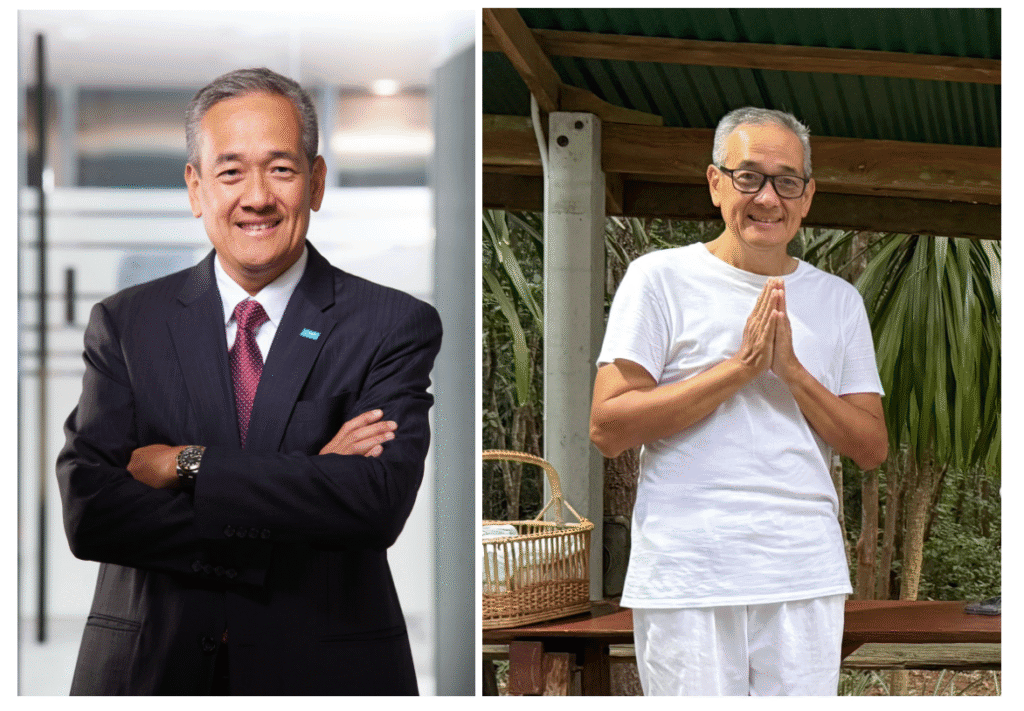
Replacing corporate life with more meaningful Buddhist activities. 

Answer: Firefly Mission (FFM) started in 2003 and was officially registered as a society in 2005. It began as a sub-committee of the Buddhist Fellowship and had its first overseas mission in 2001. FFM focuses on humanitarian work in Education, Healthcare, Community Welfare, and Dhammaduta. Over the years, FFM’s footprints have spread beyond Singapore to Myanmar, Bangladesh, Bhutan, India, Nepal, Sri Lanka, Thailand, Laos, Mexico, Cambodia, Indonesia, and Malaysia. We have funded the building of schools, clinics, toilets, and bridges, as well as sponsorship programs for nuns, children, and funerals. We have also carried out disaster relief and rehabilitation programs.

FFM has no paid employees or premises, and volunteers pay for their own incidentals and trips. We encourage our volunteers to practise meritorious actions focusing on Dana, Sila, and Bhavana (Generosity, Morality, and Mindfulness).

For many of FFM’s members, including myself, we firmly believe that these are important conditions we are setting for ourselves in our striving toward the end of suffering. With this in mind, we no longer spend our money, time, and effort expecting praise or recognition. The smiles on the faces of the beneficiaries, knowing that they have a safe and conducive environment to study, create the hope of a brighter future. These are what drive our volunteers to keep doing what they do.

At appropriate times, we also organise meditation retreats, Dhamma talks, and Kathina trips for our members. These help in the development of our own spiritual path.

The opportunity to practice Dana, Sila & Bhavana is truly something that we cherish being part of FFM family.    

Friends Who Keep the Flame Alive

Dharma in the City: Can You Practise the Dhamma While Climbing the Corporate Ladder?

Question:

In the Uppadha Sutta (Sn 45.2), it was told to Ananda that “the entire holy life,… is, good friendship, good companionship, good comradeship”. Thank you for being a wise friend to the HOL readers through this interview. 

You’ve clearly faced and worked through many challenges in your practice and life journey. Are there particular teachings or insights that have most helped you endure and overcome difficult periods, which we might also hold onto in our own darker times?

Answer: Indeed, the Buddha’s exhortation to Ven. Ananda was a very important one for all of us to keep in mind—the importance of Kalyana Mitta (spiritual friends). We are all encouraging each other on the Buddha’s Path. Handful of Leaves (HOL) and FireFly mission (FFM) are both creating the conditions for readers, supporters, and volunteers to come together—not necessarily always in person, but to be connected spiritually and inspired to stay close to the Triple Gem.

During the course of my career, I was based in Thailand, Malaysia, and Indonesia with my family. That gave me a real appreciation of the countries and the lifestyles there. A couple of locations were appealing as possible places for retirement, due to the lower cost and abundance of land. Nevertheless, I wanted to return to Singapore and reconnect with my spiritual friends before retiring. Eventually, I returned to work in Singapore for four years before I retired in 2023.

Handing over of a students’ dormitory at Chumchonbanthasongyang Secondary School, Tak Province, Thailand in Octo 2024.  Dormitory sponsored by Firefly Mission members. 

Close friends and family can comfort you in trying times and sometimes provide immediate relief. Kalyana Mittas encourage you to stay close to the Buddha’s Path and, on many occasions, inspire one another to practise together. On many occasions, when I am slacking in my Dhamma practice, the sense of urgency arises when I am with Dhamma friends.  It is normal that we tend to be part of the company we keep, doing things that the group finds interesting.  Therefore, hanging around Kalyana Mittas is truly a blessing.


Wise Steps:

  • Practise Right Livelihood daily by ensuring your work brings value and integrity, just as Daniel checks if his contributions match his pay—avoiding dishonesty by giving his best at work.
  • See career and Dhamma as one path, not two separate lives; Daniel shows that lessons like communication, compassion, and leadership naturally align with Buddhist practice.
  • Balance contentment with ambition by applying the law of Kamma—do your best without clinging to results, knowing outcomes are shaped by both past and present causes.

References:

What’s at the end of the chase?

What’s at the end of the chase?

TLDR: Having a set of goals to work towards gives us a sense of direction in life. Our society prizes this go-get-it attitude as a self-improvement hack; many of us strive for this mindset. However, there could be a risk of doing something just for the sake of it and we may end up beating ourselves for getting lost in the pursuit of excellence. 

Many of us have been conditioned to chase something, consciously or unconsciously. We race with others to prove our worth, ever since birth – to be the first to crawl/walk/run, the top rank in class, the one to get into a famous university, the first to be office management level, the one who found ‘the one’ and have family……The list continues. 

The neverending chase has been fuelled by the comparison trap we adopt from our parents, society and ourselves. 

Have we ever pondered what is the source of our chasing mindset?

I was so used to the chase that I rushed from one achievement to another, not sparing time to truly soak in whatever I was doing and its outcome. After landing my first job as an accountant, I quickly enrolled on a professional certified course. 

Upon completion, I thought, ‘what’s next?’. Before long, I was looking to register for a postgraduate degree. 

I must admit those learnings were not in vain. I gained something out of them – both technical skills and soft skills like time-management, relational skills, self-organisation. These skills have been helpful to me in my personal and professional life. But whether or not I could use the effort on a more targeted outcome, that’s another question altogether.

To outsiders, I may look like someone with a thirst for knowledge (or paper certificate, for that matter). 

Little did I know this chase was masked as self-improvement; there would always be a better thing to go for next if I don’t consciously define the outcome that I want to achieve. 

This deceptive ‘self-improvement’ is not limited only to the worldly chase – I realised that I wanted to keep improving myself spiritually too. While spiritual advancement may be a sensible goal, my underlying intention was warped, at least initially. 

I kept myself immersed in spiritual talks one after another. I sat meditating even when the heart refused to – just to prove that I, too, can evolve in my spiritual practice. 

This spiritual chase resulted in resistance between the mind and the heart, not to mention the sense of dejection when I didn’t see the improvement I expected. Definitely not a fun experience!

The source of my chasing mindset was a sense of lacking self-worth. I wanted to prove myself a  deserving human being by reaching the level that is deemed ‘good enough’. And we know that ‘good enough’ is a subjective measurement and may not serve as a good gauge. 

Comparing myself today with who I was 3 years ago, for example, I can honestly say I have grown into a different and (hopefully) a better, more mature person. This is probably a better use of the comparison mind for improvement measurement.

Be kind to ourselves and others

I chanced upon an apt Dhamma talk by Venerable Ajahn Brahm on how we often hold on to ‘I need to be better’ thoughts just because everyone else thinks or expects so. Ajahn Brahm further taught that this ‘I’m not good enough’ mindset is neither kind nor helpful to ourselves. 

Of course, we need to carefully distinguish between accepting ourselves with kindness and not growing out of unconstructive habits. 

There could be a risk of not improving the mind under the false pretence of self-acceptance. Learn to be at peace with what we already have, then improvement would flow naturally. 

Many of us may be performing good deeds and consciously express kindness to others. Doing so not only keeps the mind at peace but also elicits joy during and after the act. I identify with this definition of living a blessed life in the spirit of Mangala Sutta, when I can share and contribute what I have with others. However, with the chasing mentality, I might have forgotten about the one person who would benefit from such good deeds as well – myself. 

How many times do we speak harsh words inside our head when we act less than ‘perfect’? 

‘Why did you do that silly thing?’

‘How could you forget about that important event?’

‘What is wrong with you?’

I probably would not say such things to my close friends or even strangers, so why do I say them to myself? Am I unworthy of the same kindness I have so freely and joyfully shared with others? 

Nowadays, I decide to contemplate my pursuits with an objective mind, even if it seems like an improvement on the surface: 

‘Does this course/workshop feel aligned with the heart or is there another reason why I want to join?’

‘Do I feel joyful in learning or is it another medal on my chest to show the world?’

Suffering arises when we don’t get what we want and when we get what we don’t want

I recently read separate teaching from Venerable Ajahn Chah1 on “wanting with right understanding”. The teaching explained that desire towards and away from something can arise from us as worldly beings. I find resonance to this gentle outlook towards self and am aware that setting goals can start off my self-improvement actions – but blindly chasing and grasping the desire tightly is not right either. Instead, taking action accompanied by gradual and reflective practice would be more helpful. 

For example, I started this article with the intention to write about chasing struggles. It has developed into deeper contemplation of my underlying beliefs and expanded thoughts that I am sharing now.

Trying to be mindful of my wanting and not-wanting, I do my best at the moment and allow the outcome to unfold. 

I realise that telling myself to let go of expectation, is an expectation by itself – another debacle to untangle! 

Rather, it is much more peaceful to put in my best effort for the situation; watch the result arise and take the next step from there. 

When a learning experience concludes as expected or not, I try to take time to settle down and truly embrace the event. When another learning opportunity comes, I will then be able to jump in wholeheartedly. Even if I failed, I could learn from it. Failure is just another piece of feedback! With this outlook, I hopefully lessen the suffering created for myself.  

I conclude that having a goal is necessary, especially for myself and many others who are just entering the ‘real’ life of the professional and social world. 

Clarity of true motivation is essential as we take on the path, paired with conscious kindness towards ourselves when the comparison mind takes a negative turn. The next time I look at others and start to put them on the pedestal with an unreasonable expectation of myself, I will remind myself: ‘remember how far you have gone’ and ‘we all have our own path to take’.

Notes:

  1. Source: The Collected Teachings of Ajahn Chah – Single Volume, Aruna Publications, 2011, Chapter 22, page 237, https://forestsangha.org/teachings/books/the-collected-teachings-of-ajahn-chah-single-volume?language=English

Wise steps:

  • Pair working on goals with a mindful review of underlying reason in choosing these goals, it could provide clarity on the true nature of our motivation
  • When harsh reprimand arises within, ask if these are the words we will give to others 
  • Refrain from punishing ourselves when we could not let go immediately. Be still, the conditions for letting go will arise.
Having the courage to quit my job and start again. #Mindfulchats with Yanda

Having the courage to quit my job and start again. #Mindfulchats with Yanda

TLDR: Why quit your job during a pandemic? How do we help our friends who are thinking about quitting?

When the pandemic plunged the world into recession, university graduates felt nervous. The fear of not finding a job or having your job offer rescinded was real.

Hence, to land a job and then quit your stable, full-time job during a pandemic makes you pause and say “Huh, why?”. Yanda has a different take. He asks ‘Why not?’.

Sipping coffee as Yanda shares his story

The Job Hunt Hype

Yanda, a final year student in 2020, took his time to enjoy university while it lasted. He mentioned that “everyone was rushing to secure a job. There was great hype for job hunting.”

It was definitely not an easy climate to be in. Rather than worrying about uncertainty, Yanda volunteered for Buddhist Organisations such as NTU Buddhist Society/ BYN (Buddhist Youth Network). He then took on the job search in his own time.

(No. Yanda doesn’t come from an uber-rich family where a job falls on his lap. He didn’t see the need for an all-or-nothing chase.)

Eventually, Yanda obtained a few offers in the engineering space and took on a role he thought he might enjoy. That is where things changed.

Is This It?

Work soon became monotonous and a routine for him. He noticed a routine of “working, going out for lunch, sitting back down and going home.”

This made him wonder, “Is this it? Is this how I am going to spend my life? What do I want? If I lived to 60 years, will I be content with doing 40 years of the same thing?”

In response to his musing, I mumbled: “Definitely not me.”

His attempt at sharing work struggles with some friends did not yield something he could relate to. They alluded to “finding meaning in your job rather than have the meaning come to you.” It was cold comfort.

I could see his thought process unfold and why that advice didn’t sit well. Yes, there was this sense of job security during a pandemic but it brought little meaning to him. That meaning was nearly impossible to find.

The turning point came when this question popped to mind, “If tomorrow, I am going to die, I would only remember that I did paperwork here and there. That’s it”. That spurred him into action. He tendered his resignation and left the company to the shock of his peers. New hires are usually expected to stay in that job for at least 2 years, but he stayed in that role for less than 6 months.

The Pains Of Change

“I had fear and felt scared”, he gulped when recalling the moment he quit and had no job offer on the horizon.

“So what helped you through the uncertainty?” I quizzed.

The fellowship of his Buddhist circle who listened patiently was what brought him to a brighter state of mind. Friends that were slow to advise but quick to listen to his pain helped him greatly. “That is what matters…being there for me,” he concluded.

“Confidence in the Buddha’s teaching, knowing that all these negative emotions would fade,” he added, gave him strength when he was alone. He viewed the transition as “uncertainty at its very core.”

Over the years, having done mindfulness practice enabled him to watch his emotions and to make  necessary changes without attachment. That gave him the conviction that it was not an impulsive move but an informed one.

Starting Again

Smiling as he recalled his Buddhist work, “I have done a lot of Buddhist work that brought joy to me. If this (engineering) job doesn’t fit me, what can I do?”

As causes and conditions came together, Yanda didn’t need to wait long for an answer.

“A friend told me that she had an opening at a preschool where they wanted a Dhamma friend to help build the school’s curriculum.” He recalled. He mulled on the idea of facing kids all day and decided to take the plunge.

Yanda is now studying for a Diploma in Early Childhood Education while working to help build the preschool’s curriculum.

“Uncertainty,” he answers immediately when asked what he loves about his job. “What the children can bring to you every day with every interaction presents uncertainty,” he added.

When he dived deeper, he felt lifted about being able to help kids appreciate this ‘thing’ called the mind. Letting them know that there are ways to develop their minds. Equipping them with Buddhist concepts, techniques and emotional awareness to thrive in a stressful world really motivated him.

“Kids are easy to teach, as they are free of concepts,” he quipped. At that moment, I recalled being an inquisitive child, something I felt I have lost along the way. It was interesting to see how uncertainty could bring us pain (job transition) and joy (teaching kids).

Helping Others Start Again

I was curious to hear Yanda’s take on how we can help our friends’ transition from one job to another.

“There is no one-size-fits-all solution, but what I can say is that this is something cliché,” Yanda shared.

“Listen to them and be genuinely happy for them. Recognise that they took a courageous decision to step out of something that did not fit them,” he added.

On a practical side, Yanda shared that we should remind our friends to also financially plan ahead if they choose to resign without a job offer. As a rule of thumb, one should have at least 3-6 months of expenses saved in cash to weather them through their job search.

His advice was grounded heavily on the Buddhist idea of appreciative joy which is a joy in the achievements/victories of others.

“How can I support you? Do you need resources/contacts?” has been one of the most helpful questions friends asked. I instantly agreed by nodding furiously as I felt that we often are quick to develop solutions without considering our friends’ needs.

Turning Back Time

“Your first job is super important” is one piece of advice that Yanda recommends ignoring for graduating students. It adds unnecessary stress to the individual. That person may then seek out the perfect job which may not exist.

Having wisdom is crucial in helping us see the world properly. If he could turn back time to advise his graduating self, he would say this: “Have an attitude in life that let the results take care of themselves once I try my best. If it doesn’t go my way, what can I do next?” and “We are our own boss, only we can understand our emotions and the true nature of our mind.” 

Asking that question gives us the courage to be open to what life can bring. What we can do is to create conditions for success while developing a sense of non-attachment to the outcome.

“Understand we have a mind, and emotions are never truly ours. Just like a cup. The reason why we wash it is that we are confident that the dirt can be washed off. The dirt was never the cup.” he summarised.

It was a mind-blowing summary of expectations and emotions. Recognising emotions as transitory and being at ease with the unpleasant is a skill set we all need as we go through the different changing phases of life.

Yanda showed that Singapore youths are hungry for life and meaning. We need not stay in the same job just to clock a magical number of years before leaving. Asking ourselves “Is this it?” can spark conversations and paths we never dreamt of.

Yanda is currently working in Blue Lion Preschool as an early childhood educator trainee.