
Ep 67: Why Buddhist Couples Stay Happier – The Surprising Truth

Ep 67: Why Buddhist Couples Stay Happier – The Surprising Truth

Summary

Many couples don’t fall apart because of a lack of love — they drift because they stop listening, growing, and meeting each other where they are. In this episode, Cheryl sits down with Angela, founder of Almost Peaceful, to explore why some relationships deepen over time while others quietly disconnect.

Drawing from lived experience, Buddhist principles, and years of working with couples, Angela shares how mindfulness, curiosity, and honest communication can transform conflict into connection — and why lasting love is less about grand gestures and more about daily intention.


About the Speaker

Most relationship experts either focus on therapy (fixing what’s broken) or surface-level advice (communication tips that don’t stick). Angela bridges the gap with relationship mastery – the systematic approach to building extraordinary partnerships.

Her unique combination:

  • Academic rigor from her Master’s in Social Development Policy (Distinction) from University College London
  • Real-world experience from 6 years facilitating high-stakes government dialogues as a Singapore Scholar
  • Professional training in Gottman Method, Mindfulness-Based Stress Reduction, and Co-Active Fundamentals Coaching
  • Personal understanding of what makes marriages thrive


Key Takeaways

💬 Listening Over Fixing

Most relationship tension comes from rushing to solve problems instead of first offering presence, empathy, and a listening ear

🌱 Love Is a Verb

Healthy relationships are built through consistent effort, curiosity, and small daily actions — not assumptions or mind-reading

🧘 Non-Attachment Strengthens Love

Honouring impermanence, personal space, and emotional awareness helps couples grow together without clinging or control.


Transcript

Full Transcript

[00:00:00] Angela: And Xuan actually looked at me and he said I’m only gonna propose once.

[00:00:07] Angela: And if you don’t accept, I’m gonna walk out of the relationship.

[00:00:11] Angela: Is that serious, right?

[00:00:17] Cheryl: Welcome back to the Handful of Leaves podcast. Today we are talking about something so many couples feel but rarely say out [00:00:25] loud. We live together, but somehow we are not really connecting anymore. In Singapore, almost half of divorces cite unreasonable behavior and over sixty percent of women say that’s why they filed for divorce.

[00:00:39] Cheryl: So today we are digging deeper into what makes relationship stick. And with me is someone who knows this terrain intimately, Angela.

[00:00:48] Angela: Hello,

[00:00:49] Cheryl: [00:00:50] Angela, you’ve built Almost Peaceful that turn tough conversations into meaningful connection. And I’m very excited to have you here. So can you share with us, what in your journey inspired you to build this work?

[00:01:02] Angela: I spent the last six years working at ministry and helping residents, citizens to understand difficult policies. What I observe for the six years of work is when people are trying to find common [00:01:15] ground they tend to jump very fast into problem solving. And that’s something that I noticed in my relationship as well where either of us is always trying to problem solve.

[00:01:24] Angela: When most of the time what I wanted or what my husband wanted is really a pair of listening ears. So that’s when three years ago when I got engaged, I started to look around in Singapore whether there is marriage preparation workshop that can help [00:01:40] me, my husband better prepare ourself in marriage. Guess what?

[00:01:44] Cheryl: There’re none.

[00:01:45] Angela: Yes, exactly. So we are trying to look for something that’s a bit more zen inspired when it comes to marriage, how do we approach marriage, how do you approach communication whether we want to solve problem or listening ear? So that’s when I realized in Singapore there isn’t such workshop or such training, advice available. [00:02:05] So it has always something at the back of my mind that I always wanted to plug the gap. So that’s how I started almost peaceful which is to help couples turn tough conversation into meaningful connection.

[00:02:17] Cheryl: Wow, that’s very inspiring. Can you share a specific moment where you realize that [00:02:30] we are really just problem solving here, we are not listening to each other anymore and what you learn from that?

[00:02:30] Angela: In fact there is a major actually the transition from dating to marriage, actually quite a scary phase because you are going to enter a different identity.

[00:02:39] Angela: It makes sense

[00:02:44] Angela: to get married

[00:02:44] Angela: It’s the normal next step. yes, yes, yes. So in Singapore it’s very normal you date for some time you are serious in the relationship, you go get married.

[00:02:50] Angela: For me, at that point in time, I just felt like I prefer the dating [00:02:55] stage, why do you need to move into the official marriage where there are so many other senior stakeholders involved and then you you have to move out of your own place. My mom’s place which I really enjoy staying with her with my nieces nephew and the convenience of being at my mom’s place versus having to set up your own home.

[00:03:14] Angela: So the conversation when

[00:03:17] Angela: Okay, this one I never tell people before.

[00:03:19] Cheryl: Wow, we can hear it [00:03:20] first time.

[00:03:22] Angela: So the conversation when I told Heng Xuan that I am not ready to move into marriage life. I prefer to stay dating life where we are now, it’s good, it’s comfortable and And And Xuan actually looked at me and he said I’m only gonna to propose once.

[00:03:44] Angela: And [00:03:45] if you don’t accept, I’m gonna walk out of the relationship.

[00:03:48] Angela: Is that serious, right?

[00:03:52] Angela: And he has always been someone that is he meant his words, very sincere. Always putting in effort in the relationship and that was when I realized that this thing is serious right. I need to take time to decide whether or not to transit to the marriage life.

[00:04:06] Cheryl: And it seems that both of you were at different paces at that time. What helps you [00:04:10] to make that decision as a couple?

[00:04:12] Angela: Whether to go get married or not right? Woah this one very drama ah.

[00:04:17] Angela: So I applied half day of leave from work, I told Heng Xuan, I want to time out. So I told I told him that I want a three days time out from the relationship where we don’t text each other, we don’t meet, really just giving me the space and time to think because marriage is a big thing.

[00:04:32] Angela: I don’t want to rush into it, I don’t want to act out of [00:04:35] anger. So I I took half day leave, I asked for a three days time out from my boss, my husband then my boyfriend and I packed this picnic bag with apple, hot tea, and when I went to MacRitchie where I took a very very long walk. And that was when I was walking at MacRitchie, and then I saw this young couple walked past me. And then at the moment in my mind I was young couple. [00:05:00] The next moment immediately there was this elderly couple that walk past me in my mind, I said, oh that’s so sweet. That was the moment when I realized that I want to grow old with someone. And I cannot see anyone else except for Heng Xuan.

[00:05:14] Cheryl: Wow, that gave me goosebumps.

[00:05:16] Angela: I know right. So immediately, I texted him. And I said that no need the three day time off already. That’s how I got engaged I got married.

[00:05:24] Cheryl: [00:05:25] Tell me a little bit more how did you know this was the one and how do you know you know you are not, you’re making the right decision, not something that was emotional, sentimental.

[00:05:38] Angela: It’s a combination of effort as well as time. So effort because we are always constantly trying to get to know each other.

[00:05:46] Angela: We don’t assume that we already know you since you are seventeen, you are [00:05:50] always the same person. So it’s really spending effort and how do I know that it’s the right person is really practicing the same believe. That’s very important. So having the same values, having the same belief that guides us and of course it’s about time, right, spending time with each other.

[00:06:08] Angela: yeah, that helps to know that he’s the one and is he the one? I hope so.

[00:06:14] Angela: I actively [00:06:15] practice what I teach for my

[00:06:17] Angela: couple in my relationship.

[00:06:20] Cheryl: And you mentioned a really good point that marriage is an active process and effort. So talking about marriage and the life after In Singapore actually the largest share of divorces happened around five to ten years of marriage. um often you know when the couple are [00:06:40] juggling different stages of their careers, inlaws, mortgages. What do you think makes that time such a risky and vulnerable period that makes even the strongest couple slip in their relationship?

[00:06:52] Angela: It’s absolutely brutal. Marriage where it’s five to ten years that’s the real brutal stage in Singapore where couples are juggling with their career, they are also having young children and not [00:07:05] forgetting the aging parents

[00:07:10] Angela: on top of the mortgage being stuck in generation that’s your demand and then there’s the finances demand. So that’s where. the crack starts to happen and they are not being sealed up. At the start of the relationship, You are curious towards each other, you are curious about each other, you spend time, you prioritize each other.

[00:07:28] Angela: When life get busy with all [00:07:30] this priority, what happened in most couples is that they give hundred and ten percent to work, hundred and ten percent to that aging parents, hundred and ten percent of the young children. Whatever is left, ten percent, twenty percent on the relationship. So you see that’s the problem, right?

[00:07:45] Angela: They are spending the remaining energy, whatever is left on relationship.

[00:07:50] Cheryl: And more often than not that means bringing your worst self to your relationship.

[00:07:54] Angela: That’s right, [00:07:55] so the stress, anxiety into that relationship pillar.

[00:08:00] Cheryl: What do you think can be helpful because sometimes it’s inevitable as much as we say don’t bring your work home, you just can’t stop the first thing when you wake up, it’s about work, the last thing that you think about it about work. How can people prioritize each other in their relationships?

[00:08:16] Angela: So the good news is this can be prevented and [00:08:20] that is where you have the mindset of being curious to each other. So in mindfulness based stress reduction which I’m trained in, we call it the beginner mindset.

[00:08:33] Angela: So you always begin assuming that you don’t know everything about your partner yet. And you have that curiosity, right, you want to know how was the day, was there anything that made you smile, was that something that I did recently that you feel [00:08:45] loved. So that’s where you continue to be curious about each other.

[00:08:49] Angela: Actually love is a verb. It’s not a noun.

[00:08:51] Angela: And that that requires a lot of effort and in Buddhism, the we talk about right effort. effort is not just working hard. Effort is about directing your awareness with intention. So when it comes to relationship it’s about being curious with each [00:09:10] other and having that this micro moment all this add up.

[00:09:13] Angela: It’s not a grand gesture where you buy beautiful things, you have beautiful experience, grand expensive. But it’s really all this micro moments that.

[00:09:23] Cheryl: I’m very curious about your relationship. In the fourteen years or so you are together, was there a moment where you felt that you kind of lost that curiosity and interest

[00:09:33] Angela: to each other and brought back that spark.

[00:09:34] Angela: [00:09:35] Definitely in the season of life that’s up and down that period where you are busy, there’s period where you are trying to strive for your career.

[00:09:41] Angela: for me it’s less of the career, but it’s more of the caregiving for my late parents that’s where I had to prioritize them and I’m glad I did. Right. But because of the prioritization of my late mom and that means that other things have to be second third, fourth priority. [00:10:00] So that’s a shift right. So instead of my husband being the priority and my career being the priority, my mom is a priority.

[00:10:07] Angela: And that shift means that certain things have to go, certain things have to change. So it was tough because I was going at the place where I was giving a caregiving for my mom and I wasn’t coping that well because there was a lot of stress emotionally and physically. [00:10:25] I de-prioritized my career, but I didn’t verbalize to my husband.

[00:10:29] Angela: And he had the assumption that I was going at the same pace as before. So he was giving me a lot of suggestion for my business out of good intention right, you just don’t want to help your wife succeed, you are the cheerleader, he is the cheerleader for me and he wanted me to succeed but I was at the pace where my career is actually my third priority at that point in time.

[00:10:49] Angela: And [00:10:50] there’s a mismatch of pace. He wanted me to be at the same pace as before but I couldn’t, I know that I didn’t have the capacity to be at the pace where I want to be. Not now. So I didn’t communicate to him and that’s where we have a bit of that frustration

[00:11:04] Angela: and I just felt like I’m caregiving now, I’m regulating myself, I’m glad I am still functioning. I still can show up for volunteer, sport and show up for myself. Why is it that there is this uh tension in the [00:11:15] relationship. So that’s where we have our monthly uh couple chat, we we usually go to a cafe to have a monthly chat.

[00:11:22] Angela: So that’s where I surface tension and I said that actually what I need now is the space to prioritize caregiver. career at this season of my life is third priority.

[00:11:37] Angela: So asking very clearly asking very clearly that I need space. I [00:11:40] appreciate your suggestion but even if you give me, I won’t be able to look at it immediately.

[00:11:46] Cheryl: Monthly dates just to catch up with each other. That sounds really amazing! For our audiences who want to have monthly chat in their relationships, how do they get started with this?

[00:11:57] Angela: Having it monthly is a really good rhythm. So building rhythm in your relationship and having it at cafe [00:12:05] is up to you, your choice.

[00:12:06] Angela: What’s more important is the content. So there are three things that we talk about during this monthly couple check in.

[00:12:14] Angela: The first is about yourself. So you ask question about in the past month, what’s one thing that you are proud of, what’s one thing that you wish you could have done better? The second pillar is about relationship.

[00:12:27] Angela: What’s one thing in the past month I’ve done that make you [00:12:30] smile? What’s one thing you notice about me that you really love. And the last part is about future goal. So in the next month, what’s something that you are excited for individually and in the next month, what is something that you are hoping for that we can experience or do together.

[00:12:49] Angela: So you just keep repeating the same set of question, [00:12:55] you keep repeating month for month and that helps you to be curious. to each other, right, because thirty days, thirty one days is a lot of time, many things can change

[00:13:02] Cheryl: And I really love how you also incorporated the part of the vision of what you want to do together because a lot of people get so lost in the mundane.

[00:13:10] Cheryl: I wanted to shift gear to bring us into something all relationship, all couples face, conflict. And the number one challenge about -conflict is that many [00:13:20] people find themselves stuck in the same cycle.

[00:13:21] Angela: There are patterns that keep repeating. The first pattern is the avoidance So when one person want to talk about it, the other person just want to avoid. sweep it under the carpet. And that what happened resentment resentment built up and over months it just explode resentment doesn’t go away without having actively working on it.

[00:13:44] Angela: So that’s the [00:13:45] avoidance pattern that I see and a lot of what we do in the workshop is sitting down and Go topic by topic. So instead of just opening the whole kind of worm and say that what what are you avoiding about what you. It’s really about going topic by topic, right? So during the workshop where I run for my couple, so we will begin with dealing with conflict resolution and then there is the finances and then there is your in-laws, your [00:14:10] future goals.

[00:14:11] Angela: So there are different topics right. Then you realize that some they are very good at They don’t avoid. Some they tend to avoid. So that’s where you go topic by topic to help them talk about it in the safe space and also using fun way using board games to to understand more about each other to just using play as a way to learn about each other. So that’s something that I realize can help those who tend to avoid [00:14:35] difficult topic using play and using topic. The second time of people, the couple come to workshop, I realize the other. I call it the mind reader.

[00:14:47] Angela: So what what the reader right? The word implies that if you love me, you know what I want. Love is enough. You know what I want. A lot of times couples that come to my workshop they are like I don’t know. he or she doesn’t get [00:15:00] it.

[00:15:01] Angela: And then I asked have you communicated? No, I expect them to know.

[00:15:06] Angela: If you love me, love me, they will know. So so so in the workshop we always use this magic formula about Soften start up. how do you communicate your us in a way that is soft yet specific. So it’s a formula where it’s about this [00:15:25] is how I feel when this incident happened and my ask. So instead of saying you say you put your phone away lah.

[00:15:32] Angela: Meal time they are always using phone instead of having connection. So instead of saying Use phone again lah. Passive aggressive, passive aggressive the mind reader. So mind reader plus passive agressive.

[00:15:49] Angela: So I always tell [00:15:50] them that the magic formula, right? I feel lonely when you use phone during meal time. Is it okay if you put aside the phone for twenty minutes so that we can connect. Okay you see the difference?

[00:16:02] Cheryl: I would imagine the toughest thing to do is even naming and identifying the emotion and then the second thing is of course ego right like if you love me, you care [00:16:15] for me, you should not want me to feel lonely.

[00:16:18] Cheryl: So how do you encourage people to use that, especially I guess in the Asian context it’s really weird to your feeling and this kind of thing.

[00:16:28] Angela: It’s a piece of muscle that you can grow over time, self awareness awareness of your emotions that feeling. Emotion is nothing wrong with it. There’s nothing wrong with emotions, whether [00:16:40] it’s it loneliness, whether it’s anxiety, there’s nothing wrong with it.

[00:16:43] Angela: The thing is being aware of it and communicating that, that that is a super power. The more you are able to build this muscle, the more you are able to avoid miscommunication, avoid the mind reading and the passive aggressive.

[00:16:56] Cheryl: Can you share with us, the hardest relationship lesson you have to learn in your own marriage. [00:17:05]

[00:17:05] Angela: I think the hardest lesson is bringing in your baggage from your own life into the marriage. So for me, I am a hyper independent person since you because of the way I was brought out.

[00:17:24] Angela: So when I was seven, my mom was a babysitter and she just couldn’t bring me to [00:17:30] primary school. So at seven I learned to be independent, to walk by myself to school uh when most of my friends they were brought by parents or being chauffeur. So that independence started since a young age and that brings into the relationship and it’s a fine line between interdependence between two persons and being independent as a person.Can you explain more about interdependence [00:17:55] what does that mean?

[00:17:55] Angela: In a relationship it is a partnership between two persons.. Being hyper independent, there is a cost. Because being hyper independent makes your partner feel that, eh, am I not needed? Am I not helpful and that there’s a question mark because you are hyper independent. [00:18:20] So at the start of the relationship, I’ve always always rejected when offer help or just like you know like like simple things like oh walking me home.

[00:18:32] Angela: I feel like myself I got got seven years old. Ya, why? em ya so there’s this hyper independence part that I bring to [00:18:45] my relationship. But the thing is it’s not about losing who I am. It’s not about losing quality. But it’s about knowing when to bring up the quality and when to tune it down. So you have to navigate that part.

[00:18:59] Angela: So I will always ask for space. So along the way we are negotiated such that once a year I’ll go for my own solo trip. And in my own home as well, I have this library [00:19:10] little small little reading note where I cover the space and it’s like my zone. So that’s where during renovation we agreed that I needed a space for myself not because I don’t love you, but because I need my own space in order to love you more.

[00:19:26] Angela: so you you see when you are able to still live yourself to being independent, still having your own space, you can show up better. [00:19:35] as a partner.

[00:19:36] Angela: So that’s something that I have to learn the hard way, you know, like through through the feeling of the question am I needed, I am not doing good enough there is always this conversation.

[00:19:48] Cheryl: So in this process of unlearning this very ingrained habit of hyper independence, what do you have to let go of?

[00:19:57] Angela: letting go of [00:20:00] being right all the time em that this is who I am. Exactly right. So holding on to the view that this is who I am since seven years old, so you should accept me for who I am at thirty one years old.

[00:20:16] Angela: learning to let go that this identity is shaped by environment. So when I was seven because of my mom’s working condition, she cannot bring the baby, she was a [00:20:25] babysitter, so I have to go my best. shape my environment and now that we are together as a couple again my environment has changed. So that can shape my identity.

[00:20:34] Angela: So it’s learning to let go of the the the fixed identity, the fixed view and that that identity is right. Not being the identity means I’m wrong.

[00:20:45] Cheryl: That really reminds me of the concept non in Buddhism, where you know [00:20:50] there is no one core identity that remains unchanging rather we are constantly shit. Environment. Actually that’s a good way to see relationship

[00:20:59] Angela: because the moment we see that it’s not permanent, then we are willing to always learn about each other and meet the person where they are. I never think of it that way. I didn’t see the another part in the relationship, I will incorporate that in the next workshop.[00:21:15]

[00:21:16] Cheryl: And if I may I also wanted to just ask about the inevitable en of relationship. What is your thought of that being someone who has experienced losing both your parents and eventually right all relationships have to end. What are your current perspective, [00:21:40] thoughts and reflections that’s all.

[00:21:44] Angela: Mm Important question that is often overlooked because people tend to want relationship to last forever and again it’s a concept of. Anicca Impermanence Nothing last forever. But does it mean that we don’t put in effort now? Does it mean that because the end is there, then we don’t really walk to the end. since we know that we should end.[00:22:05]

[00:22:05] Angela: So it’s the mindset of embracing the here and as a partner, also in relationship, it’s really enjoying the moment, being better together, practicing our values, practicing our faith and if you can, if you have the capacity to serve.

[00:22:23] Angela: Knowing that all relationship come to an end is nothing unique about you. So first you have to acknowledge that [00:22:30] there’s nothing unique that all relationships come to an end. The moment you accept that it’s nothing unique, you embrace that okay, this is natural, right? The Thai word that came to me was Dhammada Tada means it’s normal normal.

[00:22:43] Angela: So accepting that all relationships have come to the end, it’s not unique to you, don’t make it a big hoohaa right? Yes, don’t make it so personal. So how do you accept, [00:22:55] embrace and make the best of the relationship. Whether is it with your parents, whether is it with your current colleagues or whether it with your partner, right?

[00:23:02] Angela: How do you make the best. So again having curiosity towards each other, don’t assume that they are the same person. Don’t assume that your parents always have a health to walk with you, to go overseas with you to take care of your children. Don’t assume that they will always be the same person as they are and don’t take kindness for [00:23:20] granted.

[00:23:20] Angela: When our partner is kind to us, and our parents is kind to us, appreciate them and if we can reciprocate with kindness, right? Yeah, so to me knowing that Th come to an end, it’s not a sad thing. but actually there is beauty in that because it gives you urgency and it helps you to it’s called this life reiser, [00:23:45] help you to cut through life, cut through the distraction and the noise and help you to par.

[00:23:50] Angela: Maybe at this season of life, what’s more important is aging parents.

[00:23:53] Angela: So you spend more time with them every Saturday schedule time to work with them knowing that maybe I just left with thirty more times with them and with your relationship again cut through the noise right knowing that maybe you want to prioritise monthly cafe chat with them. [00:24:10] So helps you to prioritise.

[00:24:12] Cheryl: And because precisely because relationships end, each and every moment is even more precious.

[00:24:20] Cheryl: Okay. So sometimes there are couples and perhaps even couples listening right now who maybe on the brink of giving up. Angela, what would you want to tell them

[00:24:32] Angela: The brink of giving [00:24:35] up, that is not the end. The brink of giving up, that is actually a path, right?

[00:24:41] Angela: It’s a split path where you get to decide Do we have the capacity to continue as a couple? Or do you want to let go of the relationship because letting go is the wiser choice and there’s nothing wrong with each of the path they are taking, but to accept that when you [00:25:00] feel you at the brink point, it’s not the end, it’s actually two path for you to choose.

[00:25:07] Angela: So the moment you know you have a choice, that is a very powerful thing and then what you want to do is to make a not make a choice out of fatigue, not make a choice of anger, not make a choice out of desperation but make a choice because you have run through questions intentionally, you have [00:25:25] asked yourself have we tried things to solve the relationship or are we just doing the same thing repeatedly.

[00:25:34] Angela: You see the difference, right? A we trying different ways to solve the relationship problem or are we continuously doing the same thing over and over again. So that’s one, the second one is do we still have good to each other, do we still have loving kindness towards each other [00:25:50] and that’s important in a relationship and the third one is are you both willing to take responsibility for the relationship.

[00:25:59] Angela: So again, having gone through this three question, couple can decide, can make a choice. If yes, let’s try new things, let’s take responsibility for relationship, let’s take this path. On the other hand, if you have evaluated and you feel [00:26:15] that no this relationship is no longer serving me, this relationship is no longer one where we want to take responsibility we we are over that take the choice to let go of the relationship.

[00:26:28] Angela: Because doing that serves you better. It makes you a kinder person to yourself and that’s where you practice compassion. So taking this choice is not failure. [00:26:40] So we must always acknowledge each making either of the choice, neither of it is a failure, neither of it is being easy on yourself or being hard it.

[00:26:47] Angela: It’s about making choice intentionally knowing that you have evaluated and you are going to make a decision based on what you know at this moment.

[00:26:58] Cheryl: There’s no right or wrong, it’s really the best that you could do with all that you know in this moment. [00:27:05] Okay. And great. So we will come to our one final question for today and what is one small tiny simple step a listener could take today whether you are single, whether you’re in a relationship to feel more connected to someone important in their life.

[00:27:27] Angela: One small step will [00:27:30] be looking at the person’s eyes and of course not when the person is rushing, brushing in the toilet

[00:27:38] Cheryl: Look at me!

[00:27:38] Angela: I say look at me!

[00:27:40] Angela: So at the appropriate moment, asking your partner or your parents what’s one thing that make you smile today. So that’s meeting the person where they are and it also show care right show that actually you are not just asking me how was my day or asking [00:27:55] me about logistics.

[00:27:57] Angela: “Eh the toilet paper buy already anot ah?” So this are logistics. But are we meeting the person where they are asking the person what was one thing that made you smile today.

[00:28:07] Cheryl: And then we come to the end of the episode. Thank you so much, Angela for sharing your wisdom with us. And I hope this episode makes everyone better actors in their relationships.

[00:28:19] Cheryl: See you in [00:28:20] the next episode and thank you for joining us till the end. Bye bye.

[00:28:23] Angela: Thank you.


Special thanks to our sponsors:

Buddhist Youth Network, Lim Soon Kiat, Alvin Chan, Tan Key Seng, Soh Hwee Hoon, Geraldine Tay, Venerable You Guang, Wilson Ng, Diga, Joyce, Tan Jia Yee, Joanne, Suñña, Shuo Mei, Arif, Bernice, Wee Teck, Andrew Yam, Kan Rong Hui, Wei Li Quek, Shirley Shen, Ezra, Joanne Chan, Hsien Li Siaw, Gillian Ang, Wang Shiow Mei, Ong Chye Chye, Melvin, Yoke Kuen, Nai Kai Lee, Amelia Toh, Hannah Law, Shin Hui Chong, Dennis Lee, Kayliam, Darren

🙏 Sponsor us: https://vrqbl96dqbz.c.updraftclone.com/support/


Editors and Transcribers of this episode:

Havalooka Studios, Tan Si Jing, Bernice Bay, Cheryl Cheah


Visual and Sound Effects

Anton Thorne, Tan Pei Shan, Ang You Shan


Get connected here:

Telegram Instagram YouTube Facebook

Ep 66: Alone But Not Lonely ft. Ven Sumangala

Ep 66: Alone But Not Lonely ft. Ven Sumangala

https://youtu.be/Gag4APzBZ-4

Summary

What does it mean to be alone without feeling lonely? In this episode, Venerable Sumangala reflects on solitude, companionship, and the inner stability needed to stand confidently on our own. She shares why learning to be at ease with oneself is essential for mental freedom, emotional resilience, and genuine connection with others.

Drawing from Buddhist teachings and lived experience, this conversation explores how spiritual friendship, mindful discipline, and self-understanding allow us to navigate loneliness in modern life. Rather than escaping solitude, we learn how to transform it into a source of clarity, strength, and peace.


About the Speaker

👤 Venerable Sumaṅgalā Therī is the Abbess of Ariya Vihara Buddhist Society. She embarked on her spiritual journey in Buddhism at the age of 19, inspired by the serene sight of a monk and people meditating, which deeply delighted her heart. This initial inspiration led her to actively pursue, learn, and practise the Buddha’s teachings, with a particular focus on meditation.

She holds a B.A. in Psychology and in 1999, she completed her M.A. in Industrial and Organizational Psychology, both from Universiti Kebangsaan Malaysia. Furthering her academic and spiritual education, Ven. Sumaṅgalā Therī obtained an M.A. in Philosophy (Buddhism) from the International Buddhist College, Thailand in 2011.

Her formal journey into monastic life began in 2005 when she left the household life to become an Anagarika. Her ordination as a Dasasil (akin to a Sāmaṇerī) took place in November 2008 under the sacred Sri Mahābodhi at Bodhgaya, India. Her preceptor-teacher was Ven. Mahinda Mahāthera, a proponent of Mettā and one of the early disciples of the late Ven. Dr. K. Sri Dhammananda Nāyaka Mahāthera from Malaysia. Her meditation teacher was Ven. Nadimale Sumedhā Maniyo of Sri Lanka, who guided her in samatha-vipassanā meditation practices.

On 21 June 2015, she took her higher ordination under the guidance of preceptor Ven. B. Sri Saranankara Nāyaka Mahāthera – the Chief Judiciary Monk of Malaysia, and bhikkhuni preceptor-teacher Ayya Santinī Mahātherī of Indonesia.

In 2004, inspired by the late Venerable K. Sri Dhammananda Nāyaka Mahāthera, she decided to start a bhikkhunī training centre to complete the Fourfold Assembly for Theravādin practice: bhikkhu, bhikkhunī, upāsaka and upāsikā. In 2015, she pioneered the formation and registration of Ariya Vihara, Malaysia’s first Theravāda Bhikkhunī Nunnery and Dhamma Training Centre. In 2019, she received a government allocated land for the building of the project with construction to commence in the first half of 2025.

From 2014 to 2023, she inspired six short-term Theravāda Samanerīs to go forth for good, including the first 3 Cambodian Samanerīs to do so. She has assisted more than 50 bhikkhunīs in higher ordinations in Bodhgaya, India.

Currently, she serves as the Abbess and President of Ariya Vihara Buddhist Society and is an advisor of Gotami Vihara Society in Malaysia. Ven. Sumaṅgalā Therī is actively involved in conducting meditation retreats and giving Dhamma talks in various centers and camps, sharing her deep understanding and experiences in the Dhamma with others.

She is one of the recipients of the 23rd Anniversary Outstanding Women Awards (OWBA) 2024, in honour of the United Nations International Women’s Day.


Key Takeaways

Solitude Is Not Loneliness

Being alone becomes nourishing when the mind is trained to be steady, kind, and present.

Right Companionship Matters

Wise friendships support growth and values, without creating dependence or fear of being alone.

Inner Stability Creates Freedom

When we are rooted within ourselves, we relate to others from wholeness—not lack.


Transcript

Full Transcript

[00:00:00] Ven Sumangala: You master your life, you master your mind. You cannot live according to how people want you to be or how people perceive you to be.

[00:00:08] Cheryl: Welcome to the Handful of Leaves podcast. My name is Cheryl. And today I have Venerable Sumangala as my guest. Venerable Sumangala, is a fully ordained nun of 10 vassas and she’s also the president of Ariya Vihara Buddhist Society, Malaysia’s first Theravada [00:00:25] bhikkhuni nunnery and Dhamma training center.

[00:00:28] Cheryl: She’s also an advisor to Gotami Vihara Society in Malaysia. (add HOL intro clip) How can one be supported in this journey? And how to intentionally cultivate spiritual friendships?

[00:00:43] Ven Sumangala: It’s a very lonely journey because, majority are behaving that way, and you’re behaving [00:00:50] differently. We have to understand that when we walk the path in our life, again and again I say, we are seeking for what? Happiness, freedom. So that is our goal. If we think that, oh, when we have less friends, then we’ll be very lonely. But actually it’s not true. The important thing is kalyāṇa-mitta.

[00:01:11] Ven Sumangala: Friends that are beautiful. In a way that’s [00:01:15] supportive of your mental development. Most of the time, maybe every day, we look into our mind, we can feel the mind is at the lower side, not the upper side. So, who we associate is very important. So the Buddha even mentioned in the Mangala Sutta, what brings blessing number one is not to associate with the fool.

[00:01:37] Ven Sumangala: Number two, to associate with [00:01:40] the wise. Number three, respect those who are worthy respect. So there are altogether 38 blessings. And the Buddha also said, if you can’t find a friend that is better in their wisdom, ethical conduct, generosity in all those good states, then you better not mix. Why? Because it can [00:02:05] actually ruin your whole life.

[00:02:06] Ven Sumangala: You may think that when you associate with a lot of people, you are someone or you will feel very warm around, but no. Even you may have a few friends, but then that few friends is friend that you can really learn from, friends of sunny day and rainy day, friends of a counselor, motivator, and friends who doesn’t actually give up [00:02:30] on you when you are facing trouble. So, these are the friends that is more important. Not how many friends we have. And it is important to have friends that actually growing together, it will help the person to really develop.

[00:02:45] Ven Sumangala: When we don’t have friends, don’t be worried. For me, my best friend is the Buddha. why I think so is that because even we sometimes say, oh, this [00:02:55] is my best friend, they are not taking you as their best friend. Then you feel very hurt. But I think the Buddha is my best friend, and the Buddha said, you know, whoever that take him as a kalyāṇa-mitta, then the path of this happiness and freedom is open. Because they are possessing the path of the Noble Eightfold Path. You’ll find a lot of inspiration and also a lot of motivation and the [00:03:20] way how you can actually improve yourself to that the best human can do.

[00:03:26] Ven Sumangala: And the Buddha will never betray you. And his teaching is so vast. The path that he shows is so clear. And then we still have the Buddha, Dhamma, the Sangha until today that we can actually follow. This path is tested, validated. It’s not talking in the air or just a belief system.

[00:03:43] Ven Sumangala: So, not to worry, you [00:03:45] won’t be alone. And I was always asked, because I used to be alone. I always tell them, I’m alone, but not lonely. In the past, when I would stay in a retreat center, I used also to be alone and when the cleaner come, she always shook her head and saying that, aren’t you boring?

[00:04:04] Ven Sumangala: I tell her and said, I don’t have this vocab in my head “boring”. From [00:04:10] young until now. I used to tell last time my colleagues or whoever, I say if one day I say I’m bored, I say you should tell me, “something wrong with you”.

[00:04:18] Ven Sumangala: I mean the time that we have is such precious. And the thing that we can do is such wonderful. So therefore if we can really see the order of things and we do it and then you get all the result of what it means through happiness and [00:04:35] freedom.

[00:04:35] Ven Sumangala: Then we are not pushed around anymore. You master your life, you master your mind, you cannot live according to how people want you to be or how people perceive you to be.

[00:04:46] Cheryl: It reminds me of the Dhammapada verse where the Buddha said the mind is the forerunner of all things. What you shared about the Buddha being your best friend is so powerful. And I wanted to understand [00:05:00] how have you relied on the Buddha as a best friend in your loneliest times?

[00:05:06] Ven Sumangala: Sometimes we may face with some challenges, and then you don’t know who to turn to, right? When I face some challenges, like one time I remember during my work time in the past, key thing is that when everybody is like chaotic, throw out your anger and your temper.

[00:05:23] Ven Sumangala: “You think I don’t have temper?” That kind of [00:05:25] thought will come. Then reflection come in when you have Dhamma, then I say, it’s dangerous. If the darkness is there and you are the last hope, and if you give in and become dark, then it is worse. Nobody see any light.

[00:05:43] Ven Sumangala: Everybody will be banging at each other and get hurt. So then I tell myself, no matter how difficult it is, the [00:05:50] Buddha went through six years to discover this path. He went through even more tougher things. Then I tell myself, no, no, no, no, no. I should actually continue to uphold this light. Even the light is not very bright, I must keep holding this light. I cannot lose my temper. I cannot lose to join them in the darkness.

[00:06:10] Ven Sumangala: When this light is in the darkness, people can see hope. [00:06:15] People see, can see goodness. People see, can see, yeah, somebody is still holding that. And truly after that, all of them settle down again. So in times of difficulty, when we think of the Buddha, the perspective of what we should do, how we should do, and ability to be more compassionate and more kind in times of difficulty, the Buddha don’t get angry.

[00:06:38] Ven Sumangala: Even people want to kill [00:06:40] him. Not only he don’t get angry, he don’t have fear. So we wish that we can be like the Buddha, nothing to be fearful about the world. Then we have the energy, we have the motivation, and we have also ability to overcome challenges in life.

[00:06:57] Cheryl: When we hold on to the Buddha and the Dhamma, we’re holding on to light, goodness and hope. That really did [00:07:05] give me goosebumps as well. So thank you so much for sharing, Venerable. If there’s one advice that you can share with young people who are feeling disillusioned, also very confused in terms of seeking deeper meaning, what would that be?

[00:07:22] Ven Sumangala: You know, in our life, we have our goal from young, and then now we are on our own. We actually start to realize that [00:07:30] what we always think are not the same as what it really is, for example, especially those who are studying in colleges or university.

[00:07:38] Ven Sumangala: We can think or we can be very proud. Maybe we are very good student and we know like a lot of things, especially technology and everything. But when we come to the workforce, you start to see it is not what it is.

[00:07:51] Ven Sumangala: The reality is such that you are put in a situation that you have to [00:07:55] perform. And sometimes there’s no mercy because the competition is so great. So there’s no complacency of not doing something. And so all the stress, everything comes. So why not we keep to a principle. What life has it entail? What is the purpose of our life?

[00:08:14] Ven Sumangala: And that is very important for us. If we don’t have any principles in our life, then we are going [00:08:20] into the workforce by pushing around, by thinking competition is the way to our success or our happiness. So true fulfilment of life comes from not what you acquire, it’s what your principle is — principle that leads you to the order of things so you don’t have to be disillusioned, having disillusion of reality.

[00:08:43] Ven Sumangala: So come to [00:08:45] reality, face the reality, upskill your knowledge and whatever you need for your career. And then balance your life with the right lifestyle. Now a lot of people their lifestyle is out. When the lifestyle is out, you have to pay extra cost not only for your physical health, but mental health. So principles of life is important. So therefore, why it’s so important [00:09:10] that we have a purpose of life guided by the Triple Gem, the Buddha, Dhamma, Sangha.

[00:09:15] Ven Sumangala: Many people have tested this path and it helps not only when they are monastic, but also when they are lay people, when they are able to live a balanced life. So they still can live a very, very happy lay life, even as a young person cultivating your career. You’d be surprised if you can practice this, [00:09:35] taking the path, the Buddha, Dhamma, and the Sangha as your best friend, as your guide. And then you start practicing the principles of life that protects you, and protect others.

[00:09:47] Ven Sumangala: Then you follow the Noble Eightfold Path. Not that you have to chase after the success, success will come to you without you asking. I think this is my own experience. When I work, they are rank and [00:10:00] file. Some of them work for 15 years, 20 years. I worked there for five years only.

[00:10:04] Ven Sumangala: Then they already promote me to branch manager. I didn’t ask for it. When they interview me, what would I be within three years or five years? I just say to be happy and to make others happy.

[00:10:17] Ven Sumangala: So find peace within and do your best. Serve, share. And I think that is what the quality is [00:10:25] for being successful. Because other than that, the success will come to you. The promotion come to you. I didn’t ask for it, but they come to you because people trust, people see the quality and we feel the happiness.

[00:10:38] Ven Sumangala: Others also feel the happiness. Let success come to you rather than you chase after the success. Then you’ll find peace along the way. I think that is more important in our life because or else we will always feel very stressed, [00:10:50] very depressed, like always lacking of something, never feel content and fulfilled.

[00:10:56] Cheryl: And we are so lucky, we’re so lucky to have the Buddha’s blueprint alive with so many Sangha walking it as well as a direction and example.

[00:11:07] Ven Sumangala: So that’s why we say invest in personal growth, not just to get a worldly skill, but [00:11:15] also the spiritual path, the order of true happiness. So then you become the best version of yourself in the thriving journey of your life. So cultivate those good qualities and these are the protection, it will give you the resilience, the wisdom. Then the path will be even more smooth and easier for everyone.

[00:11:38] Cheryl: Sadhu, sadhu, [00:11:40] sadhu. Thank you so much Venerable, for the sharing and so much wisdom. I’ve learned a lot differentiating that material success is different from true happiness and that each of us have the ability and opportunity in this life to make use of the precious time that we have to walk on the path so that we can experience true [00:12:05] happiness for our own selves.

[00:12:07] Cheryl: And if lay people would like to offer support to your projects, can we find the details in the website or Facebook?

[00:12:17] Ven Sumangala: Yes, in our website, they do publish on the bank that if they want to donate directly or else they can contact sister Siew King. We use that (donation) for the service for the [00:12:30] society, for people to also come to know the Dhamma and also to partake the merits of building this is the very first Theravada Bhikkhuni Sima, nunnery and Dhamma Training Centre for family in Malaysia.

[00:12:44] Cheryl: What’s a Sima actually?

[00:12:46] Ven Sumangala: Sima in the translations, it’s called boundary. So in any monastery that we wanna set up for the proper ordination [00:12:55] of a bhikkhuni, in accordance with the vinaya, rules that the Buddha have set for developing pure community of monks or nuns .

[00:13:05] Ven Sumangala: So they need a sima boundary dedicated for pure action and also purification of impurity in case they have made any offenses. So, this year, in April it was fully [00:13:20] established by 17 bhikkhunis. And there are five Maha Theris.

[00:13:25] Ven Sumangala: So we hope for not only for this generation, but for generations to come, and also for the female who are keen in walking this path. There are also rooms for people to come and practice all year. We have another aspect that we provide, family education for parents and children to come and so [00:13:45] parents who have Dhamma, they can be a good role model for the children.

[00:13:49] Cheryl: Sadhu for all your contributions in building this for the benefit of all. So we come to the end of this episode. I will put in all the links below. And our listeners, please do subscribe to us on YouTube, Spotify, or anywhere you find us. And we hope to see you in the next one. Stay happy and [00:14:10] wise.


Special thanks to our sponsors:

Buddhist Youth Network, Lim Soon Kiat, Alvin Chan, Tan Key Seng, Soh Hwee Hoon, Geraldine Tay, Venerable You Guang, Wilson Ng, Diga, Joyce, Tan Jia Yee, Joanne, Suñña, Shuo Mei, Arif, Bernice, Wee Teck, Andrew Yam, Kan Rong Hui, Wei Li Quek, Shirley Shen, Ezra, Joanne Chan, Hsien Li Siaw, Gillian Ang, Wang Shiow Mei, Ong Chye Chye, Melvin, Yoke Kuen, Nai Kai Lee, Amelia Toh, Hannah Law, Shin Hui Chong, Dennis Lee, Kayliam, Darren

🙏 Sponsor us: https://vrqbl96dqbz.c.updraftclone.com/support/


Editors and Transcribers of this episode:

Hong Jiayi, Tan Si Jing, Bernice Bay, Cheryl Cheah


Visual and Sound Effects

Anton Thorne, Tan Pei Shan, Ang You Shan

Get connected here:

Telegram Instagram YouTube Facebook

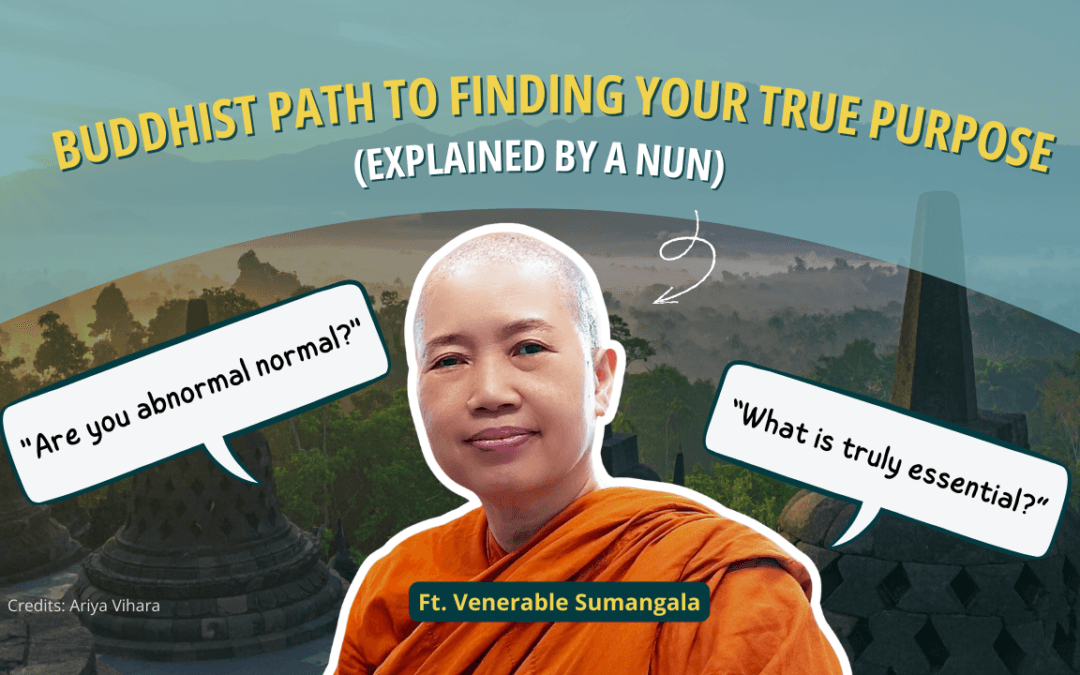
Ep 65: The Buddhist Path to Finding Your True Purpose ft. Ven Sumangala

Ep 65: The Buddhist Path to Finding Your True Purpose ft. Ven Sumangala

https://youtu.be/IK0KphAxygA

Summary

What gives life true meaning beyond achievement, comfort, and success? In this episode, Venerable Sumangala reflects on purpose, happiness, and the Buddhist path—challenging modern ideas of fulfillment and inviting us to look inward. Through teachings on non-attachment, mental training, and the Noble Eightfold Path, this conversation explores how lasting happiness comes from freedom of mind, not endless striving.

In a world driven by speed, consumption, and constant comparison, Venerable Sumangala offers a countercultural perspective: that peace is not found by adding more to our lives, but by understanding what is truly essential. She speaks about the quiet stress underlying modern living, the illusion of control through success, and how mindful awareness allows us to appreciate life without clinging to it—pointing toward a simpler, steadier form of happiness that can be cultivated here and now.


About the Speaker

👤 Venerable Sumaṅgalā Therī is the Abbess of Ariya Vihara Buddhist Society. She embarked on her spiritual journey in Buddhism at the age of 19, inspired by the serene sight of a monk and people meditating, which deeply delighted her heart. This initial inspiration led her to actively pursue, learn, and practise the Buddha’s teachings, with a particular focus on meditation.

She holds a B.A. in Psychology and in 1999, she completed her M.A. in Industrial and Organizational Psychology, both from Universiti Kebangsaan Malaysia. Furthering her academic and spiritual education, Ven. Sumaṅgalā Therī obtained an M.A. in Philosophy (Buddhism) from the International Buddhist College, Thailand in 2011.

Her formal journey into monastic life began in 2005 when she left the household life to become an Anagarika. Her ordination as a Dasasil (akin to a Sāmaṇerī) took place in November 2008 under the sacred Sri Mahābodhi at Bodhgaya, India. Her preceptor-teacher was Ven. Mahinda Mahāthera, a proponent of Mettā and one of the early disciples of the late Ven. Dr. K. Sri Dhammananda Nāyaka Mahāthera from Malaysia. Her meditation teacher was Ven. Nadimale Sumedhā Maniyo of Sri Lanka, who guided her in samatha-vipassanā meditation practices.

On 21 June 2015, she took her higher ordination under the guidance of preceptor Ven. B. Sri Saranankara Nāyaka Mahāthera – the Chief Judiciary Monk of Malaysia, and bhikkhuni preceptor-teacher Ayya Santinī Mahātherī of Indonesia.

In 2004, inspired by the late Venerable K. Sri Dhammananda Nāyaka Mahāthera, she decided to start a bhikkhunī training centre to complete the Fourfold Assembly for Theravādin practice: bhikkhu, bhikkhunī, upāsaka and upāsikā. In 2015, she pioneered the formation and registration of Ariya Vihara, Malaysia’s first Theravāda Bhikkhunī Nunnery and Dhamma Training Centre. In 2019, she received a government allocated land for the building of the project with construction to commence in the first half of 2025.

From 2014 to 2023, she inspired six short-term Theravāda Samanerīs to go forth for good, including the first 3 Cambodian Samanerīs to do so. She has assisted more than 50 bhikkhunīs in higher ordinations in Bodhgaya, India.

Currently, she serves as the Abbess and President of Ariya Vihara Buddhist Society and is an advisor of Gotami Vihara Society in Malaysia. Ven. Sumaṅgalā Therī is actively involved in conducting meditation retreats and giving Dhamma talks in various centers and camps, sharing her deep understanding and experiences in the Dhamma with others.

She is one of the recipients of the 23rd Anniversary Outstanding Women Awards (OWBA) 2024, in honour of the United Nations International Women’s Day.


Key Takeaways

Purpose Beyond Success

Modern ambition promises fulfillment, but lasting meaning comes from understanding suffering and cultivating inner freedom rather than external identity.

Non-Attachment, Real Peace

By loosening our grip on desires and outcomes, the mind becomes lighter, steadier, and less shaken by change or loss.

Train the Mind

Regular mindfulness and meditation build clarity and emotional resilience, helping us respond to life with wisdom instead of habit.


Transcript

Full Transcript

[00:00:00] Ven Sumangala: if a person live a hundred years without a purpose, so, what they do is eat,

[00:00:04] Ven Sumangala: sleep,

[00:00:05] Ven Sumangala: then play, play,

[00:00:07] Ven Sumangala: pain, pain,

[00:00:08] Ven Sumangala: die.

[00:00:14] Cheryl: Welcome to the Handful of Leaves podcast. My name is Cheryl. And today I have Venerable Sumangala as my guest. Today, we question the purpose of life. A lot of us wonder around just doing our nine to five, and then after that we spend five to nine on scrolling on IG, scrolling on TikTok.

[00:00:34] Cheryl: Then day by day, it just goes by and one day we are 60. So what truly is the purpose of life and how can we make our day to day more meaningful? My guest today, Venerable Sumangala, is a fully ordained nun of 10 vassas and she’s also the president of

[00:00:51] Cheryl: Ariya Vihara Buddhist Society, Malaysia’s first Theravada bhikkhuni nunnery and Dhamma training center.

[00:00:57] Cheryl: She’s also an advisor to

[00:00:58] Cheryl: Gotami Vihara Society in Malaysia. Welcome Venerable Sumangala.

[00:01:02] Ven Sumangala: Thank you. Namo Buddhaya.

[00:01:05] Cheryl: Namo Buddhaya so to begin off, I will start with a cheeky question, which is what is the purpose of your life?

[00:01:15] Ven Sumangala: My purpose of life is

[00:01:17] Ven Sumangala: to live every moment as it is. The main purpose is to be free from suffering and feeling free.

[00:01:27] Cheryl: Can you share a bit more what does feeling free mean?

[00:01:30] Ven Sumangala: So when we practice the Dhamma,

[00:01:32] Ven Sumangala: we will come to the stage of the mind where we get into the insight of what reality is, which is impermanent, constant change. And because of that, you can see there’s no entity that is in operation.

[00:01:48] Ven Sumangala: Then from there,

[00:01:49] Ven Sumangala: then the practice of letting go of desire and also the attachment on things in the world, even regarding with our body, we have that kind of sense of understanding that everything that we see, we experience is a fleeting nature.

[00:02:09] Ven Sumangala: So, if you understand that, then you would not want to crave and also grab or attach.

[00:02:19] Ven Sumangala: Thing comes and thing goes. We make good use of it when it is necessary or in need. But other than that,

[00:02:26] Ven Sumangala: when it comes, it comes. When it goes, it goes. If we don’t hold that attachment, then everything will flow freely.

[00:02:34] Ven Sumangala: We don’t get stressed and upset,

[00:02:37] Ven Sumangala: angry over the change of things or not getting what we want. So I think this is a very important insight to experience that freedom from all this entanglement and the grip of desire and attachment. Once the mind understand the reality, I think we will be free. And then because of that, we are happy. Not because we look for, but because we experience that happiness through that freedom from attachment.

[00:03:04] Cheryl: Wow. Sadhu. Well, does this also mean then that purpose will be changing and flowing? And if that’s the case, then why do we need purpose?

[00:03:17] Ven Sumangala: Well, when we are young, when we don’t have the understanding of the Dhamma or the truth, this is the process that we go. I mean, in the past when I was young, I mean, all of us go through, right?

[00:03:29] Ven Sumangala: And when we are young, people will ask, what’s your ambition? So I would say, oh, my ambition is to become a doctor. Then the mission start to change again because your inclination may change. So our purpose of life, we think, is to be or to become somebody.

[00:03:44] Ven Sumangala: And so if our purpose of life just to become and become and become, there’s no end. So these are the things that is ongoing. So we don’t have any really purpose, but we just live life like passing time. We don’t have a direction. But at the same time, we also know that we are not really that happy, although we have all the material things.

[00:04:05] Ven Sumangala: And we are also worried,

[00:04:08] Ven Sumangala: have fear,

[00:04:09] Ven Sumangala: and we are confused,

[00:04:10] Ven Sumangala: we don’t know our destination. So if we do not have any purpose in life, this is how we are going to live our life. Like I used to share with people,

[00:04:20] Ven Sumangala: even if you live a hundred years right, and then if you look at it, people will say,

[00:04:26] Ven Sumangala: wow such a long life.

[00:04:27] Ven Sumangala: It must be a good life. But one third of our life is what? Sleeping. Can you imagine you sleep for nearly 33 years in your life, doing nothing. Then another one third of your life is what? You’re taking care of this body. Then another third, then they say, oh, Venerable, normally, you know, it’s work. So, but I say if you live 100 years old, the likelihood is 12, 13 years old, you play, play, right?

[00:04:56] Ven Sumangala: Then 80 to 100 years old, what happen? Here pain, there pain. So, if a person live a hundred years without a purpose, so, what they do is eat, sleep, then play, play, pain, pain, die.

[00:05:11] Ven Sumangala: I ask them meaningful or not. If we are not aware, this is the life that we are going through. And this is what we see around us. And we think that majority doing that, so it must be true. But actually, sometimes majority may not be correct. And so we have to be very careful to see why we are facing stress, unhappiness,

[00:05:35] Ven Sumangala: the feeling of bored, upset, angry, not satisfied, fear, and then worry,

[00:05:42] Ven Sumangala: so much worry about our career, about family, about future.

[00:05:47] Ven Sumangala: Why is this happening? It’s because we do not know. We do not have purpose in our life. So it’s important to ground ourselves. to have a purpose. What is purpose? Very simple. Everybody say, if I have a car, I’ll be happy. If I have a house, I’ll be happy. If I have a career, I’ll be happy. So what do you want?

[00:06:08] Ven Sumangala: Not the car, not the house, not the partner. Happiness. So how to find the happiness. So happiness doesn’t come from just spending time doing, all these other things without that kind of mindfulness and awareness of how they can get out from that, unhappiness or unsatisfactoriness and fear and confusion.

[00:06:33] Ven Sumangala: Because we want happiness, we want freedom. But how to get there? So it’s important that we set the goal, how this purpose to be is because we want to find true happiness and freedom. So there is a path that leads to that. And we are so fortunate. 2,600 over years ago until today,

[00:06:53] Ven Sumangala: we still have this path to true happiness and freedom. That is the Noble Eightfold Path that the Buddha taught. And the Buddha also went forth to search for this path. And of course, he found the path and we are so fortunate we are the followers or the disciples of the Buddha.

[00:07:11] Ven Sumangala: We have like kind of a more in advance package for us to find true happiness and freedom. It’s only whether we take it or not,

[00:07:20] Ven Sumangala: or we just make a wish and do nothing. We must put into action. Then we can actually realize

[00:07:27] Ven Sumangala: the true happiness that we are looking for, the freedom that we are looking for, and live meaningfully.

[00:07:33] Cheryl: Can you share more about

[00:07:36] Cheryl: true happiness and freedom,

[00:07:37] Cheryl: and the happiness from material success?

[00:07:42] Ven Sumangala: As we look for something that is material, whether is money or is in the form of thing or is in form of relationship,

[00:07:52] Ven Sumangala: we get pleasure actually from the material association. And so we thought this is like the true happiness, but actually, this is sensual pleasure,

[00:08:04] Ven Sumangala: the senses are activated and derive the pleasure in it. But this happiness, we know that it is very fleeting and when the visual object is not there, then we feel unhappy.

[00:08:17] Ven Sumangala: Whereas the happiness that come from true happiness is a happiness that come from within.

[00:08:22] Ven Sumangala: It’s a cultivation of mind. We can see between a mind that is distracted and a mind that is calm and peaceful. What is the happiness that come from material things? Because when we don’t have it, that’s why we feel very restless. Especially when they say going for meditation, right? Then they sit still there, don’t move, close your eyes, don’t see, don’t hear. Don’t move. Yeah, that’s a time where a lot of people say, well, it’s torturing, they say. But actually no, that is the path to the happiness. Because right when the mind starts to be trained to know how to look within to the mind itself in a way that if the mind is scattered, distracted, restless, what would be the way, the method to help it calm down without looking at things or without hearing it.

[00:09:17] Ven Sumangala: So we silence everything around us, and then just go deep into the mind, and then there’s always method that the Buddha already shown us. For example, even like mindfulness of your in breath, out breath,

[00:09:29] Ven Sumangala: then metta bhavana,

[00:09:31] Ven Sumangala: means cultivation of mindfulness on your loving kindness,

[00:09:35] Ven Sumangala: then on your compassion to see joy and equanimity.

[00:09:40] Ven Sumangala: And then also there are methods that help us to cultivate, like for example,

[00:09:44] Ven Sumangala: the loathsomeness of attaching to the body, which we are attached so much and we think so beautiful,

[00:09:50] Ven Sumangala: but every day, you know,

[00:09:51] Ven Sumangala: it has turned out so much stinky things, yeah?

[00:09:54] Ven Sumangala: we still say, oh, it’s nice, it’s nice, when the moment it comes up from a body, we say yucky. But how come when it’s in the body, this is so beautiful. So it’s kind of to come to reality, we need to have that bravery to really address. It is true, you know, is reality. We still live like normal, but we understood that so that we don’t get the kind of a desire or attachment over something that actually is not what it is. So, if we cultivate the mind, then we establish a true experience of love, kindness. And it doesn’t become something that is so self centered, we feel the spaciousness of things.

[00:10:39] Ven Sumangala: And also the interconnectedness of all things. And then we see the beauty of how we actually change without holding to it. So we can embrace it as you move along. We are happy and at peace. So that happiness of within one is not so much of the kind of happiness that people think, you need to have a stimulant from external source.

[00:11:03] Ven Sumangala: But this kind of happiness, it actually spring up. The Buddha expressed it like in a lake, there’s a spring water that comes up. So it gives us that cool feeling, comfortable, calm, at peace, clear, light, and so embracing, and they can kind of be even more clear in knowing and understanding things around.

[00:11:28] Ven Sumangala: And at the same time, keeping the mind very, very stable and very peaceful. So, one is from outside, the other one is from inside. So, I think in our daily life as a layperson, we need both, right? Only thing we, we have to understand that the external one, in order to experience that, yes, we earn our money, we can spend on ourselves and for our family, relatives and friends.

[00:11:55] Ven Sumangala: Well, we spend it rightfully. And then we can gain happiness to the money that we earn. And so the pleasure that we experience. But at the same time, we also know the danger of sensual pleasure. So, if they don’t go to the extreme. I think for a lay person, that’s how they live their life.

[00:12:14] Ven Sumangala: But at the same time, it’s important to couple with what we call the spiritual cultivation of happiness that comes from within. So, when you’re able to develop this, then you do not seek the external happiness anymore, because all the time you can maintain that, uh, that peace, that calmness in your mind.

[00:12:35] Ven Sumangala: So that is even better, isn’t it? Because if you keep seeking, you know, there’s no end to it. And then when you lose it, then you already feel imbalanced.

[00:12:45] Cheryl: I think what really stood out to me is that the Buddha’s teachings is almost contrarian where the whole society is about maintaining and upkeeping beauty. The Buddha tells us, hey, the body is not so beautiful. And when, you know, so many companies, consumerism is geared towards getting more and more and more, the Buddha says, Hmm, sense pleasure is not true happiness.

[00:13:11] Cheryl: I’m just trying to reconcile the idea of finding true happiness with the reality of how much suffering it is. So for example, getting material or sense pleasures is so easy. Just one click of the button, then we get to see something that we like, or just one, one click of the button again, we get to order a food that we like.

[00:13:32] Cheryl: But then you ask us to sit down, meditate, fall asleep, restless, then anxious thoughts come. So what advice would you have for people who are struggling to find that internal happiness and easily get distracted with the sensual pleasures of the world?

[00:13:51] Ven Sumangala: The world that we are in, it is such. And not only that, you know, we are pushed to the kind of speed that I think a human mind, if they are not mindful, they go off tangent, because the speed that they are pushing the human today, yeah, is very, very fast, right?

[00:14:11] Ven Sumangala: You feel like you are being pushed around. Even though you don’t want to, whether the emails or WhatsApp, whatever, that keep coming, right? Now is the era of AI. It’s even more. You don’t even understand yourself so much, but the AI will understand you better. They know what you crave for. They know what you’re attached and they keep coming and feeding you.

[00:14:34] Ven Sumangala: So, if you don’t sit back and reflect, then, you know, our life is just like spinning and spinning and spinning, and then, when you spin around without your own control, then what will happen? You get confused. You just feel like life is so stressful. And this is the danger of it.* *So, as I think a wise person, we should actually come out from that cycle, and then look back into it. Actually, what the Buddha teach is not about suffering. The Buddha taught us, the end of suffering, you have a choice.

[00:15:06] Ven Sumangala: So we must have this wisdom to see that, that what is the reality. So if we go against reality, that’s why we go spinning. But what the Buddha taught us, a lot of people misunderstood, because the Buddha say there is suffering. So people say, Buddhism always tell us suffering, nothing but suffering.

[00:15:24] Ven Sumangala: We are, you know, still enjoying our life. But we also get all the stress. All the fast paced kind of life that we cannot sometimes breathe. Because everywhere we see, everybody is the same. What choice do we have?

[00:15:38] Ven Sumangala: Last time I remember, my boss, when I put in the letter for resignation cum retirement. Right at the age of 39. Then my boss was thinking,

[00:15:53] Ven Sumangala: you have things to enjoy. You are at the peak of your career. Why are you going to let go all these things. Don’t you think they are abnormal?

[00:16:02] Ven Sumangala: So then I told him, I said, it’s true, it’s abnormal, but there are different kind of abnormality in the normal curve. So there are majority that fall in the normal curve, and those, there are normal curve is actually because they are majority, but their lifestyle, everything is against reality. And they can get sick.

[00:16:23] Ven Sumangala: They can get stressed, get depressed. And when they cannot handle it, then they will fall into the abnormal, abnormal, which is very serious depression and out of the normal group, which is also abnormal. Yeah, but it’s only the abnormality still can be contained with the stress.

[00:16:41] Ven Sumangala: But I said there’s another kind of abnormality which is abnormal normal.

[00:16:47] Ven Sumangala: They are abnormal because they are small group, but their lifestyle their everything that they do according to the order, according to the reality

[00:16:54] Ven Sumangala: But because they are small group and very few people wants to do that, although they know it’s good, they always think, not for me, only maybe the Buddha or only those monastic people can do, but not us.

[00:17:07] Ven Sumangala: But the result is they are normal, because they are living according to the order. Naturally, it will lead you to peace, happiness, freedom, which everyone is wishing for.

[00:17:21] Ven Sumangala: But when come to action, they do separately. They do differently against what they wish. So how to get back? So the Buddha say, we have to know what is essential is essential. What is unessential is unessential. And then only we can get to the essential.

[00:17:38] Ven Sumangala: It cannot be. You want to be happy, then you do something else. I want to find peace, but then you keep having craving, you want this, you want that, right?

[00:17:47] Ven Sumangala: So like, for example, you wish for a big house. But then I said, then, no, you have to toil and toil to pay for your house. But then after that, so big, your house, and nobody clean. Then you have to get a maid. Then toil and toil to pay for the maid. Then I say, then you don’t have time, you are always in the office.

[00:18:06] Ven Sumangala: Then, who is enjoying the house? Your maid, not you.

[00:18:10] Cheryl: Which is so true, yeah.

[00:18:12] Ven Sumangala: So you see, the order is such, so you have to follow the order. Then from the order, you will still find enjoyment. Because you know that everything is interconnected, and it doesn’t belong to anyone, it’s appreciation of all things without being possessive. So when we are living, why not be really rejoice, right? In this journey, we can really see so many we can appreciate without possessing, right? So then we feel light, isn’t it? So why not, you know, just simple. Our life actually four requisites only.

[00:18:46] Ven Sumangala: You can live already. The rest is a want.

[00:18:48] Ven Sumangala: I worked there for five years.

[00:18:50] Ven Sumangala: Only then they already promote me to branch manager. I didn’t ask for it. What would I be within three years or five years? I just say to be happy and to make others happy.


Special thanks to our sponsors:

Buddhist Youth Network, Lim Soon Kiat, Alvin Chan, Tan Key Seng, Soh Hwee Hoon, Geraldine Tay, Venerable You Guang, Wilson Ng, Diga, Joyce, Tan Jia Yee, Joanne, Suñña, Shuo Mei, Arif, Bernice, Wee Teck, Andrew Yam, Kan Rong Hui, Wei Li Quek, Shirley Shen, Ezra, Joanne Chan, Hsien Li Siaw, Gillian Ang, Wang Shiow Mei, Ong Chye Chye, Melvin, Yoke Kuen, Nai Kai Lee, Amelia Toh, Hannah Law, Shin Hui Chong, Dennis Lee, Kayliam, Darren

🙏 Sponsor us: https://vrqbl96dqbz.c.updraftclone.com/support/


Editors and Transcribers of this episode:

Hong Jiayi, Tan Si Jing, Bernice Bay, Cheryl Cheah


Visual and Sound Effects

Anton Thorne, Tan Pei Shan, Ang You Shan


Get connected here:

Telegram Instagram YouTube Facebook

How knowing the metta sutta changed my approach to meditation

How knowing the metta sutta changed my approach to meditation

TLDR: In this post, we share insights on loving-kindness meditation, where we learn that within us, lies the mother who loves her child unconditionally. 

Like many beginner Buddhists, I started my meditation training by paying attention to the breath. 

At the time, I had no idea how to meditate. I was just watching the breath, and over-focusing on it brought on both tension and calm. Tension arose when I was unable to focus my attention on the breath and calm arose when I was able to pay attention to the breath. 

It was after a very long time that I noticed I was meditating unskillfully because I did not want tension but I wanted calm (wanting and not wanting are causes of suffering in the second noble truth).

While training my mind, I learnt the loving-kindness chant, and also loving-kindness meditation. This meditation practice was a lot easier than focusing on the breath. It is very pleasant to practice and seldom did I feel the tension in loving-kindness meditation

But when there is a narrow focus on loving-kindness as an object of attention for a sustained period of time, I clung to the pleasantness of this meditation and felt dissatisfied when I could not escape the tensions of daily life into this beautiful experience of inner conditioned love.1 

An external understanding of loving-kindness

The entire loving-kindness chant is worth reading over again and again for reflection. When we become familiar with meaningful chants such as the loving-kindness chant, we may find ourselves experiencing some of the verses in daily life. 

For instance, the verse: “Unburdened with duties and frugal in their ways”, made me realise that I need to not surround myself with so many tasks or hobbies that I can’t practice mindfulness in my life.

There is also a portion of the chant that inspires me:

“Even as a mother protects with her life

Her child, her only child,

So with a boundless heart

Should one cherish all living beings”

Love and wisdom are aspects of the Dhamma that are inseparable. 

Love without wisdom is foolishness while wisdom without love is cold and selfish. I was inspired by the verse and wondered how I could cherish all living beings with a boundless heart as a mother who loves her child. 

But I was blinded by arrogance as I was still very identified with my personality – my name, and my background – essentially thoughts I could not let go of. While clinging onto the thoughts of ‘I’, ‘me’, and ‘mine’, I thought about wanting to spread boundless, or unconditional love to all beings. But how could it be possible, when the type of love I understood, is a thought that has no permanence? Since thoughts are fleeting. 

An internal understanding of loving-kindness

Whenever a habitual thought/feeling is solidified (seems real to the mind), we take ownership of it and defend it. The experience of a solidified thought/feeling or feeling/thought is tension in the body. There is a contraction which is a feeling of tightness somewhere in the body.

When we notice how tension (suffering) is caused by holding onto thoughts, and how one thought causes a chain of thoughts (psychological rebirth), we can drop thoughts as if we are dropping a lump of hot burning coal we have been holding onto all our lives. 

Our society prize thinking as the gift of humanity, as shown in our knowledge economy, and so we cannot bear to part with it. Thinking has contributed to a better way of life for individuals but has also destroyed much of Mother Earth. 

The result of dropping thoughts habitually causes an almost immediate letting go of tension in the mind and body. Upon letting go of the tension, there is deep relaxation and opening of the mind (which embodies the whole body).

Thoughts start to part like clouds in the sky, and the sky is the experience of a widened awareness, resembling the mother in the loving-kindness sutta, who loves her child (the fleeting thoughts and feelings) without being attached. 

The child here can be unwholesome thoughts or feelings, as well as wholesome ones. There is that embrace of the mother with love and wisdom. She knows the child comes from her womb, but it isn’t her, and therefore she can soothe its pains and pleasures.2

Loving-Kindness in every object of meditation

Loving-kindness is a precious spiritual practice in our world where most minds are absorbed into the digital domain of endless thoughts – on social media, news apps and video streaming. Although most meditators begin their meditation journey with the breath, and practice loving-kindness separately, in reality, they aren’t separate.

We can see loving-kindness as the mother, that embraces the child, which is the breath. Every meditation object we use to train our attention is embraced by the mother, a spacious awareness that embraces the child. Within all of us, lies this mother who loves her child unconditionally, within or without.


Footer:

1 Conditioned love involves a person thinking about love. Unconditioned love is an experience without needing someone to think about love for it to arise. 

2 We normally identify pain as suffering. But pleasures cause suffering too, when we don’t get what we want, or get what we don’t want. 


Wise Steps:

  • Loving-kindness is an unconditional aspect of the dhamma. But to practice it, we need to condition our minds with regular guided practice.
  • Reflect on the loving-kindness chant, so that you can notice the verses become a reality in your life. 
Harry Potter & The power of Metta: Buddhism in the Potterverse

Harry Potter & The power of Metta: Buddhism in the Potterverse

TLDR: The Harry Potter series has demonstrated many different ways for us to cultivate immeasurable love to ourselves and other beings. Apart from learning different spells in Hogwarts, we can also apply our magical abilities to further strengthen our loving-kindness and extend the benefits of metta to the muggles and beyond! 

“Expecto patronum!” I exclaimed as I garnered all the thoughts of loving-kindness (metta in Pāli) within me to cast my Great Grey owl patronus, wishing all sentient beings around and beyond me well and happy. As I get up from my seat cushion, I visualise my energy and joy restored – just as how the dementors are scattered to the four winds by my patronus charm, bringing back happy thoughts.The joy of peace hugs me.

Dementors are a type of soul-less evil creature and thought to be the foulest beings on Harry Potter’s planet Earth. They have the power to consume the happiness out of you, creating feelings of dejection and despair. 

A dementor’s kiss, the kiss of death. 

Some of us may forget what our first kiss was like. You’ll never forget being kissed by a dementor, however, in fact you’ll forget everything – instead of your saliva, the kiss sucks your soul, trapping its lovers forever,  so deadly that it leaves its victim  lifeless in a permanent vegetative state –  a punishment worse than death. 

A patronus charm is one of the most powerful protective spells and it’s also the main spell used to protect against dementors. The charm takes the form of an animal in which the caster shares a great affinity with.

It is an exceptionally complicated and difficult spell to produce, as it channels the caster’s happy emotions into a spirit guardian. A patronus drives away dementors due to its counterforce of immense positive energy. 

Patronus equals Metta?

A patronus spell is the only way to protect us against a dementor. Initiating as a pure concentration of happiness, it conjures a spirit guardian that drives away dark creatures. 

Likewise, metta is the direct remedy the Buddha recommends to counteract ill will. Metta bhavana, or loving-kindness cultivation, allows us to develop friendliness and spontaneous feelings of positivity, which is extended universally to all beings without discrimination or reservations.

This is one of many examples of how we can find similarities of Buddhist values in the stories of Harry Potter and his friends. 

The Harry Potter series of books is one of the most widely read young adult fantasy series in the world; I’m sure that most of us have come across the story in one way or another. What can we learn and apply from Harry Potter? Quite a lot! The idea of loving-kindness features strongly in Harry Potter. Here’re some scenes you might have missed! 

The magic of Metta

As mentioned at the beginning, the patronus spell is basically a form of loving-kindness meditation. So now the question is, how do you practise loving-kindness meditation? Just like how a great witch (me, haha) would cast her patronus, one must first muster happy sensations! 

We first begin with the development of loving-kindness (metta) towards ourselves, wishing ourselves to be well and happy, to be free from physical and mental suffering. 

I propose to take oneself as the first object of metta as true loving-kindness for others is only practicable when we are able to feel genuine loving-kindness for ourselves. How do we love others when we cannot even love ourselves, right? We can’t possibly pour from an empty cup! A lot of our anger and aversion directed towards others spring from the negativity we grasp on ourselves. 

Hence, to grant access to the flow of friendliness and kindness outwards, we need to melt down the hardened scab embodied by negative attitudes. Once the feeling of metta kindles and fills us up, we can stretch it to others: shifting from our loved ones, to furry animals, and to acquaintances. We wish them to be well, healthy and happy. 

As our patronus gradually takes its form and shape, we are ready to broaden it to people whom we are not agreeable with. Bit by bit, aversion and ill will, like dementors, won’t have room and will soon diminish in Azkaban, the detention facility for convicted criminals in the magical world .

The idea behind dementors

Interestingly, J. K. Rowling, Author of the Potterverse, mentioned that she used depression and self-hatred as a source material for dementors. Dementors are the very personification of our inner demons. 

Self-hatred often comes with a heavy price tag. 

It makes us perturbed, dissatisfied with life, or even depressed. Just like the dementors, self-hatred sucks the happiness out of us, leaving us feeling nothing but a sense of lack within. 

What can we do at times like this? We can confront our self-loathing thoughts in a non-judgemental way by sending metta to ourselves. Metta involves being friendly and benevolent as opposed to being harsh and judgy. Ironically, many of us make incredibly harsh, cruel self-criticism that we would never have uttered to a total stranger, let alone someone we care about.

An opportunity to spend time with ourselves

Metta meditation gives us the opportunity to spend some time with ourselves. As we pay close attention and awareness to each moment, we can open our hearts to genuinely loving ourselves for who we are. We accept our foibles and imperfections. 

By developing a calm and open state of mind, we can see ourselves and others more clearly and lovingly. We understand that other sentient beings are not much different from ourselves,  each in search of happiness and steers clear of suffering. 

We may, perhaps, be more inclined to find the courage to let go of the hurtful past. 

Loving ourselves is the gateway to loving others

Another component unravelled in the Potterverse is mindfulness. Just as Harry taught Dumbleldore’s Army how to fight off bad guys in Harry Potter and the Order of the Phoenix where the kids had to fend for themselves against Voldermort’s death squad, your patronus can only protect you for as long as you stay focused. 

When we aren’t mindfully aware of the suffering we are facing, we can’t give ourselves compassion. We are just repressing the pain or ignoring it, or being involved in the maze of problem solving.. 

We have to pause for a moment, admit and accept the torment. And we acknowledge that in this moment, we need metta for ourselves. We can’t be kind to ourselves if we refuse to face the distress. 

By being mindful, we recognise that we are suffering. Being kind to ourselves in that suffering helps to reduce anxiety and related depression too. 

What about the death eaters  in our lives? What can we do?

Apart from identifying that cruelty to ourselves stands from distress and suffering from within, we may also discover that many people, whom we deemed as “profoundly wicked” or whose mission in life seem out to make us uneasy, are also in pain inside. 

The all-time great wizard Albus Dumbledore saw through Voldemort past his icy snake-like skin and understood that Voldemort is in fact lonely and very much dissatisfied with his life. Dumbledore managed to grow his compassion in sight of such an “evil person”. 

He nudged Harry, “do not pity the dead, Harry. Pity the living, and, above all, those who live without love.” 

Dumbledore strongly believes it is more tragic to be alive and loveless than dead. Apart from pity, we could also turn this compassion into empathy: Voldemort was conditioned into the way he was. 

Voldemort was, after all, conceived without love, his father abandoned his mother and him. Both his parents were unhappy and he spent most of his childhood in an orphanage as a loner. Even for someone as powerful and monstrous as he is, we could see that Voldemort was suffering. 

In Potterverse, we notice that there are far more creatures other than humans that have magical ability. Likewise, in the muggle world, metta radiates beyond the human realm. 

In the Harry Potter prequel, Fantastic Beasts, we saw how Newt Scamander, a magizoologist known for his passion for magical creatures and beasts, was delightfully fascinated by all creatures, even those that seem hideous to the normal eye, stretching as far as to describing them as fantastic. Newt feels extremely connected to all sorts of creatures and always defends them. 

Leta Lestrange, one of the closest friends of Newt since their Hogwarts days, affirmed this by saying Newt has never met a monster that he couldn’t love.

We can learn to have a heart just like Newt Scamander in Fantastic Beasts, big enough to room any living creatures, no matter what it is. But how?

Metta sutta and Harry Potter

Metta is non-discriminatory, its benefits far exceeds the human realm. The Buddha taught us to be kind to all sentient beings, “whether they are weak or strong, omitting none, the great or the mighty, medium, short or small, the seen and the unseen, those living near and far away, those born and to be born.” 

The Buddha was a strong proponent of non-discrimination, so shall our practice on metta be thus. Regardless of race, language, religion, gender, sexuality, etc, all beings deserve to be happy, to be free from suffering and to receive metta from us.  

The Buddha has used many similes in his teachings to let us better understand and visualise his point. Buddha has shown us how a love similar to that of a mother’s love could be used to cultivate unbounded love for all sentient beings. 

A mother’s love has been greatly emphasised in the Harry Potter series where Lily Potter literally embodied herself by using her own body as a shield to block off Voldermort’s Avada Kedavra death curse to protect her child, her only child. 

As Dumbledore has repeated time and again, love is one of the most powerful forms of magic. This magic of love is also the main reason why Harry Potter is untouchable by the Dark Lord till the age of 17. 

It is also through love, that Snape, a loyal death eater (did I also mention that it was him who was the spy responsible for informing the Dark Lord the prophecy foretelling Voldermort’s downfall and lead to the eventual death of Lily Potter whom he tried so hard to protect?!?!), betrayed the dark side and joined the path of righteousness. 

The power of Metta

Learning from Voldermort’s defeat, we shall not look down on the power of metta. The Buddha reminded his disciples to not underestimate metta using the stars and moon’s radiance as an analogy

Just as the radiance of stars do not match up to sixteenth part of the moon’s radiance, no one worldly merit is worth a sixteenth part of a mind released by loving-kindness. A mind that radiates loving-kindness and full of love glows and dazzles, shining brighter than a diamond. 

There are a lot of takeaways from our daily mundane life regarding metta that we can reflect on. Even if religion is not involved, cultivating metta does no harm but let us be kinder and make the environment we live in a more bearable place. 

May we continue to practice kind speech and actions to avoid hurting others and ourselves, cultivate right thoughts. With the right means, may we have compassion for ourselves and to those around us. 

May we have the right effort and energy to walk the path of peace and pave the way for a happier, harmonious and suffering-free world filled with metta.  

May we be a great wizard with a powerful patronus. And may we be well and happy. Because at the end of the day, “Yer a wizard Buddha, Harry!” 

Try a short 10 mins guided meditation today!


Wise steps: 

  • Cultivate metta to counteract any ill will or anger we have for someone or something. 
  • We need to love ourselves first as a key to love others.
  • All beings strive to maximise happiness and avoid suffering. Metta is non-discriminatory and radiates beyond the human realm.